
PAT FOSTER AND THE MYTHS OF PACKARD’S DEMISE

1956 Packard Caribbean convertible

Pat Foster of Hemmings blames the One-Twenty model for Packard’s demise – perpetuating a myth that cannot stand up to the facts.  In his January, 2021, column for Hemmings Classic Car magazine, Foster writes that “Packard’s problems began when the company moved into the medium-price bracket in 1935.  .  .  The new cars sold like hotcakes, but, because the company didn’t create a separate marque name for its lower priced cars, the Packard brand was devalued.”  He further contends James Nance, who became Packard’s president in 1952, might have saved Packard by separating the lower-priced Clipper from the Packard brand before 1956.  According to Foster, had Nance “done it in 1955, or better yet, 1954, it might have made all the difference in the world.”

Mr. Foster is an able and highly respected automotive writer.

And wrong.

Packard One-Twenty Club Coupe

The One-Twenty model was the reason Packard survived the depression.  Further, though Nance inherited a sick corporation when he became Packard’s president in 1952, it wasn’t his brand management that killed the company.  He killed it by merging Packard with Studebaker without bothering to get an independent audit of Studebaker’s books.

Packard’s corporate annual reports are readily accessible at PackardInfo.com.  Annual revenue information also can be found at packardclub.org.   The numbers tell the real story, one far removed from the myths Mr. Foster’s column perpetuates.

The One-Twenty was introduced in January of 1935.  Prior to that, all Packards were expensive models in the top tier of automobile industry pricing.  These were the models that came to be called, after the One-Twenty’s introduction, the “Senior models.”  These were the Packards that created the image Mr. Foster claims was besmirched by the less expensive One-Twenty.

They were also the Packards destroying the Packard Motor Car Company’s capital, racking up ever-greater losses with each year of production.

Here are the numbers:

In 1929, Packard made a $25,183,296.38 profit.  In October of 1929, the stock market crashed.  Contrary to popular conception, the economy did not immediately collapse.  Rather, the market crash triggered an economic contraction during 1930 that became worse in the following years.

Packard’s profit dropped to $9,034,219.53 in 1930 – a 64% decrease from 1929.  In 1931, Packard posted a loss of $2,894,528.00.  In 1932, the loss rose to $6,824,311.72.  Packard eked out a $500,000.00 profit in 1933, but then lost $7,290,549.26 in 1934.

1936 Packard 12 advertisement - Westchester notwithstanding, there were not enough buyers for the Senior series Packards to make them profitable
1936 Packard 12 advertisement – Westchester notwithstanding, there were not enough buyers for the Senior series Packards to make them profitable

It doesn’t take an MBA to see where this would end were nothing to change.

Mr. Foster asserton that the One-Twenty was the begining of Packard’s decline ignores the reality of the automotive market during the 1930’s.  The market for the super-expensive hand-crafted automobiles was evaporating.  As we pointed out in our previous post, The Real Reason Packard Died, automobiles priced at $2,500 or more were 10% of the total automobile market in the 1920’s.  In 1932, they were 2% of the market.  By 1937, this had been cut to 0.5% of the market.

In 1930, the least expensive Packard, the Model 403 sedan, listed at $2,485; the most expensive, the Model 447 Coupe Victoria, cost $6,000.  In 1934, Packard prices started at $2,725 for the Model 703 Sedan and peaked at $7,578 for the Model 280 LeBaron or Dietrich Phaetons.

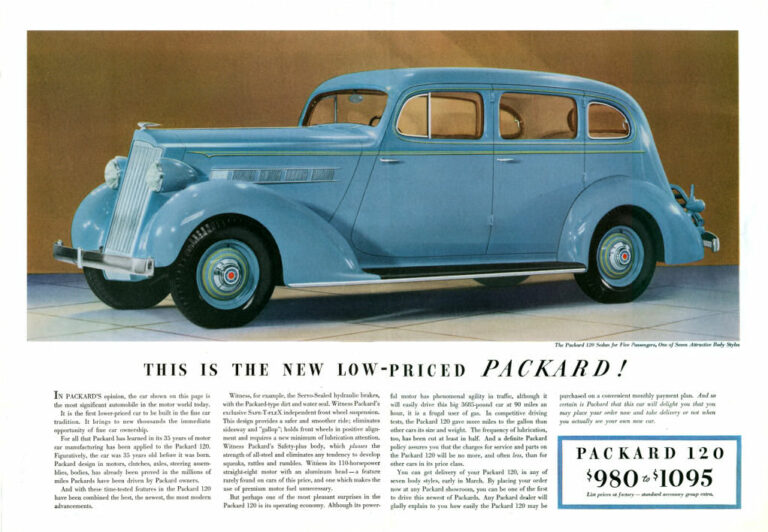
Against this tide of yearly losses and the disappearing market for its products, Packard introduced the One-Twenty for 1935.

The One-Twenty saved the company.

In 1935, Packard made a profit of $3,315,622.38 on the sale of 52,045 automobiles, of which about 7,000 were the Senior series.  The difference between the unsustainable losses of previous years and the profit in 1935 was the One-Twenty.  In 1936, Packard sales rose to 80,878 vehicles and profits exceeded $7,000,000.00.  The Model 115C, priced below the One-Twenty, was introduced in 1937 and sales reached 108,528.  Profit exceeded $3,000,000.00, in a down year for the industry.

But that doesn’t tell the whole story.

Packard continued to produce the Senior series models throughout the 1930’s, along with the One-Twenty and other lower-priced models.

Recall how much money Packard lost from 1930 through 1934 when it produced only expenseive Packards.  Losses from producing these Senior series Packards certainly continued after the One-Twenty was introduced.  Packard did not break out profits and losses from specific series in their annual reports and financial statements.  So, the profits of the One-Twenty concealed the losses created by the Senior series.

Nonetheless, it is reasonable to assume that losses from the Senior series after the One-Twenty was introduced in 1935 were at least as great as they had been in the years from 1931 through 1934.  If we make that assumption, then continuing the Senior series in production after introduction of the One-Twenty drained at least $40,000,000.00 fom the Packard Motor Car Company before autmobile production ended with the beginning of World War Two.

That is equivalent to $760,256,934.31 in 2020 dollars.  It is equivalent to $70,364,963.50 in 1950 dollars – dollars that Packard did not have  to invest in keeping pace with General Motors and Ford after World War Two, as those companies introduced models with advanced engineering and features while Packard’s product line stagnated  from lack of investment.

Yet, despite that reality, Mr. Foster claims Packard was in solid financial condition entering the 1950’s.

It was not.  The losses incurred by continuing the Senior series in production were devastating to Packard’s ability to compete in the 1950’s.  The company was not helped by a sclerotic, risk-averse management.  But that management, too, was a product of the mistake made in the 1930’s when Packard elected to subsidize its most expensive models with profits from the vehicles and market on which it should have been concentrating.

The manufacture and sale of automobiles is one of the most expensive, capital-intensive enterprises in the corporate world.  To succeed, profits from current sales must finance development of future products, just as current model development was paid by profits of the models preceding them.  This means an automobile company cannot merely make an operating profit – that is, sell the car for more than the cost of parts, labor, overhead, and costs of sale.  Unless current profits replace the capital employed in their development, the company company’s operating profit is really a loss in disguise.

That describes where Packard stood financially as the 1950’s opened.  Financially, it was not even treading water.

1941 Packard Clipper

In 1940, Packard had introduced the Clipper, priced above the One-Twenty but well below the Senior models, with a fresh new look that leap-frogged the competition.  Underneath, it carried over most of the One-Twenty’s chassis and powertrain, but these were still relatively fresh designs.  Packard struggled to keep up with demand.  Then, World War Two ended Clipper production and eliminated the profits and market share Packard would have realized had the War not amputated the Clipper’s future sales.

After the War, Packard’s management elected  to use the Clipper as the basis for the bloated “bathtub” Packards introduced in 1948, automobiles that still employed the same chassis and drivetrain introduced with the One-Twenty in 1935.  Though Packard arranged a $30,000,000.00 line of credit in 1948 expressly to finance development of new models, its president, George Christopher, elected not to borrow the funds – even as the larger automobile companies were introducing entirely new and modern models with features Packards did not offer.

It is easy to eviscerate Packard’s management for these decisions.

But focusing on the long-term – which Packard management most certainly failed to do – is far easier when you do not have to worry about surviving the short-term.  Cash conservation was the ultimate priority of Packard management after the War.   Packard’s management was reluctant to develop a new car because it was concerned that the company did not have adequate capital to do more than essentially carry on existing models.  It gambled that that Packard would be able to keep selling the existing models long enough that profits from them would pay for developing a new Packard in the future, betting that the market would not leave Packard behind in the meantime.

That decision, though regrettable and perhaps wrong, is defensible.

It is true that Packard had money in the bank and was posting profits in the early 1950’s.  But these profits were ephemeral.  They were operating profits, but not profits that could restore the capital the company needed to produce competitive products.  The profits existed solely because Packard was not investing in new products.  It was living today at the expense of tomorrow.    The truth is that Packard was not financially sound at the beginning of the 1950’s.  Packard was a sick David pitted against a very healthy industry Goliath.

In 1950, General Motors made a profit of $834,044,039.00.  Packard’s profit in 1950 was $5,162,348.00.  Even so, Packard outold Cadillac through 1949 –  which belies Mr. Foster’s claim that the One-Twenty had “devalued” the brand.  But 1949 was also the year  Cadillac introduced its high-compression V-8 engine.  In 1950, Cadillac sold 103,857 automobiles.  Packard sales were 42,627 – a 63.5% decrease frm the preceding year.   To develop modern automobiles that were competitive, Packard needed the money continuing production of the Senior series in the 1930’s had sucked out of it.  If Mr. Foster wishes to speculate about ‘what might have been,’ it would be better to focus on what Packard might have done to prepare for the 1950’s had its management dumped the Senior series as quickly as possible after introducing the One-Twenty.

Mr. Foster, though, still on the same theme, suggests that Packard might have been saved, had it divorced its less-expensive post-War Clipper from the Packard brand during the 1950’s and reserved the Packard name for the more expensive models.  To support the notion that Packard made a fatal marketing mistake, Mr. Foster cites Cadillac, stating that General Motors marketed the less-expensive LaSalle under a separate name to preserve Cadillac’s image as a luxury brand.

Not so.

The existence of the LaSalle had nothing to do with protecting Cadillac’s brand image.  The LaSalle was one of four companion brands General Motors introduced in the 1920’s to fill price gaps in the GM product line, each intended to sell for slightly less than the primary brand, but more than the next least expensive primary brand.  Oakland introduced the Pontiac, Oldsmobile the Viking, Buick the Marquette, and Cadillac the LaSalle.

General Motors culled the companion brands at the onset of the depression, dropping the Viking and Marquette in 1930 and 1931, while simultaneously dropping Oakland in favor of Pontiac.  Only LaSalle survived – until 1940.

1956 Packard models
1956 Packard models

General Motors then copied the marketing strategy Packard had pioneered with the One-Twenty and took Cadillac down-market.  What had been the LaSalle became the Cadillac Sixty-One series.  General Motors was pushing the Cadillac brand and its prestige down market, projecting that image onto a less expensive vehicle that it could sell in greater volume by using the Cadillac name.

In this, Cadillac was also following Lincoln.  Like Packard, Lincoln had introduced a far less expensive model, keeping it as a Lincoln.  The 1936 Lincon Zephyr cost $1,275 – far less than the Lincoln Model K priced, depending on model, from $5,000.00 to $7,000.00.  It was Zephyr sales that kept the Lincoln brand alive.

The reality is that the domestic luxury brands surviving the Second World War all  introduced lower priced models under their existing brand name before the War.  The cars they would build in the 1950’s were direct descendants of those pre-war lower priced models.

1956 Clipper models
1956 Clipper models

There were, of course, other elements that worked to further erode Packard’s financial condition.  After the War, Packard management subcontracted all body production to Briggs Body Company.  Briggs ongoing union troubles knee-capped Packard production – and Briggs raised prices, too, cutting Packard’s profit margin.  Later, Korean war restrictions on availability of steel stunted Packard production.

Then, too, the dictatorial chairman of its board of directors, Alvin MacCauley, picked the wrong man for company president in April of 1942 when he selected George Christopher.  Once the War was over, Christopher’s goal was volume, and he considered volume to be achieved by low price. In the immediate post-war market, when any new car would sell, Christopher instead concentrated on the lowest priced cars – even though Packard could have sold as many expensive cars as it could produce and, had it done so, would have realized higher profits per car.

1948 Packard taxicabs at the Packard factory

It was Christopher who “cheapened the brand.”  It was Christopher who produced a Packard taxicab.  It was Christopher who let the  $30,000,000.00 line of credit to finance new models expire untouched.  It was Christopher who, against the advice of Packard’s own designers, chose the bloated “bathtub” design for Packard’s first updated post-war models.

But it was James Nance who drove the nails into Packard’s coffin.

Whether Packard was truly doomed when Nance took over in 1952 is a topic for another day and, perhaps, another post.  One thing is clear:  Nance was the man running the company when Packard merged with Studebaker.  Nance failed to have Studebaker’s books independently audited before agreeing to the merger.  Afterward, it became apparent that Studebaker’s financial condition was far worse than Packard had understood.  As Mr. Foster himself explained in Studebaker: the Complete History, his book about Studebaker, “It was a great deal for Studebaker because once Packard owned the company it would have to cover Studebaker’s losses with Packard money.”

In 1953, the year before the merger, Packard’s showed a profit of $5,440.966.00.  In 1954, the year of the merger, the combined company lost $26,178,315.00.  The loss in 1955: $30,883,501.00.

We all know how it ended.


For more about Packard and the reasons it failed, see our post:  The Real Reason Packard Died.

For more about how Studebaker’s operating profits from the Lark disguised its parlous finances, see our post: Can Tesla Succeed?

THE REAL REASON PACKARD DIED

1935 Packard One-Twenty advertisement - not the real reason Packard died
1935 Packard One-Twenty advertisement

The One-Twenty vs.
the “Senior” Model Packards

Those who attribute Packard’s demise to introduction of the One-Twenty model in 1935 indulge in the fallacy that corporations fail from one factor which, had it been different, would have affected a different destiny.  The real reason Packard died was not the One-Twenty.  In truth, the One-Twenty saved Packard.  It was the “Senior” series Packards – the Eight, Super Eight and Twelve – beloved by those that blame the One-Twenty for undermining Packard’s prestige – that fatally undermined Packard’s financial destiny.  They didn’t kill the company.  They did weaken it enough that Packard was vulnerable to bad luck and management errors that ultimately did it in.  Continuing the “Senior” models in production and the poor decisions that followed are the real reason Packard died.

The numbers do not lie.

In 1934, Packard sold 6,265 automobiles – all “Senior” models selling at prices from $2,500.00 to $5000.00   Packard lost $7,290,549.26.  It had a small profit of $506,433.91 in 1933, but lost money in all the other years after 1930.  It lost $6,824,311.72 in 1932, and approximately the same amount in 1931.   Things had turned dramatically for Packard after 1930.  Packard had a profit of $25,183,286.38 in 1929.  In 1930, profit dropped to $9,034,219.53.

It was obvious to Alvan Macauley, president of Packard, that the company’s survival depended on producing a less expensive automobile.  The One-Twenty was the result.

Packard One-Twenty four door sedan

The One-Twenty was introduced in January of 1935, at a price below $1,000.00.  The Senior” models remained in production at the same higher prices.  Packard sales for 1935 totaled 52,045 automobiles of which about 7,000 were “Senior” models.  Packard made a profit of $3,315,622.38.  Without the One-Twenty, Packard would again have lost between $6 million and $7 million, depending on the mix of “Senior” models sold.

The One-Twenty was the $10 million difference between 1934 and 1935.

In 1936, Packard sold 80,878 automobiles to reach a profit exceeding $7 million.  In 1937, with the 115C model in production and priced below the One-Twenty, sales reached 109,528 automobiles.  Profit was approximately $3 million.

1936 Packard Twelve
1936 Packard Twelve

Packard’s accounting during these years did not break out costs and revenue by model line and did not allocate overhead costs by model line.  So, it is impossible to know just how much money continuing the “Senior” lines after 1935 cost the company.  That it was an enormous amount is beyond reasonable dispute.

After 1930, sales of the “Senior” lines reached the break even point only once – in 1933.  After introduction of the One-Twenty, the “Senior” lines drained money from Packard’s profits on the lower priced models.  For just the three years from 1935 through 1937, that totaled about $20 million.  That is $20 million Packard didn’t put in the bank, in addition to approximately $20 million it lost before 1935 and in addition to perhaps as much as another $20 million lost producing the “Senior” Packards in 1938 through 1941.

The “Senior” models may have drained $60 million from Packard in ten years.

Adjusted for inflation, that is $1.113 billion in 2019 dollars.

When looking for the real reason Packard died, this is the beginning of what became, in time, the end.

Though Alvin Macauley had been very quick to see the need for Packard to introduce a lower priced automobile, he seems to have been blind to the financial damage continuing production of the “Senior” models was doing to the company.

The disappearance of the market for handcrafted luxury automobiles costing $2,500.00 or more during the 1930’s is commonly attributed to the Depression.   However, the depression simply accelerated a trend that had started in the 1920’s.  Even before the Depression, that market was steadily shrinking as new production technology improved the quality and performance off mass-produced automobiles.  Ford’s development of the River Rouge complex (as chronicled in a previous post) foreshadowed the path the entire industry would take.  Automobiles priced at $2,500 or more held ten percent of the automobile market in the 1920’s.  In 1932, they were 2% of the market.  By 1937, this had been cut to 0.5% of the market.  Most of Packard’s competition had been eliminated by then, so Packard competed only with Cadillac and Lincoln.

Macauley squandered the financial bonanza of the One-Twenty.  As company President, Macauley concluded each year’s Annual Report to Shareholders with his personal remarks.  Not once after introduction of the One-Twenty did he refer in those remarks to the “Senior” line Packards.  Rather, his remarks uniformly focused on the increase in revenue resulting from Packard’s increasing sales of lower-priced automobiles.

1938 Packard Super Eight

Packard’s decision to sustain production of the “Senior” cars during the last half of the 1930’s was almost quixotic.  Lincoln continued the Model K because Edsel Ford wanted it to – and had the Model A and B Fords to finance it.  Cadillac continued to produce twelve and sixteen-cylinder automobiles because General Motors also could afford to lose money for prestige, and because it had the “companion” LaSalle to provide Cadillac dealers with sales.  Packard lacked the financial strength of Ford and General Motors that allowed those companies to indulge in huge losses for corporate prestige.

Macauley saved Packard by introducing the One Twenty.

He set the stage for its failure by continuing the “Senior” models afterward.


The Japanese Bomb Packard

In April of 1941, Packard introduced the Clipper.

By then, Packard was a changed company, run by the people Macauley had brought in to produce the One-Twenty.  Max Gilman was now company president, chosen by Macauley.  Gilman knew a new model would be needed to maintain sales.  To style it, he went outside of the company to hire Howard “Dutch” Darin.  This was not a totally new car.  It was to be built on the One-Twenty’s chassis and use the same engine, but with a new front suspension and an entirely new, completely modern appearance.

1941 Packard Clipper

The Clipper was a hit.  No – it was a home run.  Packard had introduced a newly styled automobile that appeared far more modern than its competition.  Packard sold 16,000 Clippers in 1941.  It could have sold more, but – at Macauley’s insistence and over strong opposition within the company – Packard had subcontracted production of Clipper bodies to an outside manufacturer, the Briggs Manufacturing Company.  Briggs couldn’t meet demand.  It was August before production was able to provide dealers with adequate inventory.

1942 would have been a bonanza for Clipper sales.

Then the Japanese bombed Pearl Harbor.

Last 1942 Packard
Last 1942 Packard

Packard went to war, along with the rest of the automobile industry, when it ended production in February of 1942.  During the War, it produced engines for PT boats and the Merlin engines used in the P-51 Mustang, as well as in the British Mosquito, Lancaster, Warhawk, and Hurricane.  (Packard had been solicited in 1940 to build the Merlin for the British under license from Rolls-Royce because only Packard was deemed capable of producing engines in quantity to the tolerances required for the Merlin.)

Though these wartime products were of Packard quality, the profits were ephemeral.  Packard production during World War Two was rewarded with a profit of 1.2%, dictated by the government contracts and imposition of an excess profits tax on industry.  Though Packard management avoided debt and maintained cash reserves, the company’s working capital declined during the war years from $46 million to $35 million.

World War Two cost Packard dearly.  Without the War, Packard could have used profits from the Clipper to rebuild its finances in the years following 1941`.  Packard had finally begun moving the “Senior” models to the One-Twenty’s chassis in 1938 and 1939, in the process dropping the Twelve and replacing the Super Eight with the 160 and 180.   Further melding these models into the mass-produced lines would have removed an enormous drain on Packard’s profits.  Coupling that with the jump the Clipper gave Packard over its competition provided Packard with a golden opportunity for profit in the years to follow 1941.

Those opportunities were sunk on December 7, 1941, along with the Pacific Fleet.


The Bathtub
bathtub Packard
bathtub Packard

Packard fans all know the “bathtub,” the models Packard introduced in 1948 and continued in production through 1951 that looked like a bathtub upside down.  Today, they are commonly regarded as ugly.  They are also blamed with starting the nails in Packard’s corporate coffin.  They were designed by Alvan Macauley’s son, Edward, based on a concept car he had designed during the war, the Phantom.  The Phantom started life as a shortened two-door Clipper.  It evolved during the war years into the bulbous design that was faithfully copied by Packard for the 1948 line.

As with prior significant events in Packard history, the introduction of the “bathtub” Packards and their failure in the post-War new car market centers on Alvan Macauley.  Macauley had controlled Packard from the 1920’s, first as President and then, after 1939 and until 1948, as Chairman of the Board of Directors.  His dominance of Packard was absolute.  The Board members were completely loyal to him.

In the years before World War Two, the path Macauley had chosen for Packard was copied by its competitors, Lincoln and Cadillac.  In 1937, though still producing the Model K, Lincoln introduced the Zephyr, a mass-produced automobile priced far below previous Lincoln products.  In 1941, General Motors dropped the LaSalle line that had been sold by Cadillac dealers.  In its place, GM introduced a new Cadillac model 61 in the same price range LaSalle had occupied.  Like Packard, Lincoln and Cadillac were phasing out their handcrafted models, moving to shift their brands’ prestige to mass-produced quality automobiles.

The 1941 Clipper was priced at $1,420.00 – above the One-Twenty at $1,291.0 and below the functional replacements for the “senior” line, the 160 and 180, with the 160 starting at $1,795.00.  This put the Clipper in the price range that that eventually became, after World War Two, the lower end of the luxury car market – the market that eventually would be dominated by the Cadillac deVille.  Cadillac, like Packard, had dropped its handcrafted models, the twelve and sixteen-cylinder powered cars, in favor of eight-cylinder models priced competitively with the Packard 160 and 180.  Though Packard still offered the 115C priced below the One-Twenty, the introduction of the Clipper was Packard’s claim to its share of the evolving market for modern luxury automobiles.

An unexpected event turned out to handicap Packard’s ability to capitalize after the War on the market it has begun to create with the Clipper.

On January 22, 1942, Max Gilman, the President of Packard, was in an automobile accident on Woodward Avenue in Detroit.  He and his passenger were both injured and hospitalized.  The problem was that his passenger was the wife of another Packard executive and that Alvan Macauley’s moral compass was offended by this “scandal.”  From a present-day perspective, this seems a bit too Puritan.  In the 1970’s, the arrest of Henry Ford II for drunk driving with a woman not his wife in the car caused a public stir, but more from curiosity than moral opprobrium.  (Ford’s famous response to the press was “never complain, never explain.”)  No one suggested he should leave the Ford Motor Company.  But this was another time, and Macauley considered Gilman’s conduct immoral.  Though the board had decided that Gilman should stay, Macauley acted unilaterally and fired Gilman.

Firing Gilman deprived Packard of a president who had demonstrated with the Clipper that he understood the market for the Packard brand and could give that market a car that set design trends, rather than following them.  It also meant finding a replacement for Gilman – not in a rational and developed process, but in a hurry.  Macauley chose George Christopher.  It was a bad choice.

Christopher was a production man.  He had no sense of the market.  After the War, as Packard converted back to producing automobiles, Christopher promised Packard shareholders that the company would produce 100,000 automobiles in 1946, a number it did not reach until 1948.  He focused on producing low priced cars that he believed could sell in volume, oblivious to a market so starved for new cars that Packard’s dealers easily could have sold that same volume in the higher priced Packard models, had only Christopher elected to emphasize their production.  As it was, Christopher’s decisions meant most of Packard’s sales were not in the luxury market increasingly being defined by Cadillac, but instead were in lower priced cars.   Christopher even produced a Packard taxi cab model.

Christopher, in short, had no idea of what he was supposed to be selling.  He’d promised volume production.  To him, that meant selling cars cheaply.  It did not occur to him that he was facing a new era in which a booming economy would birth a large market for luxury automobiles very different than those represented by the old Super Eight and Twelve models.

Christopher was also hamstrung by events beyond his control.  It took much longer than he had anticipated to resume automobile production after the War.  He needed to build a new assembly line.  Steel was in short supply after the war, partly due to union strikes against steel producers.   Packard suppliers were also hit with strikes, leaving Packard without the parts needed to produce new cars.  Now that the Clipper was the only model with which Packard could resume production, Macauley had elected to stay with Briggs as the supplier of all Packard bodies.  Briggs had convinced Macauley that it could produce bodies more cheaply than could Packard.  The decision eliminated Packard’s ability to produce bodies in-house, making it totally dependent on Briggs.  Briggs had a lengthy and confrontational history of labor problems.  Supplier issues, along with strikes against Briggs, kept Packard assembly lines motionless for 81 of the 90 days in the first quarter of 1946.

Packard did realize it needed a new model.  It committed $20 million to expanding post-War production and budgeted $8.5 million for tooling for the new model.  But “new” to Packard meant something entirely different than “new” meant to General Motors.

1948 Packard - Cadillac in background
1948 Packard – Cadillac in background

Though there were no automobiles in production during most of World War Two, those who would be responsible for new car styling after the war were actively experimenting with design ideas during the War.  Prominent among these ideas were streamlined designs that were very rounded in shape, often covering much of the wheels.  Known as “envelope” bodies because they carried the body line from front to back with no break for a separate rear fender, even General Motors designers considered this style for Cadillac.  In the end, Harley Earl rejected this approach and introduced an entirely new Cadillac design for 1948, one that featured a signature tail lamp that would evolve during the ensuing decade into tail fins and showed a distinct hip at the rear quarter panel.  In 1949, Cadillac introduced a modern, high-compression V-8 as standard equipment across the line.  General Motors had already introduced a fully automatic transmission in 1939.

1950 Packard
1950 Packard

Packard chose to revise the Clipper and stay with the same straight eight-cylinder engine it had been building before the War and to continue production of six-cylinder models, as well.  Though Packard’s design staff, headed by John Reinhart, favored a design that would streamline the existing Clipper design, Christopher was influenced by the envelope school of design and wanted the bulbous design based on Edward Macauley’s Phantom.  (Reinhardt would design the “bathtub’s” replacement, introduced in 1951 )

The thought process at Packard in the years leading to the 1948 introduction of the “bathtub” models, known as the 22nd Series, show management that was consistently risk averse.   Christopher’s emphasis on production goals for lower-priced models was a form of denial that avoided addressing the need for developing features, including V-8 engines and an automatic transmission, that would be beyond Packard’s resources without either raising significant new capital or incurring substantial debt.  Immediately after the War, Christopher had obtained for Packard a $30 million line of credit to finance reconverting the factories to automobile production.  There is no indication that Christopher or the Board of Directors ever considered incurring debt to develop truly new models.

Instead, Christopher chose to hoard the company’s cash.

Though George Christopher presided over these decisions, Alvan Macauley – still Chairman of the Board until his resignation in 1948 – was the person truly responsible for them..  The decisions may have been made by others, but Alvan Macauley remained the man in charge.  Those decisions could not have been reached without his approval, tacit or actual.

Chriopher kept the “bathtub” in production for 1950 and the bottom dropped out of Packard sales.

Packard would never again be a significant factor in the luxury automobile market.


Epilogue – The Real Reason Packard Died

I have a soft spot for Packard.  Their slogan was “Ask the Man Who Owns One.”  My father owned four and his last Packard was also the last true Packard – a 1956 Patrician, bought new with every option except air conditioning.   I still have a set of keys to it on my desk.

With the benefit of that perfect vision always provided by hindsight and putting sentiment aside, responsibility for the failure of Packard ultimately rests with decisions made by Alvan Macauley.

The real reason Packard died starts with the decision to continue production of the “Senior” models.  No rational businessman pursues production of an expensive product for a shrinking market that cannot make a profit, eroding the capital of the business with every product sold.  Macauley, however, did just that – and quite deliberately.   Decisions after World War Two were designed to ‘play it safe’ by outsourcing body building and not investing in a truly new model with modern features.  Having squandered vast sums on the “Senior” models, the mentality of Packard management had became risk-averse.  They failed to see that the greater risk lay in allowing opportunity to pass them by.  Had they had the financial cushion timely termination of the “Senior” models could have created, management may have seen the post-War market for what it truly was: the largest market for luxury automobiles in history.

The real reason Packard died is not that the One-Twenty saved the company at the cost of Packard’s prestige, and thereby damaged the brand in the marketplace.  The real reason Packard died is that Packard’s management squandered the lifeline the One Twenty had provided.


For further information about Packard’s post-War fortunes and its ultimate demise,  see also our additional post Pat Foster and the Myths of Packard’s Demise.


Sources:  Packard annual reports are available at packardinfo.com.