
WISCONSIN AUTOMOTIVE MUSEUM

1929 and 1930 Kissels

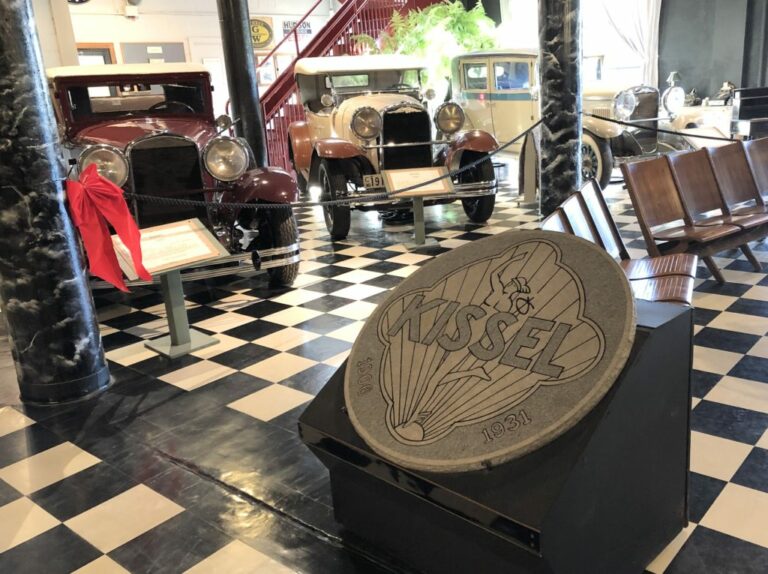
Fifteen percent of all Kissel automobiles remaining in the world are in Hartford, Wisconsin.  Kissel was a prestige automobile known for quality and value, even style, produced between 1907 and 1931.  Hartford was – and still is – home to Kissel.  Over 27,000 were produced at the Kissel plant there.   About 150 survive, of which 25 are on display at the Wisconsin Automotive Museum in Hartford.

1920's Kissels
1920’s Kissels

Today, Kissel is best known for the model 6-55, nicknamed the “Golden Bug” for its bright yellow color.  A two-seat speedster, the Golden Bug is considered a full classic by the Classic Car Club of America.  In its day – the 1920’s – it was the automobile of choice for some of the era’s most renown celebrities.  Amelia Earhart drove one.  So, too, did heavy weight boxing champion Jack Dempsey, Indianapolis 500 winner Ralph DePalma, band leader Eddie Duchin, and film stars Greta Garbo, Ruby Keeler, Al Jolson, and Mary Pickford.

1923 Kissel "Golden Bug" at Wisconsin Automotive Museum
1923 Kissel “Golden Bug” at Wisconsin Automotive Museum

You can’t miss the Golden Bug in the Museum’s collection.  A 1923 model, it begins a display of 1920’s Kissels that includes a 1927 Brougham, a 1926 four door brougham, a 1926 “All Year” coupe roadster, and a 1925 “Enclosed Speedster” painted an exquisite dove grey with dark grey accents – perhaps the most elegant Kissel on display.

Nearby, earlier Kissels are displayed, among them a 1912 “semi-racer” that was one of the first Kissels to emphasize speed and performance.  A wing off the Museum lobby features Kissels from the marque’s declining years:  a 1929 model and two of only four surviving 1930 models.

The evolution of the Kissel brand and the breadth of its model range is on vivid display in Hartford.  The vehicles tell the story of a small company that prospered, for a time, in the shadow of automotive giants, only to fail when producing quality became unaffordable.  (For more about Kissel, see our post about Kissel’s role in production of the Ruxton.)

1912 Kissel
1912 Kissel

This is, however, the Wisconsin Automobile Museum – not the Kissel museum.  The Museum celebrates all of Wisconsin’s automotive heritage – including its racing history.

Alan Kulwicki NASCAR Thunderbird

Front and center in the Southeastern Wisconsin Short Track Hall of Fame, located on the second floor of the Museum, is one of Alan Kulwicki’s NASCAR Winston Cup Thunderbirds – with the name  “underbird” on the front bumper cover.  The Hall of Fame’s display also includes an homage to Dick Trickle and two cars that bookend what many consider the prime of Matt Kenseth’s career: the Monte Carlo he drove to his first NASCAR win, prepared by Robbie Reiser, and the last car Reiser prepared for Kenseth, a Rouch Ford.

There is another automobile associated with Wisconsin:  Nash.

1950 Nash Statesman Super Airflyte

Nash may be a distant memory today – but it is a featured brand at the Museum.  They even have a new one, on loan to the museum and prominently displayed with other Nashes on the Museum’s first floor by the Nash Club of America.  It is a 1950 Nash Stateman Super Airflyte two-door sedan.

It has 61 miles on the odometer.

You’ve heard about the “little old lady who drove the car only on Sundays to church?  (Not the one with the shiny new Super Stock Dodge.)   The lady that bought this Nash intended to use it to learn to drive, an intent she never realized.  The vehicle was towed from one home to another as she moved, never driven .  Eventually, it was purchased by a Club member who has preserved it as new.

Nash history is rooted in Wisconsin.  Produced in Kenosha, Nash merged with Hudson in 1954 to create American Motors Corporation.  in 1957, the Nash and Hudson names were dropped by AMC’s President, George Romney, in favor of the “Rambler” name for all American Motors automobiles.  Thus, the circle was closed:  Nash was founded in 1916 when Charles W. Nash bought the company that manufactured the Rambler automobile and Jeffries trucks and dropped the Rambler name in favor of his own.

Nash Healey
Nash Healey

But it is Nash, not Rambler, that gets the spotlight at the Wisconsin Automotive Museum.  In addition to the first floor display, a Nash Healey is featured in a second floor display of performance and sports cars.  (That display also includes a later effort by American Motors to shed its stodgy image: the Javelin.)

The Hudson Essex Terraplane Society also exhibits at the Museum.  On the first floor is a 1949 Hudson Commodore Custom Eight – an automobile that turned out to be the brand’s apogee.  This is the remarkable “step down” Hudson, the car that in racing form dominated NASCAR in the early 1950’s and pioneered unitized body construction.   An homage to it’s NASCAR successes and it’s later fame i: s displayed on the Museum’s second floor:  a Hudson restored as “Doc Hudson” of the animated film “CARS.”

Continental Mark II
Continental Mark II

The Museum also houses a large and varied collection of other automobiles, some rare, all interesting.  These include a 1969 Camaro with the Z11 Pace Car option, a Continental Mark II, and two automobiles that remind us that Chrysler really invented tail fins: a 1960 Chrysler flanked by a 1961 Imperial.  Two Kaisers are on display – a Virginian, the top of the Kaiser line, and the unique Vagabond that was designed with seat that folded down and a rear hatchback instead of a trunk – just like an SUV today.   The collection of brass era automobiles includes a Maxwell and a Dodge Model 30, the first automobile built by the Dodge Brothers under their own brand.  That car set the stage for the  courtroom battle of automotive titans described in earlier Automobile Chronicles posts.  (Be sure to read the sequel, too.)

The Wisconsin Automotive Muesem is located at 147 North Rural Street in Hartford, which is about 40 miles Northwest of Milwaukee.  It is open until May 1st from Wednesday through Sunday, holidays excepted.  After May 1st, it is open 10 a.m. to 5 p.m. daily, except Sunday, when it opens at noon.  Information is available through their website.

It is a special place.  Take all the pictures you like and ask all the questions you want of the Museum volunteers who truly enjoy sharing their joy in the Museum with visitors.   There is a sense that taking time is important here, that you shouldn’t rush, and that you should savor what they have for you to see and appreciate.

Lionel O gauge train layout

Oh, and there’s one other display at the Wisconsin Automotive Museum you cannot find in any other automobile museum anywhere – not even at that other wonderful Wisconsin automotive museum, The Automobile Gallery in Green Bay.  The first thing you see when you walk into the Wisconsin Automotive Museum in Hartford is a gigantic operating Lionel O gauge train layout.

Even before I wanted cars, I wanted that train layout.  It is a duplicate of the one Lionel had in their corporate showroom in the early 1950’s.

I still want it.

GREEN BAY’S AUTOMOTIVE TREASURE

Green Bay's Automotive Treasure - The Automobile Gallery
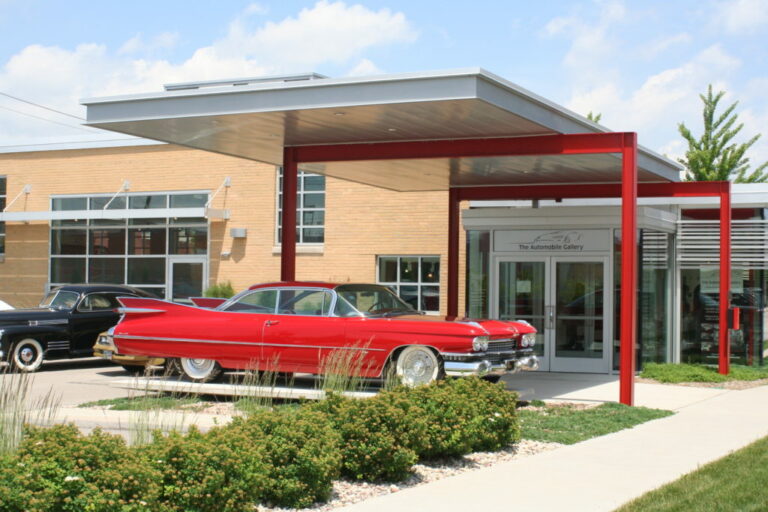
Automobile Gallery Entrance

Green Bay, Wisconsin, is known for the football Packers.  And, of course, snow.  For fans of the automobile, though, Green Bay’s real attraction is downtown – in what once was a Cadillac dealership.   Perhaps the most unique automotive museum in the Midwest, the Automobile Gallery is a combination of conference center, banquet facility, and beautifully executed automobile museum.  It is Green Bay’s automotive treasure.

You can’t miss the bright red 1959 Cadillac Coupe de Ville prominently displayed outside the entrance.  Once inside, after paying a very reasonable admission, you’ll be treated to a rotating display of automobiles, some owned by the Gallery and its founder, William “Red” Lewis, others on loan for temporary display.  Once you’ve made your first visit you will want to return – again and again.  You’ll see something new, as well as revisiting your favorites.

A personal favorite when we visited was a light green 1959 Buick Electra 225 convertible.  In 1959, Buick had a different approach to fins – it set them at a 45-degree angle.  With a leather interior almost matching the exterior color, and even a color-keyed steering wheel, the car exuded a sense of what it was to live lavishly at the end of the 1950’s, when the United States had come to take prosperity for granted.

1959 Buick Electra 225 at Green Bay's Automotive Treasure, the Automobile Gallery
1959 Buick Electra 225 Convertible

In another section of the Gallery sits another Buick for the prosperous – but this one conjures visions of the man with the ranch, someone who usually lets others do the heavy lifting, but is still they type of man that can carry the load whenever necessary:  the 1957 Buick Caballero.  This – a station wagon – was the top of the line Buick for that model year, from an era when General Motors made hardtop station wagons.  Though the Chevrolet Nomad and its brother under the skin, the Pontiac Safari, produced from 1955 through 1957, are better known hardtop station wagons, General Motors also produced hardtop wagons by Oldsmobile and Buick.

1957 Buick Caballero at Green Bay's Automotive Treasure
1957 Buick Caballero

Unlike the Nomad and Safari these were four door pillarless wagons.   (The Oldsmobile version was the Fiesta.)  The Caballero was a very limited production model, built by Buick as four door hardtops and then converted by an outside contractor into finished station wagons.  (For that reason, the Caballero does not have “Body by Fisher “carriage insignia on its door sills.)

Two cars, convertibles, tell the story – quite literally – of the rise and fall of the tail fin.

1960 Plymouth Fury convertible displayed at Green Bay's Automotive Treasure, The Automobile Gallery
1960 Plymouth Fury Convertible
1961 Plymouth Fury convertible displayed at The Automobile Gallery, Green Bay's Automotive Treasure
1961 Fury Convertible

One is a 1960 Plymouth Fury.  The other a 1961 Plymouth Fury.  They are displayed one next to the other.  These are essentially the same car, produced in successive model years.  But the 1960 model has tail fins that rival those of the ’59 Cadillac.  The next year’s model, the 1961, has none.               The demise of the tail fin, apart from Cadillac, was just that quick.

There is more, of course.

An original Corvette LT1, a DeLorean in original condition, the 1967 Corvette convertible that once belonged to Green Bay Packer quarterback Bart Starr (yes, it’s green), muscle cars, sports cars, classic cars.  There is even an electric car – produced in the early part of the last century, its manufacturer is still in business.  But now they build the convertible tops for Corvettes.

LT1 Corvette displayed at Green Bay's Automotive Treasure
LT1 Corvette

Green Bay’s automotive treasure, The Automobile Gallery, is located at 400 S. Adams Street, in downtown Green Bay, Wisconsin.  Admission is $10, or $8 for veterans, students, seniors, or children ages 7 to 17.   Children under 6 are free.

Inside the Automobile Gallery - Green Bay's Automotive Treasure
Automotive Gallery Interior

The exhibits are not roped off, so you can get a good look at each of the cars, which include cars on loan in a second building.  The Automobile Gallery is closed on Mondays, but can also be closed at other times when it hosts special events.  It is best to check their website to be sure they’re open when you plan to visit.


If you are interested in another wonderful Wisconsin Automotive Museum, please see our post about the Wisconsin Automotive Museum in Hartford.