
WHY JAY LENO IS WRONG ABOUTJAMES NANCE AND PACKARD – PART TWO

MACAULEY’S GHOST KILLS PACKARD’S LAST CHANCE

Barely five years after Packard invested in a new plant to manufacture bodies for the One Twenty, Macauley was outsourcing body production for the Clipper to Briggs Manufacturing Company.  Although this was justified at the time as an expedient to get the car into production because Packard’s own facilities were at capacity producing bodies for existing models, the explanation is suspect.  It is always less expensive to produce automobile bodies in volume in-house.  Subcontracting volume body production occurs when companies lack the capital to invest in their own production facilities and tooling.  Regardless of the ostensible justification, they end up paying more.  The company shifts the capital expense to the subcontractor.  The subcontractor rolls that capital expense into its price, plus a markup for its own profit.

If, however, if a company does not have the capital required to produce in-house, it doesn’t have a choice.

It is realistic to ask whether anything Packard did after the end of World War Two could have continued the company in the automobile business as a long-term going concern.  Macauley’s pre-War decisions not only squandered its profits, but also created a risk-averse corporate culture that prioritized cash over investment and avoided debt at all costs.

The consumer market for automobiles changed enormously during the War.  Those changes would continue after the War ended.

Between 1939 and 1945, the average family income almost doubled.  At War’s end, people had money and were no longer afraid to display their wealth.  The middle class was becoming the dominant segment of the American populace, and the upper-middle class had increased exponentially.  The market for automobiles was similarly transformed.  In 1948, 60% percent of United States households owned an automobile.  In 1955, it was 90% percent.  Between 1946 and 1955, the number of automobiles manufactured annually in the United States quadrupled.  Even more importantly for a brand aimed at the upper middle class, by 1956 the majority of jobs in the United States were “white collar.”

Macauley had hand-picked George Christopher to succeed him as company president in 1942, with Macauley continuing to control the company’s decisions as Chairman of the Board of Directors until he finally left the ship he’d torpedoed, by retiring in 1948.  Together, these two crushed whatever post-War chance Packard had for long-term survival by continuing Macauley’s pattern of reckless decisions masquerading as prudent finance.

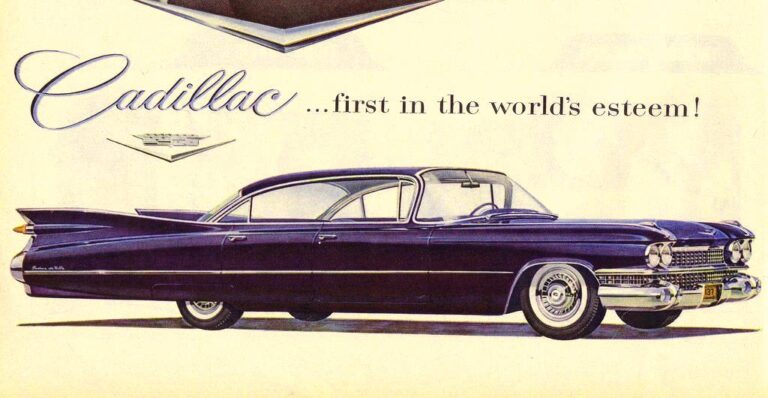
1948 Cadillac advertisement

General Motors introduced the Hydramatic fully automatic transmission in the 1940 Oldsmobile.  Cadillac offered it as an option for the 1941 model year to instant success: 30 percent of new Cadillacs were so equipped at an option cost of $125.00.  Cadillac introduced a completely new and modern body design for Cadillac in 1948 and followed it in 1949 with an all-new modern high compression V-8.   Mid-year in 1949, Cadillac would introduce a pillarless two-door hardtop.  None of this was occurring in secret – Packard, in common with the other automobile manufacturers, were fully aware of what General Motors was doing.

Yet Macauley and Christopher stuck with same straight eight engine first used in the One Twenty.  Packard’s belated attempt at an automatic transmission was the Ultramatic introduced in 1949.  Similar enough in design to Buick’s Dynaflow that General Motors sued for patent infringement, the Ultramatic was a mediocre design.  It could not actually shift gears.  Rather, it started in the second of its two gears varying speed through the torque converter.  The result was slow acceleration.  (It would be 1955, after Nance had made it a priority, before Packard’s automatic could shift gears – too late and beset by quality problems.)

1948 Packard Super 8 Convertible advertisement

And then there’s the “bathtub.”

Though the design department at Packard had created the design of a fully new model and Packard had the financing in place to develop it, Macauley and Christopher rejected all proposals for a new post-War  design.  Instead, they accepted Briggs’ proposal to produce a facelifted pre-War Clipper.  That facelift, ironically, ultimately cost enough in new tooling that the savings over a fully new body design were insignificant.

Even as competitors’ truly new models were introduced and Packard sales sank, Christopher still refused to spend the money to develop an entirely new model – which condemned Packard to keep the bloated “bathtub” in showrooms for 1950.

Christopher had been in charge of production as Macauley had driven the Packard brand down-market in the 1930’s, lowering prices and decontenting the product throughout the period in an effort to avoid the consequences of starving the product line of investment.  As company president following the War, he pursued that same strategy.  Packard had recruited new dealers after the War with promises of volume sales – promises that were foolish when made and would be rendered impossible to keep with a dated product subcontracted to an outside supplier.

1948 Packard advertisement stressing fuel economy

Christopher’s mindset as Packard president was that of a production man, which is what he’d always been.  To him, fixed costs are spread out over production.  The higher the production, the lower the fixed cost per vehicle produced.  Thus, if you are losing money on existing volume, the way to reduce that loss or turn it into a profit is to increase the volume.  You must sell what you produce, so this means increasing sales.  To increase sales without having to invest in anything new, you must decontent existing models and sell these de-contented models at a lower price.  That spreads fixed costs over greater volume and if the total income from sales exceeds the fixed costs and costs of production, you can claim an operating “profit.”

This is a strategy that postpones doom while still making the balance sheet look good.

The problem with this strategy is that the same reasons people did not want to buy your existing models will ultimately lead them to reject cheaper models that offer even less.  It is a strategy that can succeed only for a short time.  If you are using that strategy to buy time while simultaneously developing new products and bringing them to market, it may work.  If, however, you are doing this only to tread financial waters, the strategy is ultimately its own undoing and the company then drowns in red ink.

Packard taxicab
Packard taxicab

Christopher – while Macauley was still Chairman of the Board – even reduced Packard to the level of selling models specifically designed as taxicabs.  It was a decision bizarrely blind to Packard’s place in the luxury market.  This was merely one of the many short-sighted and ultimately disastrous decisions Christopher and, looking over his shoulder, Macauley would make in the years following the end of World War Two.  Nance would be the one to deal with the consequences.

Christopher’s focus on production appears to have blinded him to nature of the post-War automobile market.  The reluctance to invest in a fully new Packard following the War has been attributed to a fear by Packard management – ever in the thrall of Macauley’s corporate risk-averse culture – that the seller’s market existing immediately after the War would become a buyer’s market once the market for new cars was satiated.  Hence, fearing a decline in the market, Packard avoided capital expenditure by turning all body production over to Briggs and withholding investment in a new model with modern drivetrain and chassis.

The excuse doesn’t hold water.  This was a strategy that was designed to keep the company in the black for the benefit of its officers, not to keep the company alive and prosperous into the indefinite future.  Packard in this period was completely controlled by Macauley.  It’s management was in the care off officers selected and promoted to their present positions by Macauley or with his assent.  There was no corporate pension plan, no retirement fund.  They were paid only while the worked.  So, they stayed.

When your livelihood depends on a company’s continued existence, you will be reluctant to take any step that might put that existence at risk in the near term.  Consequently, Packard’s management was not a group disposed to take risks, in business or in their personal lives.  These were men imbued with the Macauley corporate culture, one that husbanded cash, avoided debt, and considered both the epitome of prudent management.

Against this background, the decisions made by Packard management in the years following World War Two are understandable.  Being understandable does not, however, make them justified or right.  We can understand murder, but we don’t condone it.

1950 Packard advertisement stressing low price and fuel economy.

Packard’s management should have known – since all the other automobile manufacturers did – that in a buyer’s market that you must have the newest, most advanced, most modern, most innovative, and highest quality product to have any chance of succeeding.  If you do not, selling on price will not save you.  It especially will not save you in an economy of rapidly expanding prosperity where the product is highly visible and publicly reflects your social status.

This is not a lesson that Christopher, or anyone else in Packard management, should have needed to learn.

Intentionally continuing an obsolete design with full awareness that the competition would be introducing new models with new designs and advanced technology was an inexcusable decision.  Macauley would eventually conclude that his selection of Christopher as successor was a mistake, a useless belated recognition of error designed to obscure Macauley’s unbroken chain of mistakes by blaming Christopher for the culmination of those mistakes.

Yet, Christopher has a defense.

He didn’t have the money.

Packard’s financial situation had not been improved by the War.  Packard could have realized more income by simply parking its funds in War bonds than it did by manufacturing under wartime cost-plus contracts.  The company entered the War undercapitalized and it exited the War even more  undercapitalized.

Post-War, Packard may have been unsustainable as an automobile manufacturer, no matter what it or its executives did.

Packard in the immediate post-War economy was a pipsqueak among automobile manufacturers.  Other manufacturers made the huge investments necessary to produce entirely new vehicles in competition with General Motors, Inc., Ford Motor Company, and Chrysler Corporation.  None succeeded.

There is a reason.

In 1948, General Motors profit was $440,447,724.  The next year, 1949, its profit was $656,434,232.

In 1948, Packard reported a profit of $24,789,439.  In 1949, as the “bathtub” effect set in, Packard’s profit was $13,406,042.

In these numbers, we see the impact of Macauley’s pre-War decisions squandering Packard’s profits and its position in the emerging luxury automobile market.  It was only in 1949 that Packard  finally decided to develop a new body design –  a board of directors rebellion that would ultimately force Christopher to resign to force that decision.  Packard would end up telling its shareholders in the company’s annual report that the company’s $0.50 per share dividend would be suspended in 1950 to allow for the “outlay of substantial cash for tools and equipment during the first half” of that year.

In other words, with two percent of General Motors’ profits, Packard was going to continue to try to compete with it.

Macauley would retire in 1948, leaving to his successors the dismal task of presiding over a company that could not survive, but that they would nonetheless try to save.

Continued from Part One

Continued at Part Three

See also previous posts: The Real Reason Packard Died and Pat Foster and the Myths of Packard’s Demise.


WHY JAY LENO IS WRONG ABOUTJAMES NANCE AND PACKARD – PART ONE

ALVAN MACAULEY SQUANDERS
PACKARD’S CAPITAL, WITH LASTING EFFECT

James Nance
James Nance. Nance Collection, Cleveland State University

In his Octane magazine column, Jay Leno recently wrote that “one of the final nails in the coffin [of Packard] was bringing in James Nance – a man with absolutely no experience of automobiles who came from a background of selling appliances.”  It’s a common myth, one not unique to Leno.  But it’s wrong.  Nance didn’t kill Packard.  He  saved the company, even though he couldn’t save the brand.

On March 1, 1954 – less than two years after James Nance became President of the Packard Motor Car Company – its treasurer, Walter Grant, wrote a memorandum to him: “Basically, the company is rapidly approaching bankruptcy.”  Grant predicted that, absent decreases in expenses, working capital would be exhausted by the end of June, 1955.  He concluded by advocating merger with one of the two remaining independent automobile manufacturers.

In 1955, the now combined Studebaker-Packard Corporation posted a loss of $29,705,093.

In 1955, General Motors became the first corporation in history to report a profit for a single year exceeding, $1,000,000,000 – as in one billion dollars.

It is laughable to blame James Nance for Packard’s demise.

Packard was doomed long before Nance became its president.

Yes, but did not the ‘merger’ with Studebaker – it was technically an acquisition of Studebaker by Packard, not a merger – kill Packard?  And wasn’t Nance responsible for the merger?

No, and no.

Combining with Studebaker was a desperate move by Packard’s board of directors and management, including but not limited to Nance, to save a doomed company.  They didn’t bother with what we’d today term “due diligence,” did not audit Studebaker’s books, or verify its financial representations.  None of that really mattered.  They were hoping for a miracle.  Without one, they knew their company would die.  There was only one avenue that presented any hope of a different outcome, so they – quite logically – took that chance.  It turned out that the hope was really a chimera, a financial mirage that disappeared almost as soon as the deal was done.  But you cannot fairly blame Nance for any of this.  What he did, or did not do, was largely irrelevant to Packard’s demise.

To understand why Packard failed it is necessary to go back to its earlier near-death experience during the financial depression of the 1930’s.  In the four years before Packard’s introduction of the One Twenty model in 1935, the Packard Motor Company lost $16,400,000.  Introduction of the One Twenty produced instant profits, saving the company from an otherwise inevitable bankruptcy.

Alvan Macauley
Alvan Macauley

The One Twenty was neither a new idea nor a brilliant one.  Alvan Macauley, the company’s president at the time and the man who committed the company to building a modern facility for mass production, had long sought to push Packard down market to increase its customer base and its sales volume.  Adopting mass production methods allowed him to do just that.

There are those – and were even among holdovers within Packard’s management during the 1950’s – who believe the One Twenty “cheapened the brand.”  To them, the One Twenty precipitated a chain of events ultimately resulting in Packard’s downfall.

They are wrong.

The problem was not cheapening Packard’s image, per se.  The problem was the failure of Packard’s management to understand the market into which they were now selling mass-produced automobiles and to properly position the Packard brand in that market.  That failure, in turn, was the product of a risk-adverse corporate culture that focused on avoiding debt and thought of profit only in terms of operating profits, rather than appreciating that any model’s price must contribute to covering the costs of developing its replacement if the company is to be truly profitable.

Packard Senior 1935
Packard Senior Models catalog for 1935 – Eight, Super Eight, and Twelve.

When we think of Packards of the classic era – what were then considered Senior” models, in contrast to the “Junior” models initiated with the One Twenty – we think of automobiles produced by craftsmen machining chassis parts and producing wood-framed bodies.  These were automobiles produced by obsolete technology, even in their most halcyon days.  In the 1930’s, labor was plentiful and, consequently, inexpensive.  It was machines that were expensive.  When production volume was low, it made economic sense to manufacture with cheap labor rather than expensive machines.  The cost of machine tools could not be profitably amortized over low production volume.

By the 1930’s, however, production techniques had advanced to the point that mass produced automobiles could equal or exceed the quality of those manufactured mostly by individual labor.  Welded steel bodies did not develop squeaks over time.  Bespoke bodies framed with wood did.   Quick drying automotive paints were available for mass produced automobiles and allowed customers to select colors to suit their individual preference.  Custom manufacture was no longer needed to produce automobiles that were individually distinctive.  Technology always improves as it evolves and mass-produced automobiles became more refined with improved performance during the 1930’s.

America’s social structure was also changing, as the middle class grew in size and regained prosperity.

Advertisement for 1936 Packard One Twenty.

There had always been an upper middle class.  Packard had catered to that clientele – successful doctors, lawyers, and merchants – during the two decades before the Depression.  It was to these customers that Packard had sold most of its production.

These were the customers Packard had lost during the first half of the 1930’s.  The Depression took away their prosperity.  Even those who could still afford to purchase a Packard found it financially prudent not to.  With mass-produced automobiles proving a less expensive alternative, in the first half of the 1930’s Packard’s labor-intensive product line no longer offered an automobile for this clientele.

The One Twenty was actually Packard reaching out to this lost clientele.

This was not “cheapening the brand.”  The One Twenty was not an inexpensive automobile.   This was reintroducing Packard to the upper middle class clientele upon which it had always depended.

It was after introduction of the One Twenty that Packard’s management fumbled, the first in a series of unnecessary and stupid errors by Packard management that doomed the company before James Nance would try to save it.

Introduction of the One Twenty swung Packard from a loss of over $7,000,000 in 1934 to a profit exceeding $3,000,000.  Profit reached $7,000,000 in 1936, before dipping to approximately $3,000,000 in 1937.

Packard Motor Car Company Annual Report for 1938
Packard Motor Car Company Annual Report for 1938.  Packard Motor Company Annual Reports can be found at the Internet Archive and at PackardInfo.com.

By 1938, Packard was again reporting a loss.

As a previous post discussed in greater detail, Macauley was not brilliant for introducing the One Twenty.  He was stupid for continuing the Senior models in production.  Every penny of the losses from 1931 through 1934 were attributable to those models, so it is fair to assume that they continued to lose just as much money in the following years, if not more.   That means Packard  squandered over $20,000,000 in profits from the One Twenty on the Senior models from 1935 through 1938.

That’s an astonishing amount of money.

It also money Packard should have spent on its future, rather than its past.

This, then, was the beginning of the end for Packard.

There was a lesson to be learned in the One Twenty’s success, but it was a lesson that Alvan Macauley and Packard management ignored.  That the market for hand-built bespoke bodied prestige luxury marques had all but disappeared was obvious.  It was also clear, for anyone caring enough to pay attention, that the increasing quality of mass produced automobiles had eliminated much of the quality advantage once enjoyed by automobiles produced at great cost by hand craftsmanship.

These realities were in plain view at the Packard Motor Company.  To produce the One Twenty, it had been necessary for Macauley to create from scratch a mass produced automobile – one using a new, state-of-the art assembly plant to manufacture automobiles in volume, automobiles that had been engineered specifically to be produced by assembly line methods.  That modern facility existed at the same address as the one that produced the Senior models by the same labor intensive methods Packard had used for decades.

It must also have been obvious that the One Twenty would be facing serious competition.  Using the Packard name on the “Junior” line was a marketing and financial necessity.  Companies that had introduced less expensive automobiles under a different brand had largely failed to sell them, losing even more money in the process.  Packard needed to trade on the value of the Packard name to assure sales of the One Twenty.  But the continued value of that name – its prestige – ultimately would depend on the success of this “Junior” line.  Unless those cars were leaders in quality, technology, and value, the supposed prestige transfer from Packards sold to the ultra-wealthy would prove meaningless.

Mistakes of vision are commonly excused by noting that ‘hindsight is always 20-20.’  When offered as an excuse for mismanagement, that is not an acceptable explanation.  The function of corporate management is to have vision, to anticipate the future, to anticipate the market, to consider what might occur and plan for the possibilities – and plan how best to profit in each scenario.

With the One Twenty, Packard – apparently by simple luck born of necessity – had stumbled upon the emerging luxury automobile market that would blossom in the years following World War Two.  That luxury market was not the ultra-rich.  It was the upper middle-class.  Nothing suggests Macauley or anyone else in Packard’s management saw that this emerging market existed.

1936 Lincoln Zephyr posed with the Burlington Zephyr in the background

Others were not so blind.  Lincoln introduced the Zephyr in 1936.  It was  priced at about $1,300.00 and equipped with a flathead derived V-12 engine.  Cadillac introduced the model 36-60 that same year.  Equipped with a  smaller bore version of the V-8 used in larger Cadillac models, the 36-60 was priced at $1,645.00.  In its first year, the “Sixty Series” accounted for half of all Cadillac sales.  These were automobiles with the same prestige nameplates as earlier more costly models but were offered at a price aimed squarely at a prosperous middle class clientele looking for a modern luxury automobile.  These were automobiles competing in the market at which Packard, who priced the One Twenty at from $995.00 to $1095.00 at its 1935 introduction, should have been aiming.

What Macauley should have done was use the profits from the One Twenty to develop and market future models aimed squarely at this upper middle class market – a market that was a natural one for Packard.

What Macauley did do was milk the One Twenty and Packard’s image in the following years with progressively less-expensive models offering fewer features and increasingly  dated styling – for example, introducing six cylinder models below the eight cylinder One-Twenty, sharing its appearance but priced lower.  MacCauley was constantly pushing the brand down market.

This, then, was the true “cheapening of the brand.”

Though Packard did not break out profit and loss by model range, it is evident from events that Packard used the One Twenty’s profits to subsidize continuing production of the “Senior” Packards – squandering those profits by so doing.  It was not until April of 1941 that Packard introduced a model with new and modern styling and a more modern chassis, the Clipper.  Even then, the Clipper carried over the same straight eight cylinder engine and drivetrain originated in the 1935 One Twenty.

In truth, Packard’s supposedly conservative management was disastrously reckless.  Introduction of the One Twenty had changed the nature of the company.  It had been the manufacturer of small volumes of labor intensive luxury automobiles for an exclusive clientele, a market in which it dominated.  It was now a manufacturer of mass production automobiles competing in vastly larger market, one in which it had a relatively small share.  Every resource at the company’s disposal should have been devoted to achieving success in the market in which it could naturally have dominated – the emerging upper middle class market for mass produced luxury automobiles.

Continued in Part Two

See also previous posts: The Real Reason Packard Died and Pat Foster and the Myths of Packard’s Demise.

WHY JAY LENO IS WRONG ABOUTJAMES NANCE AND PACKARD – PART THREE

JAMES NANCE:  THE RIGHT MAN ARRIVES TOO LATE

James Nance would become Packard’s president on May 1, 1952.

Poster for the Solid Gold Cadilllac movie
Poster for the Solid Gold Cadillac movie

By then, the image of Cadillac as the prestige American automobile was cemented in public perception.  On November 5, 1953, a new Broadway production opened at the Belasco Theatre in New York City: “The Solid Gold Cadillac.”   It would run for 526 consecutive performances, closing on February 12, 1955, and become a hit movie the following year.  The title came from the gift given the hero and heroine at the end of the play – the most prestigious gift conceivable: a solid gold Cadillac.  In the public mind, though, the ‘solid gold’ was almost superfluous.  Everyone knew Cadillac was the best.

The new model Packard had introduced for 1951 did not have a V-8 engine.  It did not have an automatic transmission capable of shifting gears.  The bodies were produced by Briggs, not by Packard.  It did not reposition Packard as a luxury, rather than mid-priced, brand.

Advertisement for the 1951 Packard

It was, however, with that new model that James Nance was hired to rescue Packard.

Nance came aboard with some of the work already done.  The president who replaced Christopher at Packard, Hugh Ferry, had taken several steps in the ‘better late than never’ category, decisions that should have been made by Macauley and Christopher.  In January of 1952, he’d secured approval for development of a Packard V-8 engine and construction of a new plant to manufacture it (though the costs were not actually budgeted until after Nance became president).  He introduced Packard’s own two door hardtop, the Mayfair, in February of that year.  It was Ferry who bought the rights to the torsion bar suspension system that would be introduced while Nance was company president.

Yet the legacy of Alvan Macauley and the perpetually capital starved Packard Motor Company he left to his successors influenced even Ferry, though Ferry fully understood the necessity of Packard catching up to its competition to survive.

Ferry had become Packard’s president because someone had to do it and Christopher’s forced departure had occurred suddenly, leaving no time to plan for succession.  Ferry, from the outset, regarded finding his replacement as his top priority.  In the meantime, however, he needed to keep the company alive.  His background was in finance – he’d started as a cost accountant, risen through the ranks to become corporate Secretary and Treasurer, then Vice-President.  He knew as well as anyone the financial condition of the company, the impact of its dismal sales, and the capital expenditures required in the next few years to manufacture new models with modern features.

In short, he knew he needed money.

Ferry took advantage of the government’s need for manufacturing capacity to fight the Korean War and contracted with the United States government to produce diesel engines and the General Electric J-47 turbojet engine.  He expected profits from the government contracts would underwrite the costs of modernizing Packard’s automobile line.  The contracts would potentially generate income (i.e., gross sales, not net profit) of $200,000,000 a year.  A steady flow of profits from those contracts would buy Packard time, financing the ongoing costs of new models and new features and giving Packard the lifeline it needed to keep going until the sales of those new models could sustain it.

Unfortunately, these contracts required that Packard make the investment necessary to produce the products contracted, including building a new manufacturing plant.  This  meant Packard was spending its capital – $17,000,000 of it in total – now and up front.  Ferry viewed that as a down payment on a much larger stream of future revenue.  But it was also meant depriving the automobile business of that same money – to the detriment of the product line the defense business was intended to succor.

In this decision, we see the ghost of Alvan Macauley still haunting Packard.

As he likely saw it, Ferry had two choices.  He could commit the money for capital expenditures needed to fulfill the contracts.  Or he could put that money into the development of new models, powertrains, and features for Packards that would be introduced in the coming years.  The later choice gambled that the company could keep going until it could catch up.  The former promised a revenue stream that would buy the time needed to catch up.

He chose the former.

But there was a third choice.

Packard Motor Car Company Annual Report for 1951 featuring new jet engine manufacturing plant on cover

To raise additional capital to finance the investment needed for the defense contracts, Ferry could have borrowed the money or he could have issued new stock in the company.

He should have done one or the other, or even both.

Borrowing to finance the defense contract investment should have been easy.  Packard was debt-free, reported profits in its annual reports, and the contracts themselves promised a guaranteed revenue stream that would easily repay the principal and interest of the loan.  Issuing stock might have presented more complicated issues, as it would have been viewed as diluting the value of currently issued shares.  But there was a clear rationale for a new issue of stock to finance entry into a new business that promised to increase overall corporate profits to the benefit of all shareholders.

By the early 1950’s, the automobile industry – led by General Motors – was evolving into a three-year model replacement cycle.  A new model would be introduced, slightly face lifted the second year, dramatically face-lifted in the third, and replaced with a completely new model the next year – and the cycle would start again.  That completely new model might carry over the same engines and transmissions, but new tooling would be required for the rest of the car.

Advertisement for the "bathtub" Packard - that George Christopher kept in production through the 1950 model year
Advertisement for the “bathtub” Packard – that George Christopher kept in production through the 1950 model year

From a 2.5 percent share of the United States automobile market in 1948, Packard’s share fell to 2.1 percent in 1949, and dropped again to 1.7 percent in 1950.  In 1951, Packard had a 1.43 percent share.  The effect of this low volume impacted every aspect of its automobile business.  Although it advertised much less, Packard’s advertising cost per vehicle sold was twice that of Cadillac.  Having forsaken its own production facilities to subcontract body production to Briggs, its component costs for bodies were higher than its those of its competitors and it had less control over those costs.  Its deal with Briggs still required it to pay for tooling, and that meant the cost of tooling per vehicle was higher, as well.

This was the point at which Packard needed to invest in its automotive operations.  To do that, it needed all the capital it could muster.  Ferry was probably correct in his belief that Packard needed the profits from the defense contracts to keep the company afloat while the company developed and introduced new models.  But that process also required that Packard make a large investment now in the next generation of Packards that would be introduced.  It needed to use the capital it had to develop new automobiles, not divert it to a government contract.

There is no indication that either borrowing or issuing stock were seriously entertained as options for funding the defense contract investment.  Apart from War years, when Packard had incurred debt offset by receivables, Packard management financed development and production internally and avoided long-term debt.  That culture, dating from Macauley’s years of control, appears to have limited Ferry’s perception of his options.  He understood that he needed to consider the long-term.  He appears not to have understood that there is an opportunity cost to financing internally and that it is sometimes better to rent other people’s money rather than risk your own.

Despite its competitive short-comings, the new Packard body design for the 1951 model year turned a loss in the first three quarters of the year into a $5,200,000 profit for the full year.

But it was a middle-priced car, not a luxury market automobile.  The lowest priced model, the 200, accounted for 71,362 of the 100,713 automobiles produced.  The top line Patrician 400 was almost indistinguishable in outward appearance from the 200 – and available only as a sedan.  The car continued a straight eight engine and the Ultramatic transmission.

It was carried over with only minor trim changes as the 1952 and 1953 models.

In remarks delivered to a group of Packard executives shortly after his election as President, Nance made it clear that he understood where Packard stood and what it ought to do.  He criticized outsourcing production, explaining it created a “vicious circle” of increased costs.  He challenged a system in which design of parts did not consider cost – advocating “planning for costs.”  He insisted that if parts were to be outsourced, the manufacturers of those parts needed to deliver the most advanced technology available.

He then turned to the public perception of the brand and what to do about it:

“To the man in his forties or over, Packard stands for quality.  He still thinks of it as a quality car, an impression he got as a young man.  But to the younger person of say thirty-five, Packard doesn’t stand for anything.  Now, you ask the man on the street today, whether he is twenty-five, fifty, or seventy-five, what Buick stands for and you’ll get a pretty universal answer: it’s a good solid automobile in the upper middle price class.  You ask what Cadillac stands for and every kid on the curbstone can tell you, ‘That’s the best, mister.’  Now we’re supposed to be in three of the five price classes, competing in the top bracket, for example, against Cadillac, the big Buick, and the two Chryslers, and we’re getting a miserable 3 ½ percent of that business.  Packard!  Three and a half percent.

“Now we must make a decision, gentlemen.  And whatever that decision is, I’ll be damned if I’m going to be in a horse race and get left at the quarter pole.  Let’s get in or get out.  If we are going to make a quality car, then let’s get in the race, and if we’re going to abandon the field, then by God let’s do it with honor.  Not by default.”

Packard for 1953 advertisement

Nance’s remarks were somewhat self-contradictory.  He acknowledged that Cadillac, not Packard, was perceived as “the best,” but professed to consider Packard still a competitor of Cadillac.  He posited that Packard should not abandon the luxury field by default when his predecessors had already done precisely that.  He was now faced with attempting a return to the luxury market with an automobile plainly produced for the mid-priced market.

The problem Nance faced was one that could only be solved with time.  At best, the existing model dating from 1951 could be dressed up and efforts made to distinguish the Patrician version from the plebian one.  But these could not fundamentally alter the product itself and, consequently, could only lay the groundwork for more dramatic differentiation in new models to come.  Ferry had understood this.  It was the reason he had invested in defense contracts that promised to bring Packard a constant cash flow to buy that time.

1953 Packard Formal Sedan by Derham

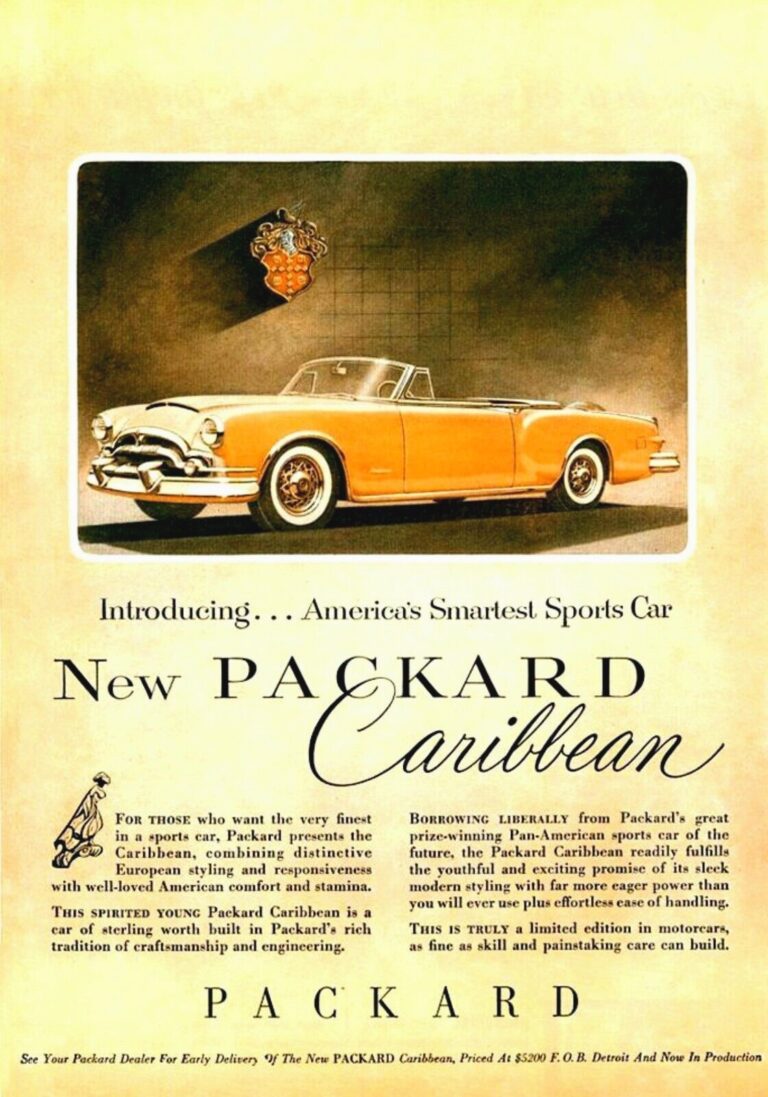
Nance immediately started the process of moving back into the luxury automobile market.  He attempted to separate the premium models from those in the mid-price range, renaming the latter Clippers.  To add glamour to the new premium line, he added the Caribbean convertible – at over $5,000 it was squarely in the Cadillac price range (though more directly competitive with the Buick Skylark).  In an effort to match Cadillac’s most premium models, Packard introduced the Packard Derham – a custom formal sedan with an interior divider window separating driver and passenger compartments and padded leather top covering that was based on the Patrician – and contracted with Henny for production of long wheelbase sedans and limousines.  (Derham was an established custom body builder dating to the classic car era of the thirties; Henney was the company that manufactured ambulances and hearses on Packard commercial chassis.)  These were baby steps, but essential to reestablishing the name “Packard” as synonymous with “luxury car.”

Yet, to assuage dealer complaints, the distinction Nance was attempting to create was blurred.  The company’s own consumer surveys had determined that the Packard name was important to retaining owners as repeat buyers.  Understandably, dealers did not want the lower-priced line divorced from that name.  Hence, the Clipper became the “Packard Clipper” in advertising.

Advertisement for the 1953 Clipper
Advertisement for the 1953 Clipper – largely indistinguishable in appearance from the more expensive models.

The concession was probably considered of little consequence at the time.  The 1953 Clipper and Packard shared the same body – they were obviously the same basic car.

In 1953, Cadillac sold 109,651 automobiles.  Packard sold 90,252.  Though that superficially suggests Packard was competitive, the raw numbers don’t tell the full story.  Cadillacs were sold only in the luxury car market.  Most of Packard’s sales were in the mid-price market.  In that market, Packard competed against Buick with 468,755 automobiles sold in 1953 and Oldsmobile with sales of 344,462 in 1953.  It also competed with Chrysler, DeSoto, and Hudson.  Even Lincoln, with sales of 40,473 automobiles in 1953, outsold Packard in the luxury market.

Seen in this light, it is obvious that Packard was uncompetitive in both luxury and mid-priced ranges.  That is why Nance wanted to move the Packard brand fully into the luxury market and separate its identity from that of the Clipper.  The luxury market was the smaller pond, where prices and profits were higher and where, though the competition with Cadillac would be challenging, at least there were fewer brands competing.

Separating the Packard and Clipper model lines was simply the first step in a plan, initiated under Ferry but revised and accelerated by Nance, to introduce fully new models with V-8 engines.  As adopted by Packard’s executive committee in November of 1952, the 1954 Packard line would receive an entirely new body.  The 1954 Clipper would be a facelift.  In 1955, the V-8 would be introduced, the Packard would receive a facelift, and the Clipper would be all new.  As the plan’s implementation progressed, the 1954 target became 1955.  It was all part of a plan Nance envisioned that spread over five years and aimed at fully reestablishing Packard in the luxury automobile field by 1958.

1953 Cadillac advertisement for the "Standard of the World."
1953 Cadillac advertisement for the “Standard of the World.”

Cadillac, however, had established itself.  If it were not the “Standard of the World” as it claimed, certainly it was the standard against which any luxury automobile would be compared.  It had the best styling, the best technology, and – as Nance’s “kid at the curbstone already knew – was considered “the best.”

And Cadillac would not be standing still while Packard tried to catch up.

Moreover, even Nance’s plan did not truly change the company’s dependence on selling middle-priced models.  Though it envisioned Packard as again a true competitor in the luxury market against Cadillac, the company itself would still be competing against Buick, Oldsmobile, Chrysler, and others in the middle price market.  Packard’s dealers were too dependent on selling in that market for the company to become exclusively a luxury brand manufacturer.

The rescue plan ended almost before it began.

In early 1953, the Defense Department reduced the jet engine contract from $392 million to $218 million, which equated to a $42 million decrease in 1953 contract revenue.

Then Briggs fell short of production targets, by 5,000 vehicles in the first quarter of 1953.

Packard was still making an operating profit, but the supply of unsold cars was building to 55 days, as the sales of the more expensive models were declining.  This compared to an industry average supply of 31 days.  The backlog of unsold models meant cutting production numbers below break-even to avoid a glut.  The company was still reported a profit for the year, but the drop in sales would continue into 1954, as the models introduced in 1952 entered their third year of production.  Plans to begin production of the 1954 models in October were modified to begin production in January of 1954.

Then the government further cut back on the jet engine contract, reducing the rate of production but extending the duration of the production run.  That again reduced annual contract income.

On January 17, 1952, Walter O. Brigg died.  To pay federal estate taxes, the heirs sold the company to Chrysler Corporation, for whom Briggs had also been manufacturing bodies.  That would ultimately force Packard to again produce bodies itself.

It was then, on March 1, 1954, that company treasurer Walter Grant wrote Nance that “the company is rapidly approaching bankruptcy.”  “Substantial expenditures” were needed to complete the new engine plant (for the V-8) and lease the Connor Avenue body assembly plant from Briggs.  (The lease was $758,568 per year for five years.  Cost of setting up production was projected at $3,000,000.)  At the existing rate of expense, working capital would be exhausted by June 30, 1955.  An $11,000,000 pre-tax loss was expected for the year, and current inventories of unsold models at dealers and Packard inventory exceeded 90 days’ supply.

It was these circumstances that led to the decision to hire investment banking firm Lehman Brothers to evaluate combining with Studebaker.  Their report unequivocally recommended doing so.   The financial press, as well, encouraged the companies to join.  In its August 30, 1954, issue, Time magazine summed up the prevailing view:

“For its part, Packard will get the advantages of the slick styling that has made Studebaker a pacesetter in postwar auto trends, will also get the benefits of Studebaker’s strong dealer organization around the U.S. Packard, which has long had trouble getting dealers to take on its big cars in fringe markets, will start off by doubling up with Studebaker to sell Packards in 1,000 towns too small to support a full-time Packard agency. In turn, Studebaker will profit from Packard’s solid engineering and its strong financial position.”

Packard, however, had no such “strong financial position.”  It merely had cash in the bank.

Packard’s acquisition of Studebaker was completed on October 1, 1954.  Studebaker’s board chairman, Paul G. Hoffman – a business luminary who had served as director of the Marshall Plan in Europe for five years before returning to Studebaker – was given the same role at Studebaker-Packard.  Packard executives later maintained that Studebaker falsified information provided to Packard, including its production break-even volume.  That may be so, but it is equally true that Packard’s board of directors and officers, including Nance, made no effort to have the Studebaker books independently audited before proceeding with the acquisition.

Studebaker-Packard Corporation Advertisement

The truth is that none of that mattered.  The acquisition of Studebaker was born of desperation.  It was Packard’s only chance.  With it, the combination might still fail.  It did not matter.  Packard was doomed.  If it did not combine with Studebaker, Packard would be bankrupt – probably within the year.

Studebaker would post a $12 million loss for 1954, while Packard’s loss was $2 million.

James Nance did not save the Packard brand.

That was not his job.  It was not what he was hired to do.

He was hired to save the company.

He did that.

Though saving the Packard brand was one way to save the company, that way would turn out to be impossible.

Yet, Nance still did his job.  He did save the company.

Studebaker-Packard would struggle into the 1960’s manufacturing automobiles and incurring losses throughout, except for the few bright years in which it was able to rebody an obsolete model as the Lark and sell it to a public as an economy car.  Yet, those accumulated losses allowed Studebaker to avoid income taxation as it reorganized itself into a mini conglomerate of divisions, including Onan generators, STP, Gravely commercial grade lawn mowers, Clarke floor machines, that were profitable.  Ultimately, it would exit the automobile business entirely, and – now known only as Studebaker Corporation – be acquired by Worthington Corporation.

In a recent column in the British publication Octane, Jay Leno cites Packard as “a precursor to what happened to the American automobile industry.”  He states, “And one of the final nails in the coffin was bringing in James Nance – a man with absolutely no experience of automobiles who came from a background in selling appliances.”

Leno’s wrong about that.

James Nance did not kill Packard.  That was done by others.

He saved the company.


Continued from Part One and Part Two

See also previous posts: The Real Reason Packard Died and Pat Foster and the Myths of Packard’s Demise.

FIN TALES – A BOOK REVIEW

Fin Tales
Fin Tales

Fin Tales is chatty, engaging, and easy to read.  Written by John Smith about his experiences as General Manager of Cadillac, Smith’s story is one of rescuing the Cadillac brand from what appeared to be its certain demise, first by pushing for introduction of the Escalade against General Motors’ foolish “brand management” strategy and then by creating the “Art and Science” theme for Cadillac’s styling, model positioning, and promotion.  Rescuing Cadillac required bucking a General Motors management isolated in a culture of its own creation, oblivious to its competition and its customers, a management convinced that the company’s diminishing sales could be reversed by perpetuating its mistakes.

There are wonderful stories in the book, including how Smith ultimately obtained corporate approval for the Escalade.  The “brand management” approach dictated by corporate executives did not allow Cadillac to have a SUV – even as Lincoln was creating the market for luxury SUVs with the Navigator.  As far as General Motors corporate executives were concerned, divisions were to market only those vehicles that fit into the definition of their market dictated by corporate “brand managers.”  Customers did not define the market.  Executives defined the market.

These brand managers defined the SUV as a truck.  Trucks were for Chevrolet and, if an upscale purchaser, for GMC.

In the end, Cadillac got its SUV – and, no, I’m not going to tell you how Smith pulled that off.  The proceeds from sale of the book go to a charity Smith supports, so you should buy the book to get the details.  Suffice it to say that Smith had an ace that he wisely waited to play until the last minute, when it was too late to for the top executives to trump it.

The Escalade would save Cadillac.  Its sales and outsized profits kept Cadillac alive long enough for Smith’s longer-range all-inclusive “Art and Science” plan to be developed and implemented.

The story behind the “Art and Science” theme exposes the weaknesses of General Motors’ management even more clearly than the Escalade’s creation.  It is a story of a corporate culture that elevated decision-making to executives far removed from the divisions affected by those decisions, executives who lacked the expertise to make good decisions.

Evoq Concept car
Evoq Concept car

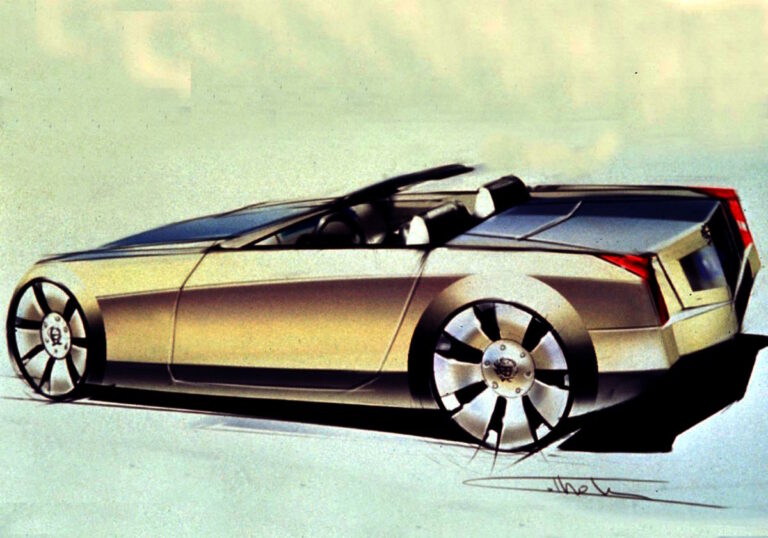
“Art and Science” was another area where Smith succeeded in getting Cadillac what it needed, despite the opposition of a corporate structure designed to deprive divisions of autonomy.  The central precept was a design theme that began with the Evoq concept car, was carried through into the first generation CTS, and then to subsequent generations of the CTS and to the XLR, SRX, ELR.    It was intended to make Cadillacs became instantly recognizable, with a family identity, one that stood apart from the blandness of import competition.  It was intended to convey Cadillac as a luxury brand of advanced technology, yet distinct from the bland rounded shapes of German luxury automobiles.

Success in creating this Cadillac identity at the division level would reverse the decline in Cadillac sales, as introduction of new models increased its sales and expanded its market – much to the delight of its dealers.

Yet quality – true quality designed and manufactured into the vehicle – would be denied to Cadillac.

Smith could not convince General Motors management, intent on centralized sameness, that quality mattered to a potential Cadillac customer and that competing with Lexus, Mercedes-Benz, and BMW meant producing quality equal to theirs.  Advanced features, though necessary, were not sufficient.  Quality required perfection in the basics of fit and finish.

Smith learned that Toyota ran the assembly line for Lexus at slightly more than half the speed of the assembly lines manufacturing Toyotas.  He wanted to adopt a similar approach in the assembly plants manufacturing Cadillacs.  But the General Motors Assembly Division had long before superseded Fisher Body and it now controlled how General Motors built its vehicles, including Cadillacs.  The effort went nowhere.  Cadillacs continued to be manufactured to the same standards as Chevrolets and an opportunity to restore Cadillac’s reputation to match its motto as the “Standard of the World” was squandered.  Precision in fit and finish had elevated Lexus from nowhere into the top tier of prestige brands.  Rather than heed the obvious significance of Lexus’s success, General Motors management would persist in trying to create profit from standardization and cost-cutting, rather than by creating the actual quality that leads to perceived prestige.

Despite the hurdles and obstacles, Smith succeeded in bringing Cadillac back from the brink, driving sales from 173,000 in 1996, immediately prior to his being named Cadillac general manager, to almost 250,000 in 2005, a few years after Smith left Cadillac by promotion in January of 2000 and a point by which the products planned when he was Cadillac’s general manager were now on the market.  He’s justifiably proud of what he accomplished at Cadillac.  Though ruing his losses, he clearly takes personal satisfaction in the wins.

Yet, it didn’t last.

Cadillac’s sales for 2019 – with a vastly expanded model range compared to 1996 – were only 175,000 vehicles.  Arguably, the brand remains in production only because of its sales in China.  The lessons taught in Mr. Smith’s tenure as general manager were not learned.  Cadillac suffered through twelve different executives in charge of the division in the ensuing twenty years, a reflection of the impotence of those ostensibly in charge of the division to control, or even influence, what it sells.

Fin Tales suffers only one deficit.

Throughout the book, the reader is left with the impression that there is more to the story, that Mr. Smith has taken too much care not to offend those with whom he once worked and has diplomatically glossed over details that would add impact to the story of his successes and more fully illuminate the failures.  In particular, his praise for Ron Zarrella’s belated support of the first generation CTS seems almost as though it were compensation for his criticism of the “brand management” structure Zarrella created, rather than the tardy epiphany it appears to have been.

Mr. Smith concludes with the expressed hope that the all-electric future now promised Cadillac will allow the brand to regain its prestige and place in the luxury car market.  He sees it as consistent with the brand’s proper role as a leader in new technology.

Yet, Fin Tails is a story of management dedicated to a plan, a plan that not only dictated to the divisions and the brands, but to the customers.  “Brand management” was a concept that dictated a corporate structure designed to decide what was best for the customer, whether or not it was what the customer wanted, and to create brand identity by badge, not by creating quality.  The lesson implicit in each chapter of the book is that centralizing decision making at the highest levels, ignoring the wishes and needs of customers, and focusing on cost-cutting rather than product quality, assure failure – large scale failure.  Mr. Smith has contributed to the history of Cadillac, whether Cadillac ultimately succeeds in the next decade or fails.  But he has not told the whole story, and that is a story that would be worth telling.   It would be illuminating for Mr. Smith to write more about that plan and its impact, tracing its daily deleterious effects rather than merely highlighting the occasional heroic executive who bucked the plan.

Today General Motors is operating on one concept – that the automotive future is electric – and one platform for that future – the Ultium.  The decision to produce only electric Cadillacs is not one taken because the market wants them.  It is taken because General Motors management has decreed it.  General Motors is relying on government subsidy, rather than consumer desire, to promote sale of electric vehicles and to simultaneously burden internal combustion vehicles with higher costs and lower values.  It is attempting to create a market for the products it will produce by destroying the market for those it currently produces.

Fin Tails is the story of another era in which General Motors’ management listened only to itself.

Smith, John. Fin Tales, Saving Cadillac: America’s Luxury Icon, 1st ed., AVIVA, 2022.

A DOSE OF REALITY

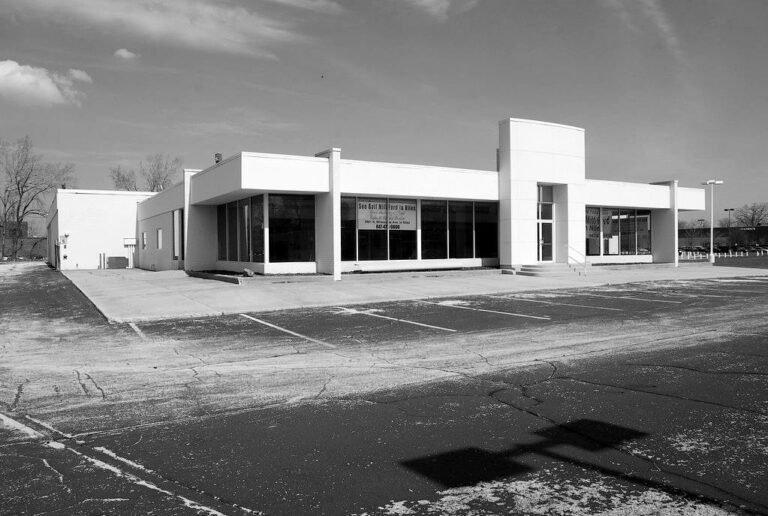
Closed Ford Dealership
Closed Ford dealership in Illinois

The herd mentality is alive and well among automobile industry executives, not excluding Mary Barra and Jim Farley.  Viewing Elon Musk and Tesla as their lodestar, automobile manufacturers seem intent on destroying the dealership model of sales.  They’re going to regret that because they’re going to do what they always do – make too many cars and trucks.

A recent article in Car and Driver magazine about the future of automobile dealers touched upon this central point but did not really give it the emphasis it deserves.

The dealership model of automobile sales was developed as the answer to two problems: the undercapitalization of manufacturers and the seasonal variation in sales.  Automobile manufacturers today may be so flush with cash that they can, for example, squander billions on driverless cars (as General Motors, Ford, and Volkswagen have done), but the second problem has not disappeared.  It is only hiding.

The last few years have been lush times for automobile manufacturers because of scarcity.  The pandemic, chip, and other supply chain issues (exacerbated, of course, by the industry’s earlier moves to “just-in-time” inventory systems that shifted parts inventory costs to suppliers but also forfeited direct control over that inventory) coupled with very low interest rates resulted in empty dealer lots, new cars routinely selling above “sticker,” and used cars that didn’t depreciate.

It won’t last.  And when it flips, the automobile manufacturers are going to need their dealers, just as the industry has needed them throughout its history.

Globally, automakers have enormous excess production capacity.  Excess production capacity is inevitable in an industry in which profit depends on the volume of sales.  No manufacturer wants to so limit itself that it cannot meet demand, thereby ceding sales to competitors that have more capacity.  Developing new models today is as necessary to being competitive as it has ever been.  Amortizing development costs over a production run will always mean that a successful product makes huge profits and an unsuccessful one creates huge losses.  It also means the incremental cost of producing one more vehicle will always encourage over production of laggard models.

Here is how that works.  Assume development costs of a new model at $15 billion, which is actually a low number for an entirely new model.  Assume also projected sales of 1.5 million vehicles over a product life of five years.  To assure that the new model makes back enough money that the manufacturer can recoup its development costs and thereby finance the next new model, each vehicle sold must generate $1,000 in revenue above the direct and indirect costs of production (i.e., materials and labor, plant overhead, advertising costs, interest expenses, health care and pension costs, salaries, etc.).

Once the manufacturer has hit that projected sales target, that $1,000 is no longer needed to recoup costs and becomes the purest of all profit.

It leverages the other way, as well.  If, for example, the new model is actually selling at a rate that’s likely to miss the target by 250,000 vehicles, then it will fail to recoup $250 million.  Faced with that crisis, the manufacturer will make the rational move:  it will drop the price.  Even if dropping the price by $500 per vehicle means recouping less, the reality is that every vehicle sold for more than the basic costs of producing it – labor and materials – means the vehicle is producing an “operating profit” (revenue above direct costs of production) and the manufacturer is reducing its overall loss on the model.  That same logic also means that a vehicle that has hit its production target can be sold for less and still generate a very large profit for the manufacturer, allowing it to progressively reduce the price and keep the vehicle in production.

Automobile Assembly Line

There is another element of automobile production that bears on profit.  Mass production requires constant production to fully achieve the economies of scale that allow predictable pricing.  Once you have an assembly line in operation, shutting it down even briefly costs millions of dollars.   (In 2009, a survey of automobile industry executives reported them as calculating the cost of shutting down an assembly line at $25,000 to $50,000 a minute.  In 2008, Chrysler triggered a spat with one of its suppliers, forcing the supplier into bankruptcy and threatening the closure of fourteen assembly plants as a consequence.  The company’s lawyers told the bankruptcy court that Chrysler could face $225 million in costs from a shutdown of those plants.)  So, you do everything possible to avoid cutting production.  You cannot match production to demand, day to day or even month to month.  You do everything possible to keep the rate of production at the level projected when determining the amortization of that model over its expected production life.

Against these background economics, it is worthwhile to appreciate the current state of the automobile industry and its lock-step march toward an electric future.  (There are many reasons to question whether the notion of an all-electric automotive future is feasible or desirable, and it is evident that automobile manufacturers are counting on governments to force adoption of electric automobiles.   All of that is fair game for comment.  But that is beyond the scope of this post, which is limited to the role of dealers in the industry’s future.)

Today, electric vehicles are less than five percent of the market for new automobiles and trucks.  Overall, new cars and trucks remain a scarce commodity – in the sense that economists use the term ‘scarcity.’  Tesla has been able to operate without dealers because the market it was creating was far larger than its ability to meet the demands of that market, one in which it had no competition.  It does not have to be a large overall market to accomplish this.  It need only be a market that is much larger than production volume.

But success with any automobile or truck means that someone will compete.  In the 1950’s, Volkswagen created a market for a small, inexpensive vehicle with low operating costs.  American Motors and Studebaker booked profits by reworking existing models as “economy cars.”  That led the major manufacturers in the 1960’s to aim new smaller cars at that market, redefining it, expanding it, and ultimately overwhelming it.

Eliminating dealers, or the functional equivalent – attempting to avoid the impact of state franchise protection laws by reducing their role to little more than delivery agents and eliminating their profitability – necessarily means that manufacturers must absorb the costs now incurred by dealers.

These are the costs of overproduction and industry overcapacity.

Volume automobile manufacturers want to sell as many vehicles as possible.  To that end, they will develop new and improved models that are intended to increase sales and market share.  Some of those new models will gain more favor with customers than others.  The manufacturers of those others will respond by cutting the price of their laggard model, as they themselves introduce other new models that they hope will be winners.   Industry economics, as illustrated above, mean that manufacturers will constantly seek to meet demand for popular models even as they simultaneously cut prices to move those that are less popular.

History, it is said, repeats.  The period following World War Two through the 1950’s can tell us something about what the automobile industry is experiencing currently.

Following World War Two, demand for new cars meant anything would sell.  Production resumed with face-lifted 1942 models as manufacturers raced to be first to the market with completely new models.  As those new models became available, starting in 1948, demand continued to exceed supply as the population entered a decade of rapidly increasing prosperity.  By 1952, that seller’s market had turned into a buyer’s market.  Ford and General Motors began a price war in which other manufacturers were collateral damage.  Both of those manufacturers also poured money into development of new, more advanced models, leading to record sales and profits in 1955.  (In 1955, General Motors became the first corporation to make a profit of $1 billion in a year.)

Casa de Cadillac in California in the 1950's
Casa de Cadillac in California in the 1950’s

When the post-War seller’s market turned into a buyer’s market, it was the automotive dealer that made it possible for the manufacturers to maintain production even as buyers became more selective and price sensitive.  The dealers took the inventory and the costs associated with it.   Any seasonal variations in demand were ironed out by putting seasonally excess production into dealer inventory.  (The manufacturers had even figured out how to make money on that inventory by creating their own dealer finance divisions, such as General Motors Acceptance Corporation, to finance dealership inventory – a “floor plan,” in trade terminology).  Collectively, dealerships also created the secondary market in used cars that supported the market for new cars.  By having a large inventory of new vehicles, dealers were able to capitalize with instant gratification on the urge to have a new car.  People became accustomed to budgeting a car payment as they would a mortgage or rent payment, which also made it possible for them to trade for a new car every two or three years – a concept that would eventually lead automobile dealers to invent leasing new cars.

As the experience of the post-War 1940’s and 1950’s illustrates, in the automobile industry scarcity will always lead to overproduction.  Overproduction will always lead to price-cutting.  Price-cutting, in turn, overall diminishes the value of existing vehicles as trade-ins, putting further pressure on new car prices and making introduction of new models just that much more essential to future profitability for the manufacturers.

Tesla may now be able to sell every vehicle it produces.  General Motors and Ford may be able to book orders for electric pickup trucks into 2025.  But it won’t last.  In fact, the recent news that Tesla is doubling the discount on the Model Y and Model 3 to $7,500 tells you Tesla is putting money on the hood to move the product and maintain production volume – a problem directly related to not having dealers to smooth out variations in customer demand.   See also our post Tesla Needs Dealers to Make a Profit.

Yet, some automobile manufacturers act as though it will last, and last forever.

General Motors is touting a new plan to cut costs.  Instead of holding inventory on dealer lots, they’ll use sales data to manufacture cars that anticipate customers’ selection and hold them at distribution points located within a day of the dealer.  Only there’s nothing new in that plan – it’s the same “pop coms” (for “popular combinations”) scheme the company used in the late 1990’s.  (It also it deprives the company of the interest income it would derive from floor planning that inventory.)  Ford intends to restrict dealers of its electric vehicles to a single demonstrator.  That’s not too different from the immediate post-War years, when ordering a car was the expected way to buy.  But that model rapidly disappeared as production came closer to demand and dealers were able to stock inventory.  Ford may choose to deprive its dealers of inventory.  But this is a competitive industry.  When other manufacturers see that they’ve been handed an advantage by Ford, those other manufacturers will stock dealers with electric inventory and customers will have the choice of having a new vehicle now or one later.  When that’s the choice, now typically wins.

Automobile dealers today are as essential to the financial health of automobile manufacturers as they were a century ago.  The scarcity of new automobiles and trucks of the past two years was artificial.  Some automobile manufacturers are building a new business model based on the belief that they can make scarcity permanent, dynamically balancing supply so that it is always just a little short of demand.

In the automobile business, it doesn’t work that way.

It never has.

It never will.

PAT FOSTER AND THE MYTHS OF PACKARD’S DEMISE

1956 Packard Caribbean convertible

Pat Foster of Hemmings blames the One-Twenty model for Packard’s demise – perpetuating a myth that cannot stand up to the facts.  In his January, 2021, column for Hemmings Classic Car magazine, Foster writes that “Packard’s problems began when the company moved into the medium-price bracket in 1935.  .  .  The new cars sold like hotcakes, but, because the company didn’t create a separate marque name for its lower priced cars, the Packard brand was devalued.”  He further contends James Nance, who became Packard’s president in 1952, might have saved Packard by separating the lower-priced Clipper from the Packard brand before 1956.  According to Foster, had Nance “done it in 1955, or better yet, 1954, it might have made all the difference in the world.”

Mr. Foster is an able and highly respected automotive writer.

And wrong.

Packard One-Twenty Club Coupe

The One-Twenty model was the reason Packard survived the depression.  Further, though Nance inherited a sick corporation when he became Packard’s president in 1952, it wasn’t his brand management that killed the company.  He killed it by merging Packard with Studebaker without bothering to get an independent audit of Studebaker’s books.

Packard’s corporate annual reports are readily accessible at PackardInfo.com.  Annual revenue information also can be found at packardclub.org.   The numbers tell the real story, one far removed from the myths Mr. Foster’s column perpetuates.

The One-Twenty was introduced in January of 1935.  Prior to that, all Packards were expensive models in the top tier of automobile industry pricing.  These were the models that came to be called, after the One-Twenty’s introduction, the “Senior models.”  These were the Packards that created the image Mr. Foster claims was besmirched by the less expensive One-Twenty.

They were also the Packards destroying the Packard Motor Car Company’s capital, racking up ever-greater losses with each year of production.

Here are the numbers:

In 1929, Packard made a $25,183,296.38 profit.  In October of 1929, the stock market crashed.  Contrary to popular conception, the economy did not immediately collapse.  Rather, the market crash triggered an economic contraction during 1930 that became worse in the following years.

Packard’s profit dropped to $9,034,219.53 in 1930 – a 64% decrease from 1929.  In 1931, Packard posted a loss of $2,894,528.00.  In 1932, the loss rose to $6,824,311.72.  Packard eked out a $500,000.00 profit in 1933, but then lost $7,290,549.26 in 1934.

1936 Packard 12 advertisement - Westchester notwithstanding, there were not enough buyers for the Senior series Packards to make them profitable
1936 Packard 12 advertisement – Westchester notwithstanding, there were not enough buyers for the Senior series Packards to make them profitable

It doesn’t take an MBA to see where this would end were nothing to change.

Mr. Foster asserton that the One-Twenty was the begining of Packard’s decline ignores the reality of the automotive market during the 1930’s.  The market for the super-expensive hand-crafted automobiles was evaporating.  As we pointed out in our previous post, The Real Reason Packard Died, automobiles priced at $2,500 or more were 10% of the total automobile market in the 1920’s.  In 1932, they were 2% of the market.  By 1937, this had been cut to 0.5% of the market.

In 1930, the least expensive Packard, the Model 403 sedan, listed at $2,485; the most expensive, the Model 447 Coupe Victoria, cost $6,000.  In 1934, Packard prices started at $2,725 for the Model 703 Sedan and peaked at $7,578 for the Model 280 LeBaron or Dietrich Phaetons.

Against this tide of yearly losses and the disappearing market for its products, Packard introduced the One-Twenty for 1935.

The One-Twenty saved the company.

In 1935, Packard made a profit of $3,315,622.38 on the sale of 52,045 automobiles, of which about 7,000 were the Senior series.  The difference between the unsustainable losses of previous years and the profit in 1935 was the One-Twenty.  In 1936, Packard sales rose to 80,878 vehicles and profits exceeded $7,000,000.00.  The Model 115C, priced below the One-Twenty, was introduced in 1937 and sales reached 108,528.  Profit exceeded $3,000,000.00, in a down year for the industry.

But that doesn’t tell the whole story.

Packard continued to produce the Senior series models throughout the 1930’s, along with the One-Twenty and other lower-priced models.

Recall how much money Packard lost from 1930 through 1934 when it produced only expenseive Packards.  Losses from producing these Senior series Packards certainly continued after the One-Twenty was introduced.  Packard did not break out profits and losses from specific series in their annual reports and financial statements.  So, the profits of the One-Twenty concealed the losses created by the Senior series.

Nonetheless, it is reasonable to assume that losses from the Senior series after the One-Twenty was introduced in 1935 were at least as great as they had been in the years from 1931 through 1934.  If we make that assumption, then continuing the Senior series in production after introduction of the One-Twenty drained at least $40,000,000.00 fom the Packard Motor Car Company before autmobile production ended with the beginning of World War Two.

That is equivalent to $760,256,934.31 in 2020 dollars.  It is equivalent to $70,364,963.50 in 1950 dollars – dollars that Packard did not have  to invest in keeping pace with General Motors and Ford after World War Two, as those companies introduced models with advanced engineering and features while Packard’s product line stagnated  from lack of investment.

Yet, despite that reality, Mr. Foster claims Packard was in solid financial condition entering the 1950’s.

It was not.  The losses incurred by continuing the Senior series in production were devastating to Packard’s ability to compete in the 1950’s.  The company was not helped by a sclerotic, risk-averse management.  But that management, too, was a product of the mistake made in the 1930’s when Packard elected to subsidize its most expensive models with profits from the vehicles and market on which it should have been concentrating.

The manufacture and sale of automobiles is one of the most expensive, capital-intensive enterprises in the corporate world.  To succeed, profits from current sales must finance development of future products, just as current model development was paid by profits of the models preceding them.  This means an automobile company cannot merely make an operating profit – that is, sell the car for more than the cost of parts, labor, overhead, and costs of sale.  Unless current profits replace the capital employed in their development, the company company’s operating profit is really a loss in disguise.

That describes where Packard stood financially as the 1950’s opened.  Financially, it was not even treading water.

1941 Packard Clipper

In 1940, Packard had introduced the Clipper, priced above the One-Twenty but well below the Senior models, with a fresh new look that leap-frogged the competition.  Underneath, it carried over most of the One-Twenty’s chassis and powertrain, but these were still relatively fresh designs.  Packard struggled to keep up with demand.  Then, World War Two ended Clipper production and eliminated the profits and market share Packard would have realized had the War not amputated the Clipper’s future sales.

After the War, Packard’s management elected  to use the Clipper as the basis for the bloated “bathtub” Packards introduced in 1948, automobiles that still employed the same chassis and drivetrain introduced with the One-Twenty in 1935.  Though Packard arranged a $30,000,000.00 line of credit in 1948 expressly to finance development of new models, its president, George Christopher, elected not to borrow the funds – even as the larger automobile companies were introducing entirely new and modern models with features Packards did not offer.

It is easy to eviscerate Packard’s management for these decisions.

But focusing on the long-term – which Packard management most certainly failed to do – is far easier when you do not have to worry about surviving the short-term.  Cash conservation was the ultimate priority of Packard management after the War.   Packard’s management was reluctant to develop a new car because it was concerned that the company did not have adequate capital to do more than essentially carry on existing models.  It gambled that that Packard would be able to keep selling the existing models long enough that profits from them would pay for developing a new Packard in the future, betting that the market would not leave Packard behind in the meantime.

That decision, though regrettable and perhaps wrong, is defensible.

It is true that Packard had money in the bank and was posting profits in the early 1950’s.  But these profits were ephemeral.  They were operating profits, but not profits that could restore the capital the company needed to produce competitive products.  The profits existed solely because Packard was not investing in new products.  It was living today at the expense of tomorrow.    The truth is that Packard was not financially sound at the beginning of the 1950’s.  Packard was a sick David pitted against a very healthy industry Goliath.

In 1950, General Motors made a profit of $834,044,039.00.  Packard’s profit in 1950 was $5,162,348.00.  Even so, Packard outold Cadillac through 1949 –  which belies Mr. Foster’s claim that the One-Twenty had “devalued” the brand.  But 1949 was also the year  Cadillac introduced its high-compression V-8 engine.  In 1950, Cadillac sold 103,857 automobiles.  Packard sales were 42,627 – a 63.5% decrease frm the preceding year.   To develop modern automobiles that were competitive, Packard needed the money continuing production of the Senior series in the 1930’s had sucked out of it.  If Mr. Foster wishes to speculate about ‘what might have been,’ it would be better to focus on what Packard might have done to prepare for the 1950’s had its management dumped the Senior series as quickly as possible after introducing the One-Twenty.

Mr. Foster, though, still on the same theme, suggests that Packard might have been saved, had it divorced its less-expensive post-War Clipper from the Packard brand during the 1950’s and reserved the Packard name for the more expensive models.  To support the notion that Packard made a fatal marketing mistake, Mr. Foster cites Cadillac, stating that General Motors marketed the less-expensive LaSalle under a separate name to preserve Cadillac’s image as a luxury brand.

Not so.

The existence of the LaSalle had nothing to do with protecting Cadillac’s brand image.  The LaSalle was one of four companion brands General Motors introduced in the 1920’s to fill price gaps in the GM product line, each intended to sell for slightly less than the primary brand, but more than the next least expensive primary brand.  Oakland introduced the Pontiac, Oldsmobile the Viking, Buick the Marquette, and Cadillac the LaSalle.

General Motors culled the companion brands at the onset of the depression, dropping the Viking and Marquette in 1930 and 1931, while simultaneously dropping Oakland in favor of Pontiac.  Only LaSalle survived – until 1940.

1956 Packard models
1956 Packard models

General Motors then copied the marketing strategy Packard had pioneered with the One-Twenty and took Cadillac down-market.  What had been the LaSalle became the Cadillac Sixty-One series.  General Motors was pushing the Cadillac brand and its prestige down market, projecting that image onto a less expensive vehicle that it could sell in greater volume by using the Cadillac name.

In this, Cadillac was also following Lincoln.  Like Packard, Lincoln had introduced a far less expensive model, keeping it as a Lincoln.  The 1936 Lincon Zephyr cost $1,275 – far less than the Lincoln Model K priced, depending on model, from $5,000.00 to $7,000.00.  It was Zephyr sales that kept the Lincoln brand alive.

The reality is that the domestic luxury brands surviving the Second World War all  introduced lower priced models under their existing brand name before the War.  The cars they would build in the 1950’s were direct descendants of those pre-war lower priced models.

1956 Clipper models
1956 Clipper models

There were, of course, other elements that worked to further erode Packard’s financial condition.  After the War, Packard management subcontracted all body production to Briggs Body Company.  Briggs ongoing union troubles knee-capped Packard production – and Briggs raised prices, too, cutting Packard’s profit margin.  Later, Korean war restrictions on availability of steel stunted Packard production.

Then, too, the dictatorial chairman of its board of directors, Alvin MacCauley, picked the wrong man for company president in April of 1942 when he selected George Christopher.  Once the War was over, Christopher’s goal was volume, and he considered volume to be achieved by low price. In the immediate post-war market, when any new car would sell, Christopher instead concentrated on the lowest priced cars – even though Packard could have sold as many expensive cars as it could produce and, had it done so, would have realized higher profits per car.

1948 Packard taxicabs at the Packard factory

It was Christopher who “cheapened the brand.”  It was Christopher who produced a Packard taxicab.  It was Christopher who let the  $30,000,000.00 line of credit to finance new models expire untouched.  It was Christopher who, against the advice of Packard’s own designers, chose the bloated “bathtub” design for Packard’s first updated post-war models.

But it was James Nance who drove the nails into Packard’s coffin.

Whether Packard was truly doomed when Nance took over in 1952 is a topic for another day and, perhaps, another post.  One thing is clear:  Nance was the man running the company when Packard merged with Studebaker.  Nance failed to have Studebaker’s books independently audited before agreeing to the merger.  Afterward, it became apparent that Studebaker’s financial condition was far worse than Packard had understood.  As Mr. Foster himself explained in Studebaker: the Complete History, his book about Studebaker, “It was a great deal for Studebaker because once Packard owned the company it would have to cover Studebaker’s losses with Packard money.”

In 1953, the year before the merger, Packard’s showed a profit of $5,440.966.00.  In 1954, the year of the merger, the combined company lost $26,178,315.00.  The loss in 1955: $30,883,501.00.

We all know how it ended.


For more about Packard and the reasons it failed, see our post:  The Real Reason Packard Died.

For more about how Studebaker’s operating profits from the Lark disguised its parlous finances, see our post: Can Tesla Succeed?

CADILLAC AND THE PENALTY OF FAILURE

1959 Cadillac Sedan deVille advertisement
1959 Cadillac Sedan deVille advertisement in Life magazine

To the management of Cadillac, today is about SUVs.  Tomorrow is electric.  The Cadillac luxury sedan is   .   .   .  yesterday.

They do, however, promise a new luxury sedan in the future – the Celistiq, powered by batteries, hand built, and priced above $200,000.

That Cadillac could sell a vehicle for $200,000 is as much fantasy as the notion that they’ll ever build such a car.  To sell automobiles at that price, more is needed than superb quality, excellent engineering, and cosseting luxury.  Those are requisites, of course – necessary, but not sufficient.  To sell an automobile at that price, the purchase must also transfer prestige to the buyer.

That transfer is the essence of “brand.”

When asked why Cadillac needs a $200,000 electric car, General Motors President Mark Reuss told Car and Driver magazine, “Do you think the Cadillac brand is in good shape?  It’s not.”

He is wrong.

In its January, 2020 issue, Car and Driver reviewed a vehicle it called “The Cadillac of Pickup Trucks.” Unfortunately for General Motors, the article was referring to the Ram 1500 pickup truck.

Yet, that almost reflexive comparison to a Cadillac to convey, in a phrase, that a product possesses supreme quality and style illustraates the continuing strength of the Cadillac brand.

It the current caretakers of the brand that are the problem.

Cadillac president Steve Carlisle recently told Cadillac Society that, [i]f  you look at our advertising, you’ll see the value and energy and attitude and color and life start to come through, so I think we’re getting our arms around what it means to be American luxury and how important it is to lead with technology and innovation, like Super Cruise, OLED, our new digital platform and everything like that.”

1915 Cadillac 51 V-8

In 1915, striving to find its place in a pantheon of luxury automobiles that included Packard, Pierce-Arrow, and Peerless, Cadillac introduced a V-8 engine – a first in the field.  Competitors claimed the engine was too revolutionary, that it would inevitably suffer reliability problems, and that potential purchasers should avoid buying a Cadillac.   Theodore MacManus, who would start his own advertising agency in 1927, was then Cadillac’s lead advertising copywriter.  He responded with a full-page advertisement in the Saturday Evening Post – one that did not show a vehicle or tout a feature – or even use the word “Cadillac” in the text.    Titled “The Penalty of Leadership,” the advertisement became an instant classic, one framed and hung on the walls of Cadillac dealers for decades afterward.

The Penalty of Leadership
Read “The Penalty of Leadership”
    (Click image to expand)

“The Penalty of Leadership” posited that those who lead, in any field of endeavor, will inevitably draw attack from those who settle for less, who fear innovation and progress, and criticize because they know they cannot compete.  “The Penalty of Leadership” was not about a car.  It was about a core philosophy, one that placed achieving innovative excellence above all else, recognizing that those who lacked the imagination or will to achieve the most advanced and innovative products would always be the targets of those who settled for lesser standards.  The leader, by definition, is not a follower and does not compromise in the creation of the product.

Were you to read the text of that advertisement today to one not familiar with its history and then ask what automobile best fit its description, the response would probably be “Tesla.”

It would not be “Cadillac.”

Cadillac, contrary to Mr. Carlisle, is not leading.   The evidence of leadership he offered is actually proof to the contrary.  The digital platform of which he boasts debuted on a Chevrolet – the C8 Corvette – and is not unique to Cadillac; it will be included on all newly designed General Motors vehicles introduced through 2023.  Super Cruise, introduced in 2017 on the CT6, is considered an excellent self-driving system, but it was the Model S Tesla that first featured self-driving capability.  The OLED screen on the Escalade dashboard is not new technology.  It’s a cute feature, but Sony and Panasonic have been manufacturing organic light emitting diodes for over fifteen years.

Yet, Cadillac aspires to build a $200,000 luxury sedan.

Why?

Because a luxury sedan is the sine qua non of a luxury brand.

Cadillac CT6 V the top of the CT6 line
Cadillac CT6 V – the top of the CT6 line

Cadillac, however, has now euthanized the one last luxury sedan it offered, the CT6.  Cadillac is now left with only mid-priced cars and SUVs, and rebadged trucks.

To succeed as a luxury automotive brand, it is necessary to sell a luxury automobile – and that automobile, for every manufacturer of luxury automobiles, is a sedan.  Other models may also be offered.  But the sedan is always the core.  Cadillac has abandoned that market.  Markets that are abandoned are seldom regained.

The Cadillac deVille was the essence of both luxury and the Cadillac brand in the 1950’s and 1960’s.   It is the automobile that created the “Cadillac of” comparison – a phrase that, even today, is instantly understood, even when applied to a truck.   That instant recognition of the meaning of the “Cadillac” brand, however, cannot forever withstand its neglect by those who should be capitalizing upon it and reinforcing it.

CT6 V's Blackwing V-8 - twin turbo, 550 hp
CT6 V’s Blackwing V-8 – twin turbo, 550 hp

The real problem is a Cadillac management afraid to compete in the luxury automobile market, much less to lead.   It is much easier to promise a $200,000 luxury automobile years from now than it is to develop, market, and succeed in the production of a truly exceptional $80,000 to $90,000 luxury automobile.   Cadillac had such an automobile with the CT6.  But its  management made abysmal decisions that undercut what little effort was expended to market the CT6.  As Robert Lutz has noted in Road & Track magazine, the concept of luxury connotes a certain exclusivity.   The CT6 was an inherently  expensive automobile because it was built on the Omega platform, a platform designed with state-of-the-art engineering and materials that made the vehicle more expensive to manufacture.   Cadillac management should have recognized that the CT6 was an expensive car, designed as an expensive car, and worth its price.   It should then have marketed it as such.  One engine – the best V-8 the company could offer.   Every luxury feature standard.   Choices of materials and colors, not choices between levels of quality.  Commitment that speaks of dedication to product – and displays true leadership.

Instead, Cadillac management decided to de-content the base model CT6 to compete on price.   As a concept, that was antithetical to creating the desired image of luxury.  The base model was sold with a four-cylinder engine and a plastic interior.   The end result was anything but luxurious – and any prospective purchaser would (and, judging from sales, did) look elsewhere.

Cancelling the CT6, however, was not the solution to bungled marketing.  To the contrary, cancelling the CT6 was discontinuing the one vehicle that was essential to giving true meaning to the Cadillac brand.

Reuss promises a luxury sedan in a future that may never come to pass.

CT6 V at Chicago Auto Show

What he needed to do was make a success of the luxury sedan Cadillac was already producing.

Cadillac management should have no fear of suffering the penalty of leadership.  Instead, it faces the penalty of failure.

Posit the hypothesis that Cadillac’s vision of an electric future is correct.  Concede to them the engineering advances in battery technology that will allow them to leapfrog the competition as they did over a century ago with the V-8 engine.

Even if that future arrives, will anyone still identify Cadillac as a luxury brand?

Or will “the Cadillac of  .  .  ” have gone the way of “It’s a Duesy”?


For more background on Cadillac management and their abandonment of the Cadillac brand, see our previous posts Cadillac without a Cadillac and GM Backs Down.

TESLA NEEDS DEALERS TO MAKE A PROFIT

Why Tesla Need Dealers to Make a Profit - Ford Dealer Taking Delivery of New Cars in 1940'd
Ford dealer taking delivery of new cars in 1940’s

Over one hundred years ago, automobile manufacturers invented dealers to save themselves the capital cost of maintaining inventory and to make the process of delivering new automobiles to customers both efficient and someone else’s problem.   “Those that do not learn from history are doomed to repeat it.”  The quote, commonly attributed to Santayana, describes Tesla today:  Tesla needs dealers to make a profit.  It has none.  That is one of the reasons it is currently losing money – almost a quarter of a billion dollars in just the first three months of 2019.

Winton automobile advertisement

In the first years of the twentieth century, automobile manufacturers seldom has access to bank loans.  For the most part, they relied upon investors to raise money, an arrangement that was fine for starting the enterprise, but not an adequate source of working capital to keep it going.  (Even Henry Ford, as noted in our previous post about Ford and the Dodge brothers.)  As the industry grew, automobile manufacturers were no longer competing with the horse.  They were now competing with each other.

Technology – both in the automobile itself and in the methods of production – was advancing with remarkable speed.  In 1904, the Oldsmobile’s one-cylinder runabout was the best-selling automobile in the United States, with 5,508 sold.  Twelve years later,  Packard introduced its famous “Twin Six,” a luxury priced automobile featuring a V-12 engine.  It sold 10,645 of them.  The best-selling car in 1916, of course, was the Model T – with 734,811 rolling off the assembly line.

For these reasons, early automobile manufacturers were almost universally undercapitalized.

When we refer to early manufacturers as “under-capitalized,” the common image is of a shoestring operation struggling to build a few cars and failing when it could not sell them.  But that is not the real picture of “under-capitalized” automobile manufacturers in the early days.  They were successful – very successful.

That was the problem.

The automobile market in the first two decades of the twentieth century was expanding so rapidly that automobile manufacturers required huge levels of investment to be and remain competitive.  In 1904, William C. Durant capitalized Buick at $100,000.00 and displayed the Buick roadster at the New York Auto Show.  He booked 1,108 orders.  By 1907, Buick production had reached four times that number and Durant was envisioning a merger of automobile companies, to be the United Motors Corporation.  To capitalize it, he intended to issue stock totaling $1.5 million.  He approached J. P. Morgan & Company to underwrite one-third of the issue.  J. P. Morgan himself rejected the idea.  He could not see the automobile as anything but a rich man’s toy and called Durant an “unstable visionary.”

William C. Durant
William C. Durant

By 1909, Durant had founded General Motors.  To Buick, he had added Oldsmobile, Oakland, and Cadillac.  Durant now wanted to buy Ford – and Ford had just lost the first round of the Selden patent litigation, so might be amenable to the right offer.  To make that offer, Durant approached a bank to borrow $2 million, toward raising $8 million for the purchase.  The bank turned him down.

The automobile industry, however, continued to expand – and expand, and expand.  But when banks finally did begin loaning to the industry, they were quick to cut off funds at the slightest setback.

In 1910, a correction in the stock market triggered banks cutting off credit to automakers, including General Motors.  With its working capital cut off by banks calling loans and seizing accounts to offset loan balances, General Motors was forced to shut down production – a loss Durant calculated at $60,000 a day to a company that had fixed plant and equipment worth $14 million and $26 million of inventory.  Durant went on a rapid cross-country quest, borrowing from General Motors dealers and the banks with whom those dealers did business, thereby raising the money needed to keep operating.

Tesla’s troubles today are really the same problems facing the automobile industry over one hundred years ago.  But Tesla is ignoring the solution devised by the industry so long ago and used successfully ever since.

Financing unsold inventory was an enormous problem for early automobile manufacturers.  Unsold inventory tied up money they desperately needed for financing plant and equipment and meeting payroll.  The more production increased, the bigger the drag from unsold inventory.  This financial drain was exacerbated by disorganized distribution that prolonged the time between production and sale.

There were, however, people who had access to the capital that the automobile manufacturers lacked.   These were local businessmen already successful within their communities.  They had existing business relationships with local banks.  They could borrow money to finance an inventory of new automobiles awaiting sale to the ultimate purchaser.  They became the first automobile dealers.

Carl Fisher Dealership in Indianapolis. Fisher was a founder of the Indianapolis Motor Speedway and of the Lincoln Highway

With the dealer able to finance new car inventory, the automobile manufacturer was able to sell its production to the dealer at the factory door.  The dealer and his bank paid cash to the manufacturer.   The car was sold to the dealer “F.O.B. Detroit.”  “FOB” meant “free on board,” a phrase denoting that the seller has completed its end of the transaction and that any risk of loss thereafter is upon the purchaser, i.e., the dealer.  It was up to the dealer to get the car to the showroom floor and sell it to the consumer.

Cadillac dealer advertisement 1910

Two problems solved:  the manufacturer shifted the burden of financing unsold inventory to the dealer and shifted the problem of distribution to the dealer.

But not Tesla.

When Tesla builds an automobile and ships it, Tesla still owns it.   While that vehicle is in transit, Tesla still owns it.  Tesla owns it until the customer pays for it, buying it directly from Tesla.  Tesla must support the entire cost of the entire inventory of vehicles not yet sold to the ultimate purchaser.

In the meantime, Tesla is not making a dime from that unsold inventory.  It can’t use the money tied up in that inventory to build more Tesla’s or develop future models.

This is why Tesla needs dealers to make a profit.

There is, however, yet another reason Tesla needs dealers to make a profit.

By 1919, the automobile industry had become the largest new industry in the United States.  Automobile manufacturers no longer had problems raising working capital.   It was now the dealers who needed access to better financing.  To meet expanding demand, manufacturers needed more dealers and dealers needed ever larger inventories.  The ability of dealers to finance this inventory directly affected the ability of the manufacturers to meet demand.

That year, General Motors invented a way to assure dealers would have access to the financing needed for adequate inventory and, at the same time, earn a handsome profit to General Motors.

It formed the General Motors Acceptance Corporation, or “GMAC.”  GMAC later became best known for consumer financing (and, through various corporate crises, became today’s Ally Bank).  However, GMAC originally was organized to provide inventory financing to General Motors dealers.  By 1919, General Motors size allowed it to offer credit to dealers in competition with local banks or when local banks were not an adequate source of financing.  General Motors still was paid cash at the dock for the automobile and the dealer still bore all the costs of distribution.   All that had changed was that General Motors, rather than outside banks, profited from the dealer’s expense of financing the unsold inventory.

This model was so successful that other automobile manufacturers copied GMAC to create their own captive financing arms.  Today, all major automobile manufacturers offer this “floor plan” financing for dealership inventory.

Except Tesla.  Tesla has no way to make money financing unsold inventory because Tesla has no dealers.

What a Tesla dealer would look like?

Tesla reported a $702 million loss for the first quarter of 2019.  Though it originally had projected profits for the first and second quarters, Tesla now expects no profit until the third quarter.  Tesla explains that production will “be significantly higher” than deliveries this year.  That means Tesla will be supporting a large inventory of unsold automobiles.

It is an expense they cannot afford and could have avoided – if they sold Tesla’s through dealers.

Here's Tesla real competition- the modern dealer
Here’s Tesla real competition- the modern dealer

Tesla attributes some of the loss to logistic problems delivering vehicles in Europe and China.  But the problem of exporting and importing automobiles is not qualitatively different than distributing automobiles within the United States.  Following World War Two, automobile manufacturers in Europe began exporting automobiles to the United States.  But they did it through importers, such as the legendary Max Hoffman (who introduced Volkswagen and BMW, as well as Mercedes-Benz, to the post-War market in the United States).  These importers took on the role of an importing dealer, paying at the factory gate for the vehicles and supporting the inventory of vehicles and parts necessary to sell and service them.

Though largely ignored in the press, within Tesla’s first quarter results is yet another reason that Tesla needs dealers to make a profit.  As noted by stock market analyst Jim Cramer, Tesla reported a $57 million loss before adjustment for depreciation, interest, taxes, and amortization (EBDITA) in the first quarter of 2019.  That means Tesla is losing money on every car they build.

After initially announcing the $35,000.00 Model 3, Tesla quickly retreated from selling them online (where 78% of Model 3 models are sold).  The $35,000.00 Model 3 promised for years and finally offered for sale on February 28th was pulled from online sale on April 11th.  It now can be ordered only in a Tesla store or by phone.

Anyone who has ever bought an automobile or truck from a dealer knows why Tesla did that.

You don’t really want to sell your loss leader and you can’t up-sell a customer online.

Which may be the most important reason why Tesla needs dealers to make a profit.


For other posts about how history repeats itself with Tesla, see our other post about Tesla and Ford and our post about its CEO, Elon Musk, and the Securities and Exchange Commisssion.

GHOSN v. JAPAN, INC.

Carlos Ghosn with Nissan GT-R

In engineering the arrest of Carlos Ghosn, the executives at Nissan displayed their nation’s barbarous judicial system and their company’s self-destructive management for the entire world to see.  It is not a pretty picture.  But it certainly is a revealing one.  Japan tortures Ghosn, and the world is watching.

Nissan, Renault, and Mitsubishi together form an “alliance,” an agreement for collaboration between the three independent companies.  Ghosn, the chief executive officer of both Nissan and Renault, wanted a merger of the companies.  Renault owns 43% of Nisssan, and this gave Ghosn the votes to get what he wanted.  Nissan’s management opposed that plan – and plotted to have Ghosn arrested by Japanese prosecutors and held in solitary confinement to stop him.

It is said that nations, like individuals, have an inherent character that inevitably guides their actions.  If so, the effective kidnapping of Carlos Ghosn by Japanese prosecutors at the behest of Nissan executives reveals more about Japan’s character than Japan apparently wants the world to see.  The recent granting of bail to Ghosn, an action almost unprecedented in the Japanese judicial system, shows that Japan has noticed the damage it has done to its national image.  But, belatedly granting bail to Ghosn does not change the system of criminal “justice” Japan employs, or the fundamental flaws in its national character that made possible the arrest and incarceration of Ghosn in solitary confinement.   Ghosn’s incarceration highlights a society that allows use of mental torture of criminal suspects to extract confessions and then justifies conviction because the accused confessed.

Civilized societies do not do that.

It also doesn’t help Nissan.

For Nissan, this is history repeating itself – a history that previously resulted in Nissan almost going bankrupt, only to be saved by Carlos Ghosn.

NISSAN’S CHARACTER FLAW

Since the founding of the United States as a constitutional society, coerced confessions have been considered violations of fundamental Constitutional rights.  The Fifth and Fourteenth Amendments prohibit use of a coerced confession in evidence at a criminal trial; the Eight and Fourteenth Amendments give the accused the right to “reasonable bail.”  Why are coerced confessions inadmissible?  It is not merely because coercing them is unfair, though it is.  The primary reason a coerced confession is inadmissible is because it is unreliable.  When you coerce a confession, you overcome the individual’s will to resist.  That means the individual will say what you want him to say.  A society that tolerates coercing confessions is not merely unfair.  It is a society that has no interest in the truth.  It is interested only in the unfettered exercise of power.

The executives at Nissan engineering the arrest of Ghosn had every reason to view him as a direct threat to their power over the company.  These are, after all, the executives responsible for Nissan’s recent scandals: safety and emissions standards violations that implicated Nissan’s highest levels of domestic management in corporate wrongdoing.  In September of 2018, only three months before Ghosn’s arrest, Nissan blamed decades of cheating on emissions and fuel economy standards.  Nissan’s official company statement explained that “[a]s a company – executives, manager to plant supervisors – Nissan had extremely low awareness of the gravity of violating  .  .  .  standards and rules.”  Notice that the statement does not claim these Nissan executives were ignorant of the rules.  It merely claims they didn’t think violating them was a big deal.  A year before that scandal surfaced, Nissan admitted another standards scandal involving uncertified inspectors.  The company had been doing it, and concealing it, for decades.   Apparently, that scandal had not been enough to give Nissan executives, managers, and plant supervisors heightened “awareness” that rules really are meant to be followed.

NISSAN AND THE KEIRETSU
Carlos Ghosn
Carlos Ghosn

Carlos Ghosn was chairman of Nissan during these periods, but plainly not the man responsible for operating the company.  That man was Chief Executive Officer, Hiroto Saikawa.  Saikawa, however, had publicly stated his complete opposition to Ghosn’s plan to merge Renault, owner of 43% of Nissan’s voting stock, into a combined company.   He opposed Ghosn’s plans to focus Nissan more directly on the United States market, rather than the Japanese market.  He was also about to be fired.  After Ghosn’s arrest, insiders reported that Ghosn intended to ask the Nissan Board of Directors at their November meeting to dismiss Saikawa, citing as reasons the safety and emission scandals and poor sales in the United States.  With 43% of the shares (and France, which owns a substantial block of Renault shares) behind him, Ghosn had the control needed to win that vote.

What Ghosn did not consider was the extent to which Japan has not changed since it lost World War Two.

Prior to World War Two, Japan’s industrial and banking industries were highly integrated.  It was common for companies to have large ownership interests in other companies, even competitors, and for those companies to own large percentages of each other’s shares.   The structure of these companies, termed “zaibatsu,” created integrated conglomerates with enormous control over Japanese government and society, including the military.  Four companies were considered in the first tier of zaibatsu.  Mitsubishi was in the first tier of zaibatsu.  Nissan was one of eight smaller companies considered second-tier zaibatsu.

The zaibatsu were an involved and essential component of the Japanese military aggression before and during World War Two.  After Japan’s surrender, American occupation forces planned to dissolve most of the zaibatsu companies, including Nissan.  Those plans, however, were abandoned.  Breaking up Japan’s interlocked industries became secondary to reinvigorating the Japanese economy to keep Japan from falling under the Communist influence overtaking China, Korea, and Southeast Asia.   Nissan emerged intact.

In the following years, Japanese industrial society reformed into alliances and cross-holdings that renewed the same type of closed integration of corporate ownership that existed before the War.  Called “keiretsu,” these were centered around the financial institutions that had been the banking components of the zaibatsu.  The keiretsu companies, like the zaibatsu companies, are marked by interlocked shareholding.  The interlocked ownership leads to interlocking boards that have the same individuals serving on boards of several companies with the keiretsu.

This is a structure designed to concentrate control.  It is also a structure designed to keep outsiders out – a design no different than it was when the zaibatsu controlled Japanese industry.

NISSAN REPEATS ITS FAILED HISTORY

The 43% ownership of Nissan by Renault, the product of Nissan’s serious financial problems in the 1990s that had the company $22 billion in debt and verging on bankruptcy by the time Renault rescued it in 1999, makes Nissan a very rare exception to the typical keiretsu interlocking ownership that assures vested Japanese industrial and banking interests effective control of the keiretsu companies.   The reality for Nissan is that a company whose name translates as “made in Japan” is controlled by Renault.  Being controlled by Renault meant being controlled by Carlos Ghosn.  That control was accepted when the price was saving the company.  It was no longer acceptable when Nissan executives saw Nissan on its way to being subsumed into a larger entity, one that would be beyond control of the Japanese interests that effectively control all large Japanese industrial and banking enterprises.

Renault Nissan Mitsubishi Alliance

According to the Wall Street Journal, a few months before Ghosn’s arrest executives at Nissan asked the Japanese Ministry of Economy, Trade, and Industry to intervene, to prevent merger with Renault.   The ministry had agreed to intervene but wanted more say in negotiations than Nissan’s executives would cede to it.

Nissan executives decided to pursue a different approach.

We now know how that turned out.

Published reports suggest that Ghosn’s chances for acquittal are vastly improved by his release on bail.  That, of course, really says little about the merits of the case, since the typical practice in Japan is to convict everyone accused by incarcerating them in solitary confinement until they confess.  Ghosn remains a board member of Nissan – though not allowed to attend board meetings by the Japanese court.   With Nissan executives having so directly confronted Renault with outright rebellion, Renault and Nissan recently announced a new oversight board that will, they say, govern by “consensus.”  While that approach epitomizes the keiretsu approach to business, the structure seems mostly designed to paper over the public schism between Nissan and Renault.  If Renault really is ceding Nissan management veto power, then it is conceding to a management that has a history of dishonesty and failure.   If Renault continues as the dominant partner, then the coup engineered against Ghosn will be only the first shot in a war Nissan cannot afford to win.

Nissan will need exactly what Carlos Ghosn intended to provide through a merger with Renault if it is ultimately to survive the challenges facing the automobile industry in the next two decades.  To compete in the global market against truly large automotive manufacturers, it will need the scale merging with Renault would provide.  None of this is news.  For several years before his death, the late Sergio Marchione of Fiat Chrysler had been warning that smaller automobile manufacturers, including Fiat Chrysler, would need to merge with larger companies to survive.  He was not looking at next year, but he was looking at the next decade and the decade after that.  He perceived a level of future investment that only the largest global automotive manufacturers would be able to afford.

For Nissan, this is history repeating itself.  As in the 1990’s, Nissan is facing the future with unimaginative vehicles, diminishing market share in the United States, and ingrown management.

Nissan remains independent of Renault.

But, without Ghosn, who will rescue it this time?


For more details about the inhumane and uncivilized system of Japanese “hostage justice,” visit Human Rights Watch.

MUSK SETS UP THE SEC

Elon Musk tweet - Musk Set Up the SEC
Elon Musk tweet

You won’t see a headline reading “Musk sets up the SEC.”  But the Securities and Exchange Commission is in a pickle of its own making with no way out.    Elon Musk, founder and  Chief Executive Officer of Tesla, Inc., has been a persistent critic of short-sellers in the stock market, people who stand to profit if Tesla stock loses value.  The SEC – intentionally or not – aided and abetted these stock market speculators at the expense of small shareholders when it brought action against Musk in 2018 for tweeting a claim that he had financing secured to take Tesla private and tried to bar him from participating in Tesla, Inc.’s management.  Musk settled with the SEC on terms that left him in control of the company.

The SEC now claims that Musk’s recent tweet, reproduced above, violates this settlement agreement because he did not have Tesla’s official approval for the tweet, though he corrected it hours later in a tweet that did have company approval.  (The SEC asserts the first statement was false because it said Tesla would produce 500,000 vehicles in 2019, instead of stating that Tesla would reach a production level in 2019 equivalent to 500,000 vehicles annually.)

Musk has set up the SEC.  There is probably little risk that a federal court is going to bar him from managing Tesla, Inc.  But there is a real risk that a federal court could rule that agreement violated the First Amendment.  If that should occur, the SEC will have lost a fight they have long avoided – and a power many critics claim they have routinely abused.

The Securities and Exchange Commission does not make many headlines, apart from those in the Wall Street Journal and business periodicals.  It is an artifact of the “New Deal,” created in 1934 by the Securities Exchange Act.  The Act was designed to prevent securities fraud and, as part of that process, prohibit corporate insiders from trading on insider information.  Tesla shares lost 12% of their value in the day after the SEC announced the 2018 action against Musk, the one person generally considered indispensable to Tesla achieving future success.  The only beneficiaries were short-sellers – functionally, Tesla’s enemies and certainly not shareholders Congress was trying to protect in creating the Commission.

Tesla Factory and Model 3

Seeking now to hold Mr. Musk in contempt for a statement that, at best, was slightly inaccurate and that he clarified hours later, the SEC is now to insisting on the right to gag corporate officers.  The concept of “prior restraint” on speech is anathema to the First Amendment.  Case law may allow the government to punish a statement.  But it seldom allows the government to prohibit a person from making a statement.  The order the SEC achieved in its earlier settlement with Musk does exactly that, and is Constitutionally vulnerable for that reason.

The Securities and Exchange Commission is already in a court battle over this issue.  In January, the CATO Institute sued the SEC in federal court challenging the SEC’s practice of settling enforcement actions with agreements that prohibit the defendants in those actions from speaking publicly about the agreement or their conduct.  Someone who settles with the SEC because he or she lacks the resources to continue the fight will be prohibited from making any statement in public that reveals what the SEC did, or why he settled despite his or her claim of innocence.

The CATO Institute wishes to publish a book by such an individual and makes two important points in its suit – both relevant to the SEC’s contempt action against Musk.  First, of course, it argues that SEC gag agreement violates the First Amendment rights of the speaker.  But, second – less obvious, but equally important – CATO argues that the gag order violates the public’s right to hear what the speaker has to say.  Communication involves both speaking and hearing.  The First Amendment is designed as much to protect the public’s right to hear opinions as it is to protect the individual’s right to express them.

The Securities and Exchange Commission has a lot to lose in the CATO lawsuit.  That suit isn’t merely about publishing a book.  It isn’t even simply about the ability of the SEC to impose gag orders as part of future agreements.  At stake is the disclosure of every one of the secret agreements it has made in the past – agreements which, if the gag orders are Constitutional violations, are then subject to disclosure under the Freedom of Information Act.  At risk for the SEC is the very real possibility that the agency’s conduct will receive a level of public disclosure that it has avoided for decades.   Government agencies that make a fetish of hiding their actions usually do so for a reason.

The SEC’s attempt to hold Musk in contempt implicates the exact same Constitutional issues as the CATO lawsuit and does so in a factual setting that could hardly be worse for the SEC’s position.  Musk has truly set up the SEC for a fight it has tried to avoid and probably cannot win,

Commentary has generally focused on the trivial nature of the supposed violation and the impact on Tesla, Inc. that results from distracting Musk from management while he defends himself.  The  exception has been Holman W.Jen kins, Jr., of the Wall Street Journal.  In his March 2nd column, Jenkins correctly observed that Musk’s tweet was “almost diabolically innocuous” and that the SEC is now in a “miserable position,” either forced to back down with “another slap on the wrist” or attempting to ban Musk from Tesla, a move that will be “seen as pushing a company’s shares off a cliff while millions of investors still have faith in its glorious future.”   If, however, the SEC attempts a “middle ground” of banning Musk from making online comments, Jenkins noted that the SEC risks a First Amendment fight that “could end up curtailing its sweeping and little-challenged powers over what [stock] market participants are allowed to hear and say.”

What Jenkins misses, however, is that the First Amendment issue is the first issue, should Must chose to raise it.  No federal court has the power to hold a litigant in contempt for violating a court order that is itself unconstitutional.  Musk is entitled to raise that issue as an absolute defense to the contempt action, not merely as a means to soften a possible penalty.

As it pursues its case, the Securities and Exchange Commission will again be allying itself with stock market speculators against the interests of Tesla’s many small shareholders.  It will make itself into Goliath, while Musk will easily assume the role of David.

It may just lose, big time.

More and more, Elon Musk seems to be channeling Henry Ford – a topic visited in earlier posts that explored the parallels between Ford, the car and person, and Elon Musk and Tesla.

Musk has produced a automobile that the established industry did not even try to produce.   In so doing, he has created a market that did not exist previously.   He is using litigation to make himself into the champion of a cause, win or lose in court.  Like Ford, he has created a public images that perfectly serves to promote himself and his company.  And, of course, like Ford did with Model T, Musk is cutting the price of the Model 3 whenever he can.  His recently announced decision to sell Tesla automobiles only online is as revolutionary to the automobile industry today as the assembly line was in Henry Ford’s day.

Like Henry Ford, Elon Musk knows exactly what he is doing.  “Musk sets up the SEC” may not be in a headline, but it is the essence of the battle between Musk and the Securities and Exchange Commission.  The SEC cannot afford to let Musk call their bluff.


For more about Tesla, visit our post Can Tesla Succeed?