
“Royal Bobcat.”
The name is a legend to those steeped in Pontiac performance of the halcyon days of the 1960’s, a time when Pontiac was the performance brand, on the strip and on the street. It was also a time when Royal Pontiac of Royal Oak, Michigan, was the dealer that made fast Pontiacs faster.
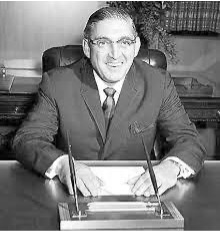
The story began in 1956, when Semon “Bunky” Knutson was named General Manager of the Pontiac Division at General Motors. A second generation General Motors executive – his father had been GM’s president – Knutson took over a moribund division that sold cars with dated styling to old people. It was a problem Knutson identified with a legendary dictum: “You can sell a young man’s car to an old man. But you can’t sell an old man’s car to a young man.”
GM management gave Knutson five years years to change that. To help him do so, he had Frank Bridge as his General Sales Manager. Bridge was the dealers’ champion in the Division. To him, selling meant getting the deal done in the showroom. He did not understand marketing. It was a foreign concept to him. Marketing, however, is what gets the prospect into the showroom. Knutson’s background was engineering. Yet, he did understand marketing and the importance of product image. Due to product lead times, at first he was able to make only superficial changes to Pontiac’s models, lessening but not eliminating their stodgy styling.
That changed with model year 1959.
1959 was the beginning of the “Wide-Track Pontiac.” The widening of the vehicle’s track was actually dictated by new the body design, which was notably wider than the 1958 models. Featuring it as a key element of the car was the idea of Pontiac’s advertising agency. In the first six months of its production, the 1959 Pontiac exceeded the total sales for the 1958 model.
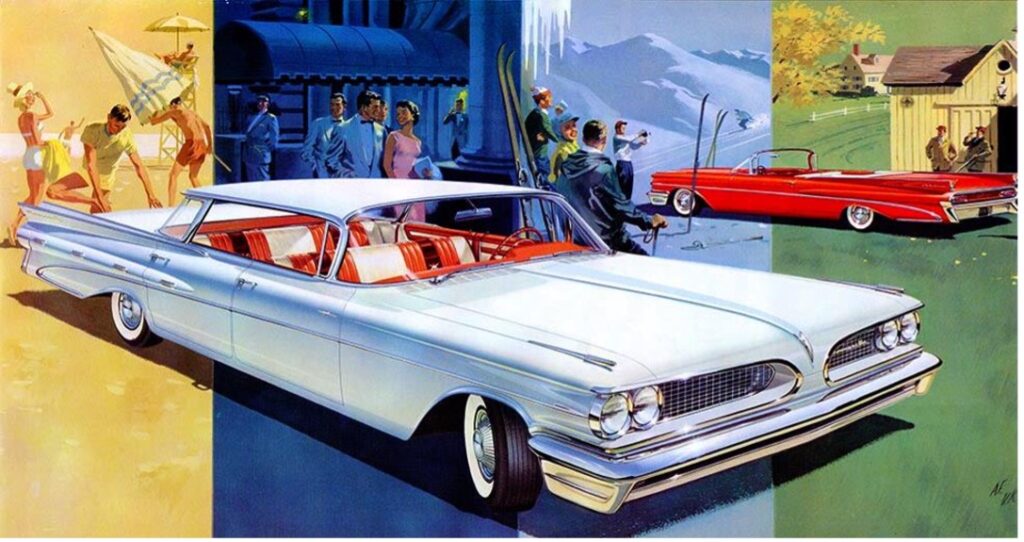
Pontiac was no longer selling old men’s cars.
One facet of Knutson’s program to change Pontiac’s image was racing. Knutson set up a Pontiac racing program shortly after becoming General Manager. At first, it relied on outside suppliers for performance parts that were then cataloged as Pontiac parts. As the Division’s involvement in racing grew, Knutson created the “Super Duty Group” to bring production of performance parts in-house. Even after General Motors joined other members of the Automobile Manufacturer’s Association to ban manufacturer involvement in racing, Pontiac continued providing favored race teams with Super Duty parts.
Competition success in both NASCAR and NHRA racing had helped change Pontiac’s fusty image to one that was youthful and performance oriented. Regardless of the corporate racing ban, selling performance was now the essence of selling Pontiacs.
And part – literally – of selling Pontiac performance was selling Pontiac’s Super Duty parts.
Which was not something Frank Bridge cared about. In fact, he opposed it
Though these parts were in the Pontiac parts books and could be ordered from any Pontiac dealer, the dealership body as a whole was not attuned to the performance market. Though racing success helped sell Wide-Track Pontiacs, its dealers were slow to appreciate performance per se as a marketable feature (as luxury, for example, is a marketable feature). There was no effort within dealerships to promote sales of Super Duty parts or educate their personnel about the potential for profit from selling and installing performance parts.
Jim Wangers was an advertising executive who worked for Pontiac’s advertising agency, MacManus, John & Adams. In 1959, he pitched a plan to Knutson, Bridge, and Pontiac’s Chief Engineer, Elliot “Pete” Estes, to teach dealers through a class held at the division’s zone offices about marketing Super Dutyb parts through dealerships to the performance customer. Knutson was interested. Bridge was opposed. Estes sat it out, without comment. The meeting ended without decision, but the atmosphere wasn’t promising.
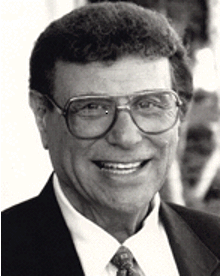
Though Knutson had been unwilling to outright overrule Bridge, he wasn’t going to let Bridge obstruct the idea, either. When Wangers returned to the agency after the meeting, Knutson had already called. When he returned the call, Knutson told Wangers to create a pilot program that would prove the concept: find a dealer, school that dealer in performance, and show what could be done. It was a chance to prove that selling performance across the parts counters and in the service departments of Pontiac dealers would drive sales and create profits.
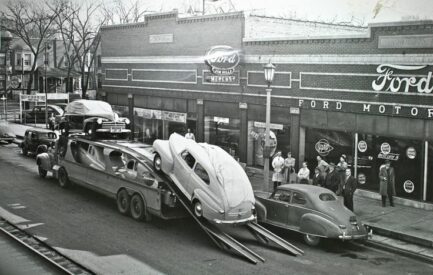
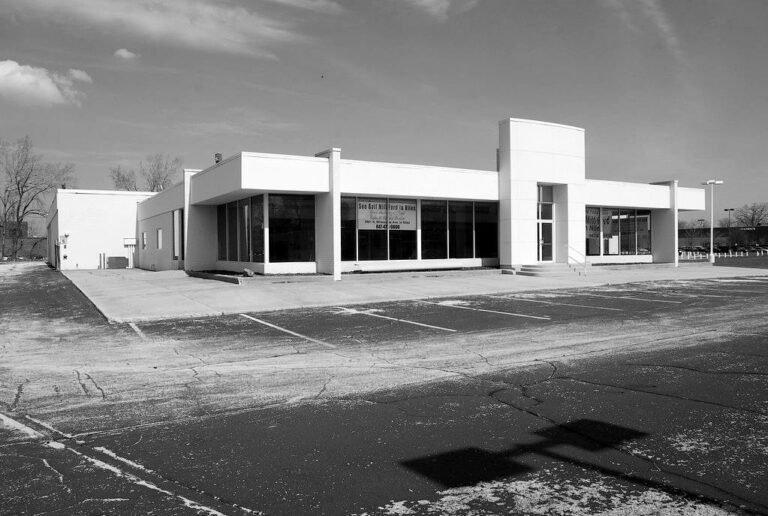
Wangers approached the largest Pontiac dealer in the Detroit area, who was non-committal. He then approached Ace Wilson, Jr., owner of one of the smallest area dealers, Royal Pontiac in Royal Oak, Michigan, about thirty miles from Pontiac’s headquarters. When Wangers explained the idea, Wilson instantly accepted. It was now September of 1959 and Wangers, still as an employee of the advertising agency, became fully involved in setting up the performance parts program at Royal Pontiac.
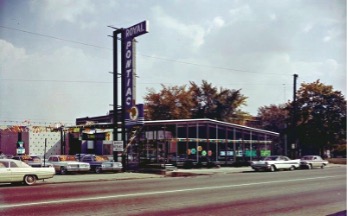
Though the idea had started as a marketing tool for Super Duty parts, it was inevitable that the tail would eventually wag the dog. Customers who came to Royal Pontiac for performance parts also expected the dealership would be able to sell them a faster Pontiac when they bought a new car. They wanted performance built into their new Pontiac.
This was all backed up by Royal Pontiac’s racing program. Wangers may have been an advertising executive employed by the ad agency, not by General Motors, but it was functionally a distinction without a difference as he approached his job. His job at the agency was to promote Pontiac and immersing himself in Royal’s performance program was doing just that. Starting in 1959, Royal went drag racing. The following year, Pontiac listed a Super Duty package specifically designed for drag racing. Royal ordered a Coronado Red Catalina with that package: 348 hp V-8, floor shifted 4 speed manual transmission (the first year offered), insulation delete, even an aluminum front bumper (an over the counter Pontiac part). But they didn’t delete the heater. (They were in Michigan, and they knew that car would be Royal’s used car lot at the end of the racing season.)
With that Catalina, Royal won the National Hot Rod Association Nationals. The driver who won the Nationals with that Catalina was Jim Wangers.
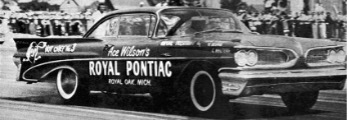
When Wangers returned to the office at MacManus on Monday after winning the Nationals, his boss informed Wangers that he’d be having lunch in Pontiac’s Executive Dining Room with Pontiac’s Chief Engineer, Pete Estes, and a few of his “engine guys.” One of those engine guys was John DeLorean.
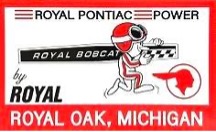
This racing success led Royal to create a specific performance package. Rather than selecting individual parts, the customer could get a package of parts designed to work together to produce seriously improved performance. Available over-the-counter or installed, this was the Royal “Bobcat.” The Bobcat name was dictated by the individual block letters used on Catalina and Bonneville models in 1962. Wangers played Pontiac scrabble and discovered that “BOBCAT” could be spelled out by selecting letters from the Catalina and Bonneville rear deck trim. Royal also created an emblem, modeled on the emblem Pontiac used for the original Grand Prix introduced in 1962.
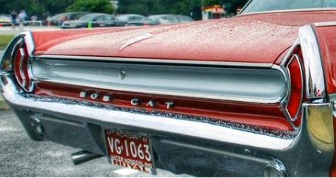
The Bobcat package was offered by Royal for the 1962 Catalina and Grand Prix models that were already equipped with Pontiac’s most powerful engine and included different centrifugal advance springs in the distributor to increase spark advance , disconnecting the vacuum advance and changing dwell, and cooler spark plugs. It also included new intake manifold gaskets that blocked off the heat riser passages to reduce heat in the intake manifold, resulting in cooler intake air and less heat sink to the carburetor. New jets were installed in the carburetor for a denser air/fuel mixture to take full advantage of the cooler intake air. Lastly, lock nuts were installed on the rocker arms that prevented hydraulic lifter pump-up at higher engine rpm.
For $200.00, Royal would install the Bobcat package and also mill the heads and install thinner cylinder head gaskets, then tune the car to take advantage of the increased compression. Or you could order your new Pontiac already “Bobcated,” in which case the appearance package included the “BOBCAT” lettering in place of the model’s name at the rear of the car – where anyone challenging the car would be most likely to see it.
But then, in 1963, General Motors decided to ban corporate involvement in racing.
There wasn’t to be any working around this ban behind the scenes through a favored dealer. Management was serious. This had nothing to do with safety. The federal government’s Justice Department’s antitrust lawyers were figuratively drooling at the prospect of breaking up GM, splitting Chevrolet off from the rest of the company. Management was terrified and trying to tamp down sales to prevent exceeding a figure – 60% of the market – at which it was commonly thought the government would sue. Even orders already placed for new Pontiacs with the Super Duty package were cancelled. But Pontiac had reached third place in overall sales in 1961, displacing American Motors’ Rambler from that spot. Knutson had built Pontiac’s sales on performance. His successor, “Pete” Estes, had no intention of abandoning the formula. Pontiac did not have to win at the track to sell performance. They merely had to produce automobiles that delivered performance.
When the ban went into effect in 1963, the design of the 1964 models was already locked in. 1964 would see the end of the compact Pontiac Tempest that had sold poorly and gained a reputation for being mechanically finicky. The 1964 Tempest would be based on the new corporate intermediate body, shared with Buick, Oldsmobile, and Chevrolet.
So, it would be just like them, too.
John DeLorean was now Chief Engineer at Pontiac. He held regular Saturday morning brainstorming sessions with other Pontiac engineers at the GM Proving Grounds. There, on a fateful Saturday morning in the spring of 1963, a prototype 1964 Tempest coupe with the 326 cubic inch V-8 was sitting on a lift. The engineers were examining the underside. One of the engineers, Bill Collin, made an observation: “You know John, with the engine mounts being the same, it would take us about twenty minutes to slip a 389 into this thing. We’ll probably need some heavier springs in the front end, but the engine will fit right in.”
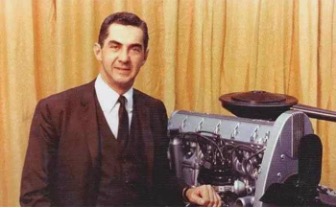
That moment conceived the GTO.
The next Saturday, the group had a prototype 1964 Tempest equipped with the 389 and a four speed transmission at the Proving Grounds. The car would be refined in succeeding weeks to improve the suspension, add a heavy-duty clutch, and find the best tires.
It is a legend that Pontiac cleverly evaded the General Motors rule requiring at least 10 lbs. vehicle weight per cubic inch of engine displacement to produce the GTO. Exceptions to the rule had to be approved by the corporate Engineering Policy Committee, and the only exception they were going to approve was for the Corvette. The GTO would, it was thought, would never get past the Committee.
The real story is both simpler and more complex.
The simple part is that Pontiac didn’t have to evade the Committee. The Committee only approved new models. The Tempest was a new model and had already been approved. The GTO was an option. Committee approval was not required for options. The complex part is the concern that GM’s corporate brass would kill the GTO even so. The solution to that problem was to get a sufficient number of dealer orders on the books before they found out. It would make the company look foolish to cancel a car for which there were already a number of orders .
DeLorean wanted 5,000 orders. But Frank Bridge still didn’t get it. He didn’t want the GTO. Pontiac was comfortably in third place in sales. Bridge did not see any need to complicate the line with a car he firmly believed dealers would park in the corner of the lot and never sell. He made his thoughts known in a meeting with Estes and DeLorean. DeLorean pushed for Bridge to get dealers to commit to sales of 5,000 GTOs. Bridge resisted: “Frankly, this thing is going to be a pain in the ass.” It was Estes who delivered the knockout punch – to Bridge’s ego. “Come on, Frank. You know you and your boys can sell 5,000 of anything.” Bridge caved. He said he’d have the District Managers see what dealers would order. “If they can take 5,000 orders, I’ll commit to it. But I don’t want any more, and I bet you won’t sell even 500.”
Pontiac sold 32,450 GTOs in 1964.
Among the legends of that introductory year is the Car and Driver magazine GTO vs. GTO comparison test, the cover story of the March 1964 issue.
The idea originated with Wangers, based on the use by both Ferrari and Pontiac of the GTO abbreviation for “gran turismo omolgato” – Italian for grand touring homologated, a racing classification and, thereby, a name that neither could copyright. He pitched the idea to David E. Davis, the editor at Car and Driver. The magazine had only recently been reformatted from Sports Car Illustrated and Davis was anxious to expand circulation. Davis saw the potential – not just for sales of a single issue, but to establish Car and Driver as the magazine about American performance cars.
Ferrari was not interested. That did not deter Davis. Car and Driver already had performance numbers for the Ferrari GTO.
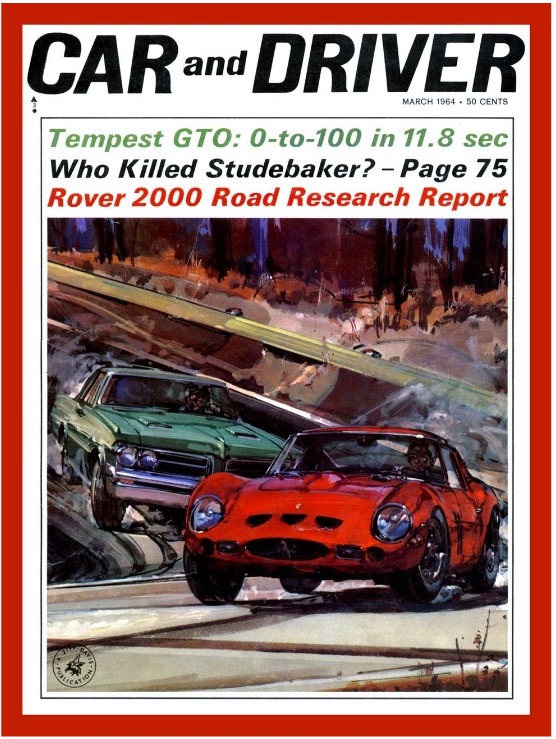
Pontiac provided two GTOs for the test, one blue and one red. The blue car was driven by Car and Driver staff from Detroit to the Daytona International Speedway where testing was to be performed. The red car was shipped to Daytona after a stop at Royal Pontiac. It was to be the GTO fully optioned for performance.
Pontiac made no secret that the red GTO was a Bobcat. It was equipped with the 348 hp, 389 cubic inch engine, the Tri-Power carburetor option, a close ratio 4 speed transmission with Hurst shifter, 3.90:1 limited slip differential, and the Bobcat modifications. Wangers and the Pontiac staff explained all of these specifications to Car and Driver.
The performance numbers turned in by both cars were exceptional, but those of the red car were astounding. Car and Driver reported 0 to 60 in 4.6 seconds, 0 to 100 in. 11.8 seconds. Part of that was due to the magazine’s crude timing methods – just a stopwatch. But part of it was due to that one undisclosed modification.
Wangers would later admit in his memoir, Glory Days, that the engine in the red car was actually a 421 cubic inch V-8, which had been – this part was true – Bobcatted. The 389 and 421 blocks looked the same, provided that one portion of the distributor boss casting was removed and the block casting number conformed.
It didn’t matter. The GTO v. GTO story was a circulation hit for Car and Driver and helped establish it as a premier automotive magazine. For Pontiac, the story established Pontiac as synonymous with affordable performance, exactly the image it wanted to project to the new youth market it was creating.
In 1965, Royal Pontiac sold 2, 500 new Pontiacs, of which 1,000 were GTOs (out of total Division GTO sales of 75,000). The Bobcat package now included a revised induction system that opened up the hood scoop and coupled it with a new upside-down “umbrella” air cleaner sealed to the bottom of the hood. That assured the engine received only the cool air coming through the scoop, lowering intake air temperatures as much as 50 degrees. This would shortly become a production option as the “Ram Air” package, supplied to Pontiac by Royal. Royal would also introduce a progressive linkage for the Tri-Power package, again ultimately adopted by Pontiac.
Royal continued to produce Bobcat GTOs throughout the halcyon years of Pontiac performance. It would build the prototype Judge, the car Pontiac evaluated for production. “Ace” Wilson sold the dealership in 1974. Jim Wangers would remain with MacManus until acquiring a Chevrolet dealership in Milwaukee, Wisconsin, which he later sold before returning to MacManus. He died peacefully in his sleep at age 96 in 2023.
The red car survives in the hands of a private collector.