
CHICAGO AUTO SHOW

Chicaog Auto Show
Chicago Auto Show

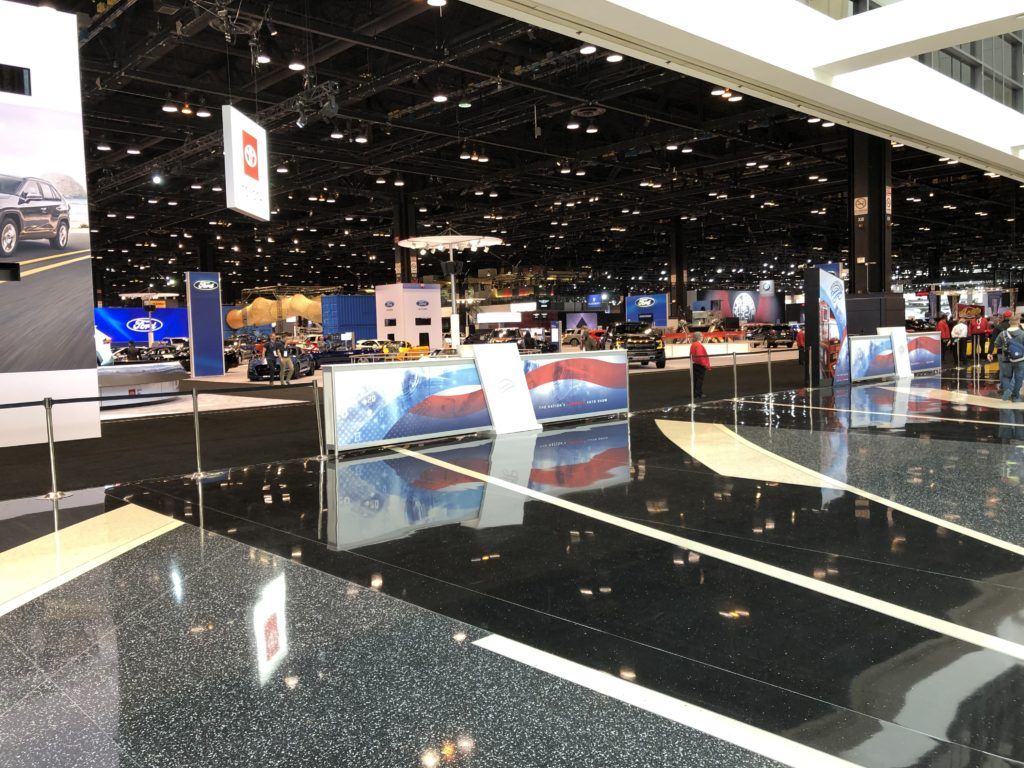
Every year, the Chicago Auto Show attracts enormous crowds anxious to see the latest models.  Though the 2019 show opens on February 9th and runs through the 18th, we were able to attend to the media preview on the Friday before opening day as part of a group invited by MotorWeek, “television’s original automotive magazine” airing on PBS and Motor Trend TV, to be part of a show tour guided by John Davis, Motorweek’s erudite and entertaining host.

Attendance makes Chicago the largest auto show in the United States, as does size:  the displays fill 1.2 million square feet in McCormick Place on the shore of Lake Michigan.  The decision to push back the North American International Auto Show in Detroit to a June date starting in 2020 and convert it into a festival means  Chicago will become the first major auto show of the year.

Automobile Chronicles focuses on automotive history, recognizing that today’s events are history in the making.  From that perspective, the evolution of the show’s emphasis from automobiles to trucks was a reality check.  Two years ago, Genesis debuted the brand and the G90, Lexus introduced the LS500 and LC500, and Cadillac introduced the CT6.  Fiat Chrysler still displayed the Chrysler 200, though it had announced shortly before it would cease building the 200 and end production of small cars.

This year, the move away from automobiles to trucks and SUVs was everywhere obvious.  The 2019 Chicago Auto Show introduced the new Chevrolet Silverado 2500HD, Ford’s Ranger, Jeep’s Gladiator, Kia’s Telluride, and the Cadillac XT6 and XT4.   The newest automotive conveniences were for trucks – the GMC six way “MultiPro Tailgate” and tailgates from Ram that can open conventionally or as doors with a 60/40 split.

This year’s show illustrates how far from passenger automobiles the industry has traveled in only two years.   In 2017, Fiat Chrysler’s decision to drop the 200 seemed almost blasphemous, so embedded was the notion that small cars were inevitably the future of the industry.  Today, that decision is viewed as brilliant, with other manufacturers copying the Fiat Chrysler’s late Chairman Sergio Marchionne’s decision to focus plant and investment on SUVs and pickup trucks.
Genesis G70
Genesis G70

Genesis was one of the few exhibitors with a new automobile, the G70.  Sharing its basic platform with Kia’s Stinger, the G70 has been uniformly praised by automotive journalists for both handling and luxury and offers a manual transmission option.   (MotorWeek named the G70 its Luxury Sedan of the Year.)   The model extends Genesis into a lower price range than the brand’s other models.  But Genesis lacks any crossover or SUV – an omission that handicaps Genesis as it works to develop the network of stand-alone dealers essential to credibility as a true luxury brand.
Kia Telluride
Kia Telluride

Kia, on the other hand, has a brand new three-row crossover SUV: the Telluride.  It is the featured vehicle for Kia at Chicago and is receiving all the promotional support Kia can offer – including airing an advertisement during the Super Bowl.  Kia is are also making sure everyone knows the Telluride is built In the United States (in Georgia).  Conventionally attractive – Kia proclaims their goal was to make it “big, bold, and boxy” and admits the design intentionally mimics the appearance of truck-based body on frame SUVs – the unit body Telluride is presented as offering luxury befitting its status as “flagship” of the Kia SUV line combined with serious off-road capability.
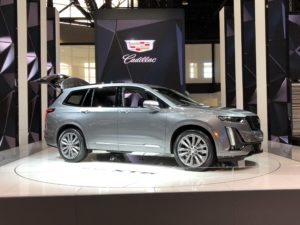
2020 Cadillac XT6
2020 Cadillac XT6

Cadillac, too, was emphasizing new crossovers.  The new XT6 was given the premier spot on the highest turntable, while the recently-introduced XT4 sat on a lesser, lower turntable.  The XT6 has a Cadillac grille and offers interior appointments familiar from the XT5, but offers a third row, plugging a hole in the Cadillac crossover SUV line.  The XT6 is based on same platform as the GMC Acadia, but the rumor is that a replacement is already under development on a new platform more in keeping with Cadillac’s image as the luxury leader.
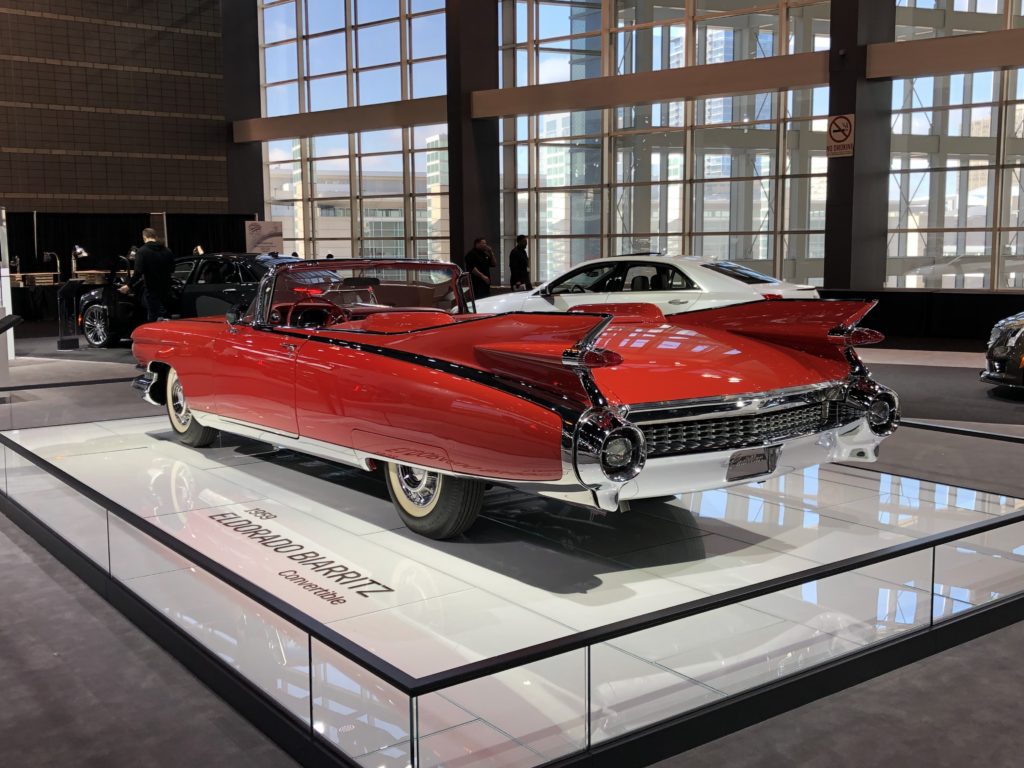
1959 Cadillac Eldorado Biarritz convertible

The real star of the Cadillac display was not an SUV, but a car – a convertible.   In the middle of the Cadillac display was a bright red 1959 Cadillac Eldorado Biarritz convertible.  Pristine and glorious, it was a reminder of the flamboyance and quality that once made Cadillac the prestige brand of the United States, not just of General Motors.
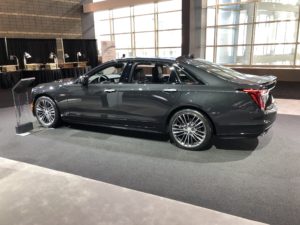
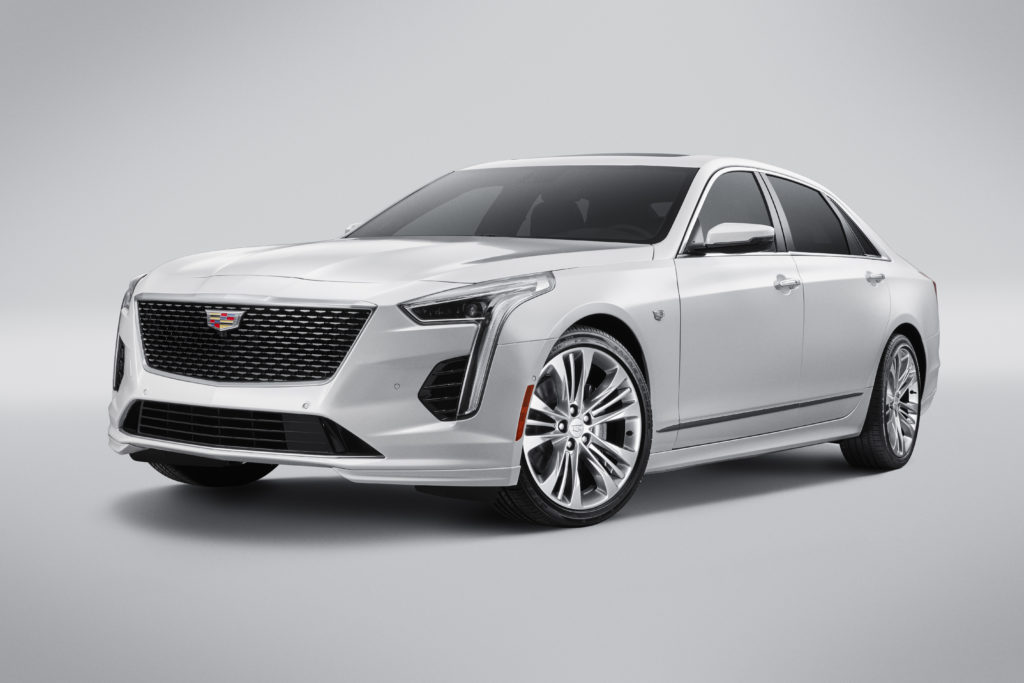
Cadillac CT6 V
Cadillac CT6 V

The new Cadillac on display that could excite automotive lust was nearby:  a CT6-V with Manhattan Noir Metallic exterior and Dark Auburn interior with Jet Black accents.   A cutaway of the 550 hp Blackwing V-8 that powers the CT6 V stood nearby.  With the announcement that Cadillac is not discontinuing the CT6, the V version is likely to be available to more than the 275 buyers allowed to preorder, with supply meeting demand in later model years.  That said, that the CT6 V, the pinnacle of Cadillac sedans, was relegated to a side space on the floor while the crossover SUVs were displayed on turntables above the other models showed that Cadillac, like the rest of the industry, is now all-in on cross-overs.  (For more about GM’s decision to keep the CT-6 in production, at the top of the Cadillac line, see our post “GM Backs Down.””
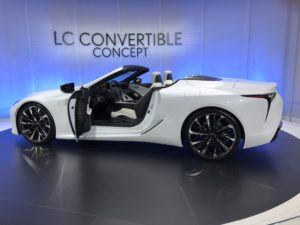
Lexus LC500 convertible concept

One luxury brand did give center stage to an automobile:  Lexus showed the concept convertible version of the LC500.  It is as certain to see production as the concept LC500 coupe was when we last visited the show two years ago and is even more beautiful than the coupe.  (The LC is the only Lexus model on which the spindle grill is attractively integrated into the design of the vehicle.)  There is no official word on when the convertible will appear in a dealer’s showroom.
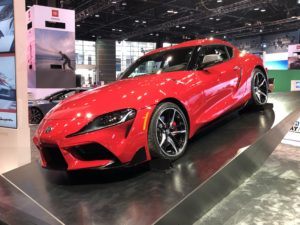
Toyota Supra
Toyota Supra

Toyota was the only brand in Chicago to present an entirely new production automobile: the Supra.  Even so, it seemed almost an afterthought in Toyota’s Chicago display.   Only one Supra was displayed, inaccessible on a tilted stand.  Built in cooperation with BMW and sharing a platform with the BMW Z4, the Supra has a many design cues reminiscent of the last Supra, from the 1990‘s.  The exterior is ovals and curves.  It already looks dated.
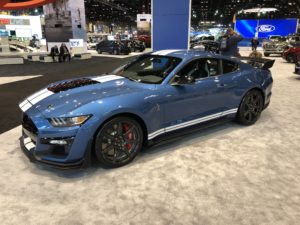
Shelby Mustang GT 500

Ford displayed its latest Mustang:  The Shelby GT500 aimed at both the Dodge Challenger Hellcat and the Chevrolet Camaro ZL1 1LE.  Ford has not quoted specifics, but says the GT500 produces more than 700 hp.  The more interesting Mustang was the Bullitt model the automotive press has uniformly praised as a perfect balance of power and handling.
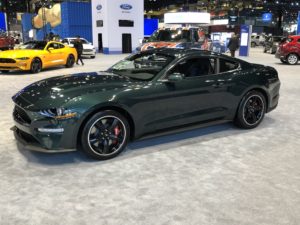
Mustang Bullitt
Mustang Bullitt

Seeing the new Bullitt Mustang, with its signature dark green paint and blackout grill, I felt a certain ambivalence.  To someone who remembers seeing the movie in a first-run theatre (when the Mustang and Charger were new cars and everyone was talking about the chase scene), it seems almost cloying for an automobile so overtly to invite its purchaser to pretend being someone else.   That said, at least it pays homage to one who bought his car for performance.  Frank Bullitt was not an SUV man.

The model Ford really promoted in Chicago was the Ranger, its new-to-the-United States and smaller-than-an-F-150 pickup.  Ford has been selling this vehicle in other markets for many years, after discontinuing the original Ranger small pickup in 2011.    Back then, the cost difference between a Ranger and an F-150 made the Ranger a tough sell.    The market for the Ranger has returned, though, as the cost of the F-150 has escalated with every model year and thereby opened a market for a less expensive truck.  Toyota filled that gap with the Tacoma.  Ford will try to claw back some of that market by producing the Ranger for the home market.  (Trivia Question:  what Ford Motor Company product first used the “Ranger” name?  Answer, the 1958 Edsel Ranger.)
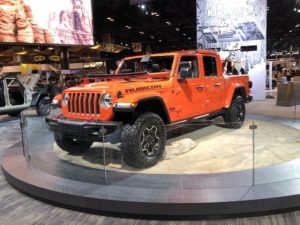
Jeep Gladiator
Jeep Gladiator

Another entry into the smaller pickup field is the Jeep Gladiator, though with a distinctly Jeep emphasis on off-road capability.  The Gladiator – another ‘everything old is new again’ renewed nameplate (it was used from 1962 through 1988 for a conventional pickup based on the original Wagoneer) – claims to have best-in-class towing and payload capacities.  It can be configured as an open vehicle by removing the doors and roof.
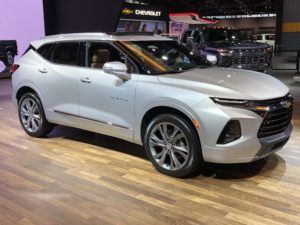
Chevrolet Blazer
Chevrolet Blazer

Chevrolet displayed Corvettes and Camaros, but their show stars were the new Blazer and 2020 Silverado 2500HD.  Previous Blazers (later the Trailblazer) were SUVs derived from trucks – full-size at first and then based on the S-10 small truck line.  Chevrolet dropped those vehicles in 2009 when it introduced the Traverse.  The new Blazer is a unit-body crossover with no pretention to be a truck.
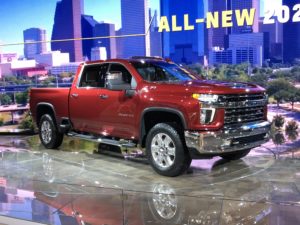
Chevrolet Silverado 2500 HD

The Silverado 2500 HD is the vehicle General Motors is counting on to keep the company’s profits lush.  As the Chicago show opened, GM announced a fourth quarter 2018 operating profit of $3.4 billion – almost entirely from the sale of trucks in the United States.   General Motors, under CEO Mary Barra, has abandoned its previous focus on sales volume in favor of focusing on profit per vehicle.  General Motors’ profits from selling pickups in the United States more than offset the decline of profits in China (which dropped in that period to only $300 million).  Selling trucks in the United States is what makes money for General Motors today and their Chevrolet display at Chicago reflects that reality.
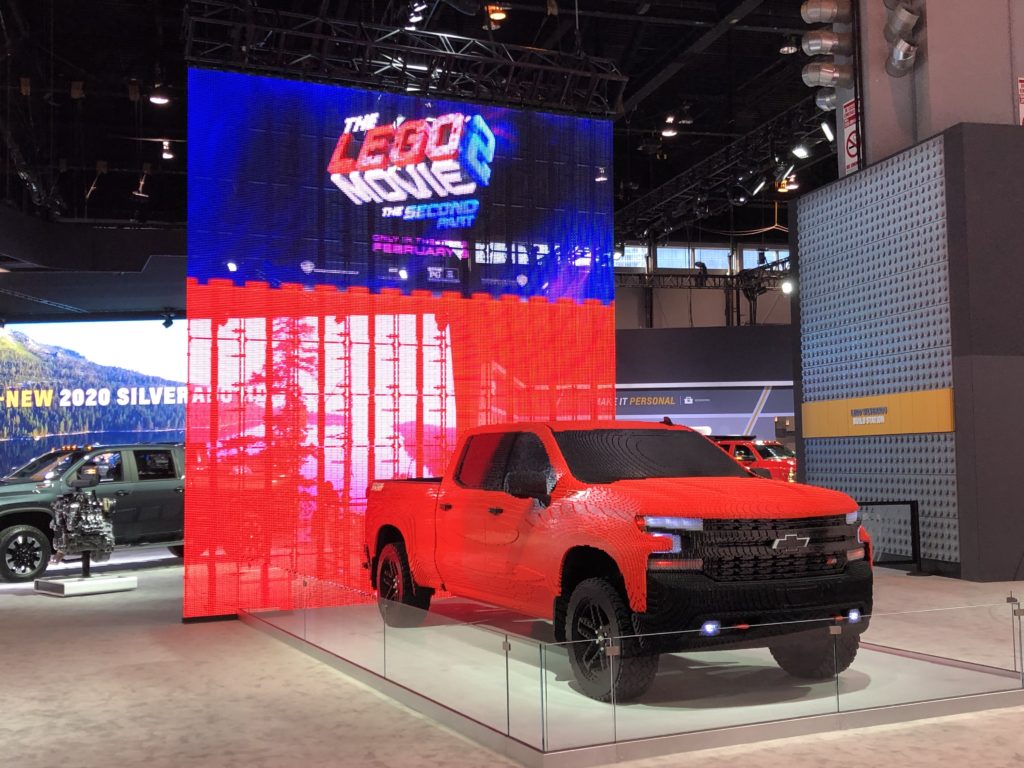
Lego Silverado
Lego Silverado

There was also a bit of whimsy at the Chevrolet exhibit.  They not only showed the new Silverado 2500 HD in shiny splendor, but in Lego®.  According to the statistics, the 2500 HD on display constructed of Legos® was built from 334,544 individual bricks, requiring the efforts of 20 “trained Lego® builders” and over 2,000 hours, primarily using red 2 X 8 stud bricks.

Towing and load capacities were not provided.
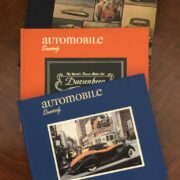
REDISCOVERING AUTOMOBILE QUARTERLY

Automobile Quarterly issues - Rediscovering Automobile Quarterly
Automobile Quarterly issues

There once was a magnificent publication named Automobile Quarterly.  Four issues per year, hardbound in leather.  The subscribers name could be embossed in gold leaf on the front cover.  Inside the covers were photography and paintings by the finest automotive artists, articles by the most distinguished automotive writers, and first-person accounts by people who had made the automotive history about which they wrote.  The subtitle of the publication summed its content perfectly: “The Connoisseur’s Magazine of Motoring Today, Yesterday, and Tomorrow.  If you missed it when it’s published, now is the time for rediscovering Automobile Quarterly.

The publication stayed true to its promise for fifty years – and then it ended.  Volume 52, number 1 was the last issue.  Automobile Quarterly, after ownership changes and the death of its founder, faded away.

Fast forward to now.

It is hard to avoid hearing about the “Volo Auto Museum” in Volo, Illinois.  It advertises widely for both the museum and its classic car sales room.  We thought a trip to the museum would be a great way to spend a day.  There was even a bonus:  an enormous antique mall is located adjacent to the museum.  While the lure of old cars captivates the present writer, the appeal is rather less for his devoted spouse.  But antique malls – that’s a different story.  With the prospect that time in the museum would be rewarded by time browsing antiques, the expedition was a go.

The Volo museum is mostly a collection of automotive celebrity and movie cars, but not really attuned to core interests of those intensely interested in automobiles or their history.  On display are the Bentley convertible Oprah drove in the rain with the top down, the Rolls-Royce stored for the next visit by Princess Diana  – a visit that never occurred, one of the many “General Lee” Dodge Chargers used on in the Dukes of Hazard on television, a Volkswagen “Herbie” used in the Disney movie, a “Back to the Future” DeLorean – you can visualize the rest.  Mostly, Volos’s museum is an adjunct to a collector car sales operation that seems to specialize in vehicles with optimistic price tags.

The antique mall, however, is the real deal.  Several large buildings offer an enormous variety of antiques.  We’ve returned to Volo twice, but not for the museum.  We go back for the antiques.  On one visit, the treasures brought home included a state-of-the-art automotive diagnostic instrument – state- of-the-art for the 1960’s, that is.  Quite perfect to use when performing a tune-up on the 1966 Riviera.  Another trip yielded a book canvasing William Harrah’s collection of classic automobiles, a collection that included two Type 41 Bugatti’s.  Harrah died in 1978 and is considered by many the man who most advanced the art of restoring classic automobiles to be factory correct in every detail.

Think of antique malls as the place to go for automotive “barn finds” that aren’t cars.

The most recent expedition uncovered eighteen issues of Automotive Quarterly, dating from Volume 3, purchased for $90.00.

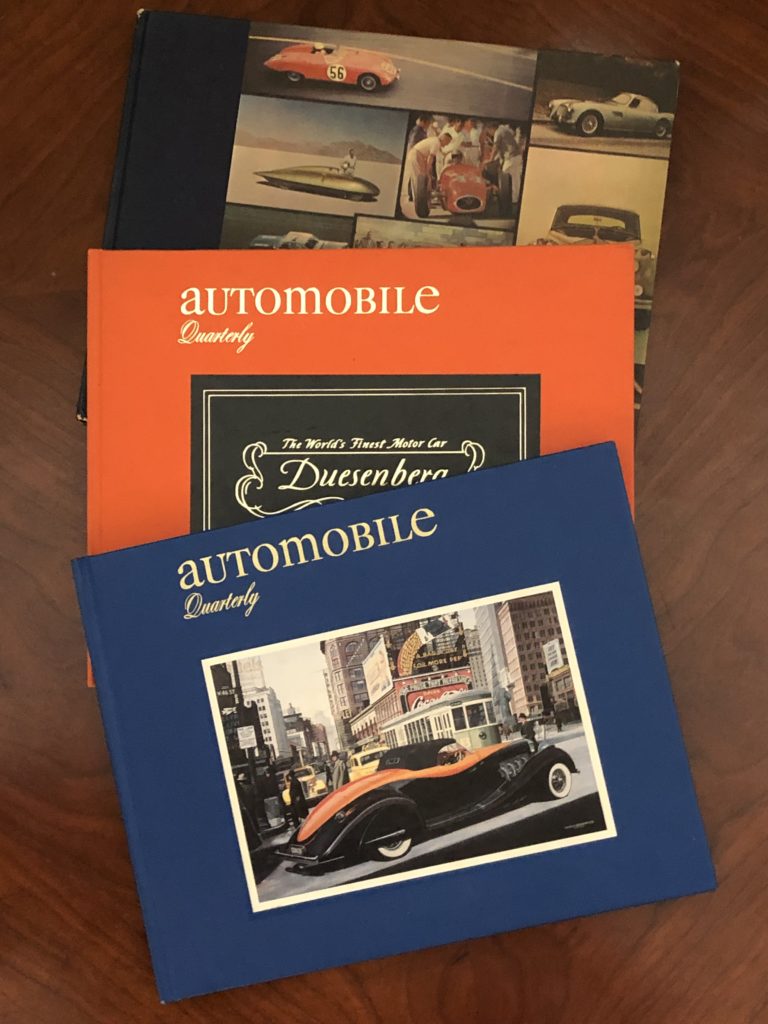
If you have not discovered Automobile Quarterly, you should.   It is automotive journalism, automotive history, and automotive art by those of an intimacy and quality seldom found in a periodical.   The very first issue – Volume 1, number 1 – featured Duesenburg.   This was a marque to which the publication returned often, including Volume 30, number 4.  That issue opened with a biography of Fred Duesenburg written by Randy Ema.  Ema holds eight class wins at the Pebble Beach Concours elegance and is a historian with vast knowledge of Duesenburg history.  (Hagarty.com once referred to him as the “Ph.D. of ACD.”)  A biography of August Duesenburg is next, followed by an extensive history of each Duesenburg model – A, J, and SJ – and of the brothers and the company, including the Duesenburg racing history.

Caracciola article
Caracciola article

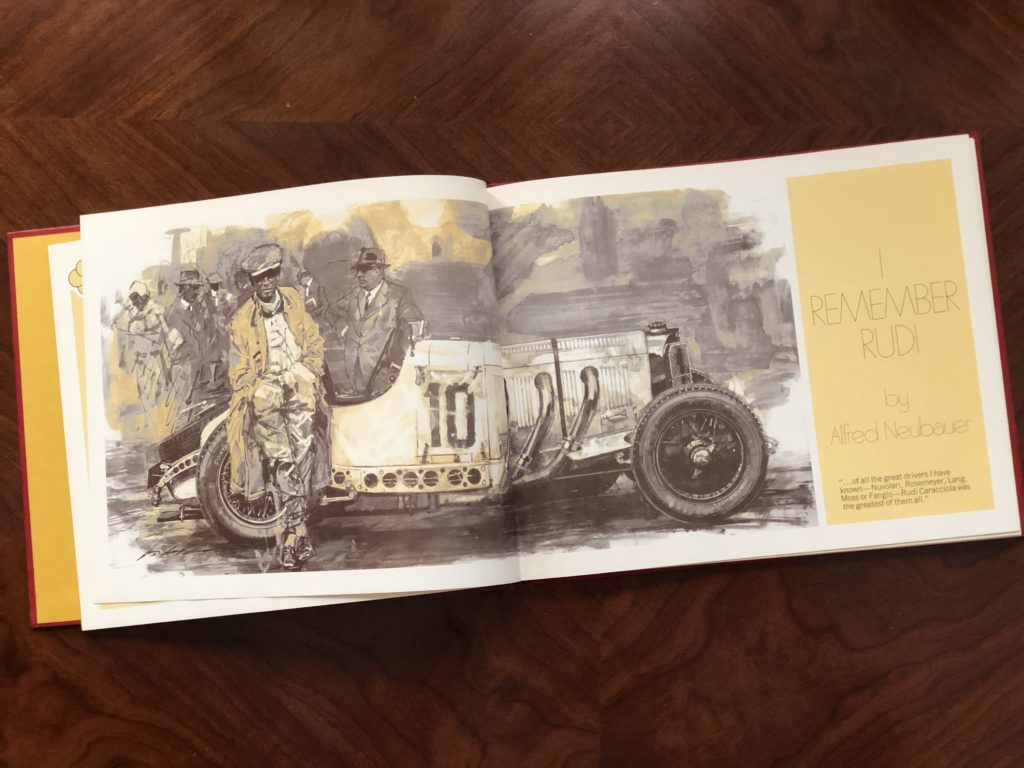
Automobile Quarterly focused on people as well as automobiles. An example is Volume 7, number 1.  The painting embedded into the leather cover is of Rudolph Caracciola, legendary driver for Mercedes-Benz Grand Prix teams of the 1920’s and 1930’s.   A driver with exceptional skill, particularly on a wet track, Caracciola won multiple world championships.  Perhaps his greatest accomplishment was surviving, as he drove in an era when Grand Prix race tracks were lined with trees, driving suits were silk, and crashes quite often fatal.  The featured article is a remembrance written by Alfred Neubauer.  Neubauer knew details of Caracciola’s career as few could.  He was the team manager for the Mercedes-Benz Grand Prix team during the years Caracciola drove for Mercedes.  Neubauer’s racing biography of Caracciola is followed by one from a different perspective.  It is written by Alice Hoffman, the glamorous time-keeper for the Mercedes team.  She ultimately married Caracciola (though she’d been close to Louis Chiron, the Bugatti driver after whom that marque’s latest model is named, before meeting Caracciola).  She shares insights that display Caracciola’s fearless tenacity in racing and how their mutual devotion to each other sustained Caracciola through some of the most difficult times in his career, including recuperating from crashes that left him hospitalized for months.

Next is an article written by another Grand Prix champion, Phil Hill.  Truly appreciating the talent, skill, and courage required to win in a Grand Prix race car of the 1920’s and 1930’s requires understanding how difficult it was to drive those cars at racing speeds.  Hill explains what it is like to drive the Mercedes-Benz SSK, the supercharged supercar of its era in which Caracciola got his start with the Mercedes-Benz team.  The issue also features paintings by Walter Gotschke, one of the most prominent automotive artists of any decade, illustrating Caracciola behind the wheel on some of the most legendary European circuits of the pre-War years.

That is merely the first half of that volume.   The volume also includes a retrospective by Howard “Dutch” Darrin’s describing his years as a designer of automobiles, first of bespoke bodies for cars now considered classics (including is partnership in Paris with Tom Hibbard as Hibbard and Darin) and later custom automobile bodies for Hollywood celebrities and production automobiles, including the Kaiser-Darrin.  It is a genteel tale of self-promotion that was frequently successful and always entertaining.

Automobile Quarterly captured those who made automotive history recounting events that were still vivid in their memories.  Part of its charm is that classic automobiles were then still tangible as automobiles created to be driven.  Those who wrote about them experienced them as automobiles, not static investments.  They write about them as automobiles experienced and enjoyed.

Automotive Quarterly is out of print, of course.  But it is still very much available – and at a nice discount to the original subscription price.  If searching antique malls isn’t your thing, then eBay is your friend – even full sets of Automotive Quarterly are available online.   Individual copies seem to average about $5.00.

Rediscovering Automobile Quarterly is habit forming.  Once you start, you’ll probably want to collect them all.

I do.

UPDATE:  New back issues of select volumes of Automobile Quarterly are available through the website of the Society of Automotive Historians.  This appears to be the last cache of unsold Automobile Quarterly issues extant.


GM BACKS DOWN

Cadillac CT6 Platinum (Cadillac photo) - GM Backs Down
Cadillac CT6 Platinum (Cadillac photo)

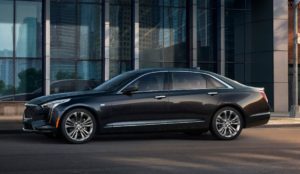
GM backs down: the latest news is that Cadillac will continue making Cadillacs.  According to the blog GM Authority, quoting Automotive News, GM president Mark Reuss now says that General Motors will not terminate production of the Cadillac CT6 for sale in the United States.  Moreover, Reuss claims that General Motors essentially misspoke when it announced in December that CT6 production would end in the middle of this year.

According to Reuss, the CT6 production will be moved from the Hamtramck plant where it is currently produced to another plant, yet to be determined.  (He also said that production in China for import into the United States is the least attractive option under consideration – a comment which must go down as one of the most remarkable understatements ever.)  According to Reuss and Cadillac President Steve Carlisle, cancellation of the CT6 in the United States was never part of the plan for revising GM’s model lines and closing manufacturing facilities.  They claimed that the announcement that  CT6 production would end was a result of poor communication within the company.

2019 Cadillac CT6 (Cadillac photo) - GM Backs Down
2019 Cadillac CT6 (Cadillac photo)

Maybe.  But if that’s true, it does not say much for the ability of top brass at GM to communicate clearly to their subordinates.  It also doesn’t explain why it took Reuss and Carlisle a month to set the record straight.  GM backs down seems to be more accurate than the explanation company executives are providing.

The likely reason is that Cadillac dealers were not happy.   The CT6 has been a slow seller, as our earlier article detailed.  (GM now says this is good – the current CT6 inventory is large enough to supply demand until a new plant is in production.)  But with neither the XTS nor the CT6, Cadillac dealers would have no large sedan to sell to their traditional clientele.  Without the XTS to undercut it and with the new V-8 in the top-tier CT6 models, continuing the CT6 will still provide Cadillac dealers a halo sedan to offer to those customers.

Or, maybe, Reuss and Carlisle simply read or previous post “Cadllac Without a Cadillac.”