HOW THREE FAILING CAR COMPANIES KILLED THE RUXTON – PART TWO

The Ruxton - the Car Killed by Three Failing Car Companies
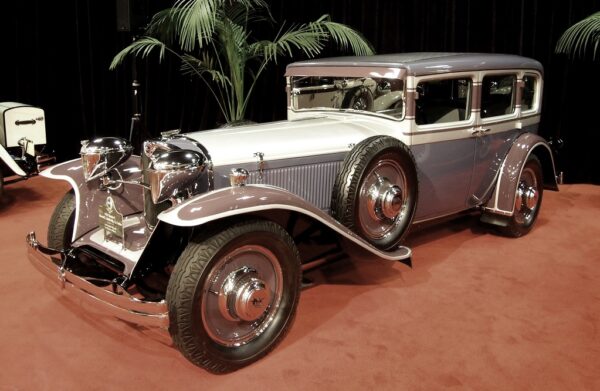
Ruxton Sedan

Moon was the second of three failing car companies that killed the Ruxton.  The Historic Vehicle Association profile of Moon says it was “faced with dwindling profits and further resistance from New Era Motors’ Archie Andrews who requested Moon begin building a more expensive luxury vehicle to be known as the Ruxton.  Forcing the car into production and seizing control of the company, Andrew’s actions weakened the leadership of the Moon Motor Car Company.”

Not true – or even close to true.
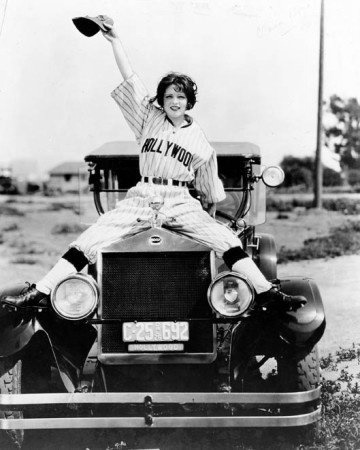
Hollywood Actress Clara Bow and a Moon circa 1923

In 1923, Moon had 500 dealers nationwide, serviced by distributors in 75 cities.  It built assembled cars, sourcing components from others instead of building its own and was a success.  But this business model ultimately put Moon at a disadvantage.  With higher component costs than integrated manufacturers, Moon was unable to afford the technological innovations necessary to stay competitive a maturing automobile market.  Then, in 1925, it introduced the Diana, a lower-priced eight-cylinder model targeting female customers.

Initially, the Diana was a success.  Moon’s sales for 1925 were 10,271 automobiles.  But then the warranty claims began flooding in.  The cooling system Moon had designed was inadequate to cool the Diana’s engine, sourced from Continental.  Engines over heated and damaged piston rings.  Moon’s warranty costs tripled, and the company’s reputation suffered lasting damage.

Moon’s management then chose to undercut the its own distributors – the businesses that were the company’s real customers and had carried primary responsibility for promoting the Moon brand.  In January of 1926, Moon announced it was bringing distribution of Moon automobiles in-house.  Company owned distributors were established in major cities, including New York, Chicago, Atlanta, Kansas City, Milwaukee, and San Francisco.  Its largest, most successful distributors were dropped.

Moon lost almost $1 million in 1926.  About two-thirds of that – $624,060 – were losses from operating its company owned distributors.  Moon abandoned company-owned distribution midway through 1927, but it continued losing money: $148,000 in 1927, $338,000 in 1928, and $277,000 in 1929.  By 1929, its total production had collapsed to 1,333 automobiles.

Today, we would recognize Moon Motor Car Company as a classic takeover target.  It had assets but could not cover its operating costs.

In November of 1929, the Chairman of Moon’s Board of Directors, Stewart McDonald, agreed with Stanley Moon, who was both a company officer and McDonald’s brother-in-law, that McDonald would engineer a loan to Moon Motor Car Company from Archie Andrews if Stanley Moon would help McDonald divorce Grace Moon.  (The divorce was granted the next year.)  Andrews did not make a loan to Moon.
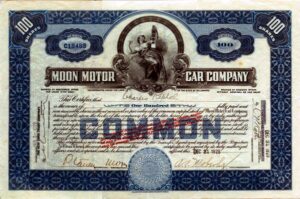
Moon Motor Car Company stock 1928

Instead, Andrews negotiated a production agreement with Moon.  Under the agreement, New Era assigned Ruxton production rights to Moon.  Moon issued 150,000 shares of Moon stock to New Era and agreed to issue another 100,000 shares that would be sold on the open market to finance manufacturing the Ruxton.  Nothing in the agreement precluded Andrews from acquiring that 100,000 shares – and he did purchase most of them.  Andrews and New Era then owned 239,000 of the 350,000 total outstanding shares of Moon stock.
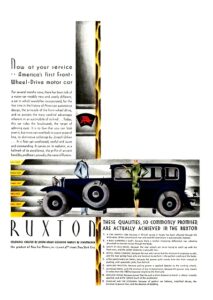
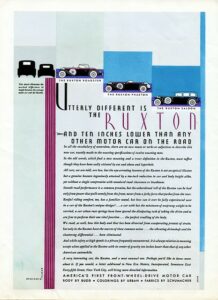
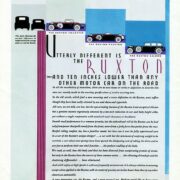
1930 Ruxton advertisement in Life Magazine
Ruxton advertisement in Life Magazine

Archie Andrews was serious about building the Ruxton.  He worked to build a market for it, promoting it with full-size multiple page advertisements in Life Magazine, then one of the most popular weeklies in the United States.  He engaged Joseph Urban to design color schemes that accentuated the inherent lowness of the Ruxton’s design, simultaneously calling attention to its unique design and setting it apart from ordinary automobiles.  He had no reason to trust the success of his dream car to Moon’s inept, self-dealing management.

Moon’s management had not anticipated that New Era would end up controlling the company.  They refused to recognize the new owner’s rights and barricaded themselves inside the Moon factory.  They were evicted by court order.
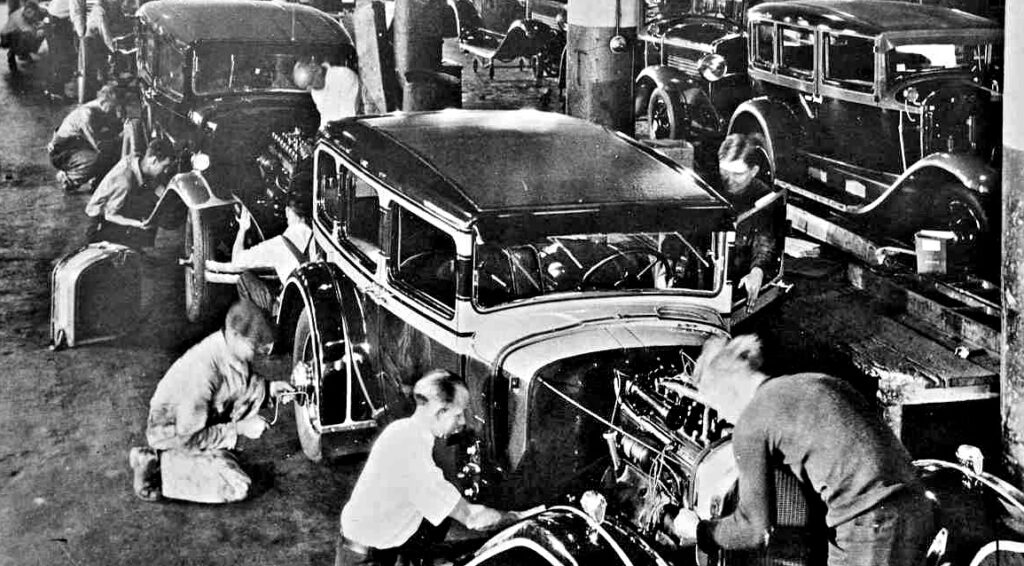
Ruxton production at Moon plant

According to Muller’s later comments, New Era then discovered the Moon factory was in much worse condition than its management had led Andrews and New Era to believe.  Moon’s plant completely lacked the ability to produce the transaxle that was the Ruxton’s key component.

This led Andrews to the Kissel Motor Car Company.

Kissel, too, was a company with no future.

Kissel was the third of three failing car companies that killed the Ruxton.
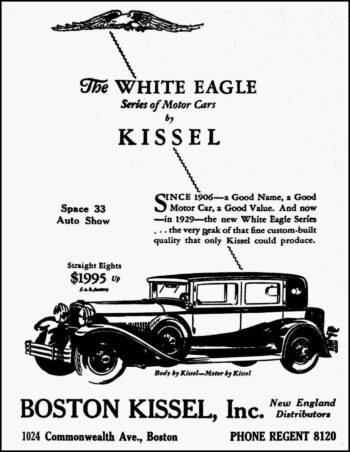
1929 Kissel advertisement

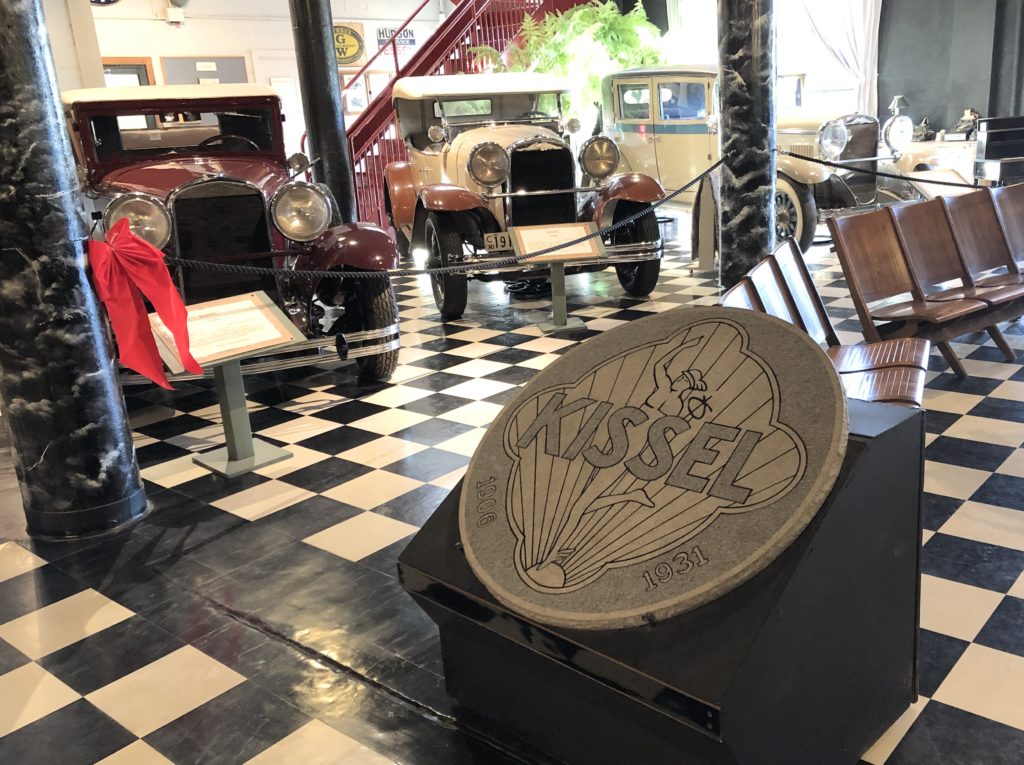
Organized in 1906, the Kissel Motor Car Company was owned by the Kissel family.  Kissel had produced some glamorous models: the “Gold Bug,” a high-priced roadster that is today considered a full classic, is the most famous.  However, in its best year Kissel had manufactured only 6,000 automobiles and sales had been declining since the mid-1920’s.  A 1929 redesign had not helped.  Kissel began producing taxicabs and funeral cars, but that had not been enough to return the company to a profit.  In early 1929, Kissel had been forced to borrow $200,000 at a higher-than-market interest rate to finance continuing operations.

What Kissel did have was the ability to manufacture the Ruxton transaxle.
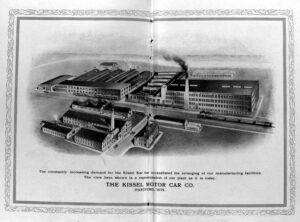
Kissel Motor Car Company plant

After an initial agreement with New Era, the transaxle tooling was moved to Kissel’s plant.   The Moon plant, however, was in dismal condition.  It made sense to tap into Kissel’s plant capacity by contracting it to build the entire automobile, not just the transaxles.  That would give New Era two assembly plants, spreading its bets.

In March of 1930, New Era reached an agreement for Kissel to manufacture the Ruxton.

The terms of that agreement display Kissel’s desperate financial condition.  George Kissel, who was president of the company and personally guaranteed the contract, was literally betting the company on its 1930 sales.

In exchange for an immediate $100,000 loan from New Era and a commitment for another $150,000 loan to be made later, Kissel agreed to produce 1,500 Ruxtons annually, contingent only upon the market being able to “absorb” that volume.  This portion of the agreement was one-sided.  It committed New Era to nothing.    Kissel was promised that it could produce 1,500 Ruxtons per year only if New Era could sell them.  New Era, however, was not promising it would, or could, sell them.

Kissel, in contrast, was making a very important and risky commitment.  In the agreement, Kissel guaranteed it would produce five Kissel automobiles, one funeral car, and one taxicab daily for the remainder of the year.  Should Kissel fail to meet these terms, the Kissel family agreed to assign their common stock in the Kissel Motor Car Company to New Era in exchange for preferred shares of New Era stock.   Common stock votes.  Preferred stock does not.   If this clause were triggered, the Kissel family would be required to give control of Kissel Motor Car Company to New Era and Archie Andrews.
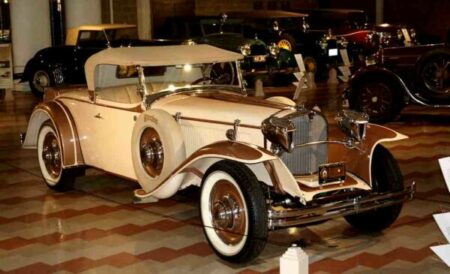
Ruxton roadster manufactured by Kissel

One-sided though it was, the terms of this contract were entirely reasonable from New Era’s perspective.  New Era was not acquiring Kissel.  It was hiring Kissel to build cars for New Era.  New Era would need to build a dealer network simultaneously as it ramped up Ruxton production.  Kissel’s plant was mortgaged.  New Era needed to be sure Kissel could support itself until Ruxton production was able to support it.  If Kissel failed to pay its mortgage, it would be out of business and the Kissel plant would go to its creditors.  The production quota clause clearly was intended to allow New Era to take control before Kissel collapsed.

George Kissel lost his bet.

Kissel had produced only 1,071 vehicles in 1929.    To meet the terms of the agreement, Kissel would need to produce more than 1,300 Kissel automobiles, taxicabs and funeral cars during the remainder of 1930, in addition to any Ruxton production.

Kissel produced only 261 automobiles in 1930.

By September of 1930, unable to meet the mortgage payments on its plant and facing foreclosure, Kissel invited a friendly receivership, a form of state court reorganization for the benefit of creditors.  With Kissel in receivership, Ruxton transaxle production ended, forcing Moon to stop production.  Within two months, Moon was in receivership and New Era had filed for bankruptcy.  New Era’s largest creditor was Archie Andrews and his investment company.

Andrews did not kill Kissel.  At George Kissel’s direction, Kissel committed hari-kari.

George Kissel blamed Andrews for the failure of the company because New Era had not made the further $150,000 loan.  Andrews claimed New Era could not raise the money in the dismal 1930 stock market.

Neither claim stands up to scrutiny.

George Kissel oversaw the Kissel Motor Car Company right to the end.  The decline of the company was the fault of its management, not Archie Andrews.   Kissel had already run through the $100,000 loaned by New Era in March.  Six months later, it couldn’t pay its mortgage.  Loaning Kissel another $150,000 would have provided funds for a few more mortgage payments, but Andrews and New Era were going to get the company on December 31st – regardless.  There was no chance Kissel could meet the production commitment of its agreement with New Era.

However, there is no reason to believe Andrews could not have raised the money required of New Era in its loan commitment to Kissel.  Andrews claimed he lost a fortune in the “crash” and rebuilt it later – but that’s not the same as saying he wasn’t still wealthy or that he didn’t have access to funds.  He may have lost a lot, but he still had a lot.  He was spending almost as much on annual upkeep for his yacht as New Era had promised to loan to Kissel.

So, why did Andrews let Kissel fold?

Had New Era made the loan, it could have prevented foreclosure.  No receiver would have taken possession of the Kissel plant.  That plant and its equipment would have come under New Era’s control as a result of Kissel failing to meet the production quota clause.  New Era would have had everything needed to assure production of the Ruxton.

So, why didn’t New Era make the loan?

It may be that George Kissel outsmarted and blindsided Archie Andrews.  By arranging the receivership, George Kissel ultimately retained family control of the company.  As it would develop, the court-appointed receiver would bring George Kissel back to run the company in receivership.  George Kissel would ultimately reorganize the company and buy its assets out of that receivership.  The company would survive under family control, though not manufacturing automobiles.  (For more about Kissel, see our post about the Wisconsin Automotive Museum in Hartford, Wisconsin.)

It may also be that Archie Andrews elected to cut his losses.

Andrews had been assessing markets since he first sold unlisted securities at age 21.   He had seen the opportunity presented by the Budd prototype in 1928.  When he had organized New Era in 1929, the country was prosperous, the market for new automobiles was strong, and front wheel drive was the technology of the future.

But the six months between March and September of 1930 had destroyed any hope that the economy would soon recover its former prosperity.  Unemployment had almost tripled.  Gross national product would fall 9.4 percent for the year.  Automobile sales were dropping drastically.  Ford sales dropped 25% in 1930 and would drop almost 50% more in 1931.  Packard sales dropped from 47,855 in 1929 to 34,445 in 1930.
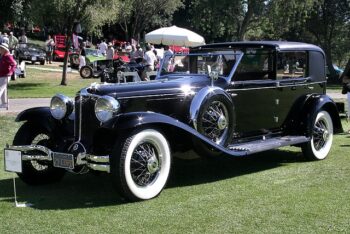
Cord L29 Town Car by Murphy - note the running boards, unneeded on the Ruxton
Cord L29 Town Car by Murphy – note the running boards, unneeded on the Ruxton

The time for the Ruxton had passed before Andrews could bring it to the market.  Auburn had introduced the Cord L-29 in late 1929 and publicity associated with the model’s poor traction on hills was dimming the luster of front wheel drive.  Established manufacturers of higher priced automobiles were struggling and New Era still did not have a dealer network.  It was even less likely to find one now.  Pouring another $150,000 into Kissel to save the Ruxton would have been wasting the money.  The Ruxton was no longer a viable business proposition.

Archie Andrews made no effort to rescue New Era or the Ruxton from the consequences of Kissel’s collapse.  The delays caused by three failing car companies had killed the Ruxton.

He moved on.

But he didn’t forget about Hupp.

In 1934, Archie Andrews attempted to take control of the Hupp Motor Car Company and oust its management.  He was elected Chairman of the Board of Directors.  Despite Andrews having substantial shareholdings in Hupp, the existing management fought him with a vigor they had not once exhibited toward selling Hupmobiles.

Claiming to represent all other shareholders, J. Walter Drake – who was one of Hupp’s original investors and its former President – filed a class action lawsuit in March of 1935 against Hupp and Andrews.  Drake was, however, really a stand-in for Hupp’s management, including DuBois Young.  As Hupp’s president, Young had presided over the collapse of Hupmobile sales while the company’s accumulated losses reached $15 million.  Nonetheless, Drake had the audacity to claim Andrews had impaired Hupp’s credit, causing suppliers to accept cash only.   Drake also claimed Andrews was guilty of self-dealing because Andrews had arranged, as part of his compensation, stock options contingent on Hupp achieving profits for a period of six months and again when profits exceeded a total of $1 million.

Today, of course, stock options based on performance are a normal form of executive compensation.  Certainly, Hupp was risking nothing in the deal with Andrews – he either sold cars or he didn’t get the stock.  But Hupp’s management wasn’t interested in selling Hupmobiles.  They were only interested in preserving their positions.  They did not want to run the risk that Andrews would meet the option terms and increase even further his holdings of Hupp stock.

It was a classic example of entrenched management fighting a takeover and dooming the company in the process.    The federal appellate court, nonetheless, ruled for Drake and his colleagues, stating that “[t]he history of Hupp and its management prior to the time the [lawsuit] arose  .   .   .  [is] beside the point.”  It held the contracts with Andrews were not properly ratified by the board of directors because the notice of the special meeting of shareholders approving them was not sufficiently specific to satisfy requirements in Hupp’s articles of incorporation.  The court’s decision put the old management back in charge of Hupp.
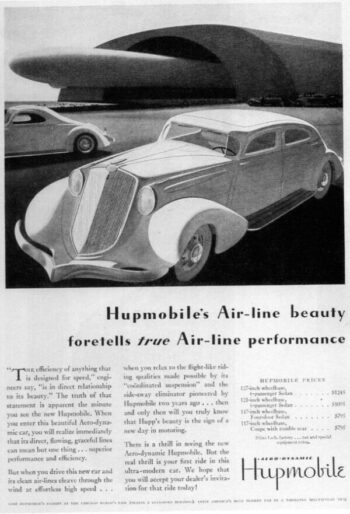
Hupmobile Aero-dynamic advertisement

With these people back in charge, Hupp continued its death spiral.  Hupp again hired Raymond Lowey to design a new “Aero-Dynamic” Hupmobile for 1934.  It did not sell.  The 1935 model did no better.  With the company’s cash exhausted by years of losses, Hupp was forced to sell plants and other assets in 1936.  It again redesigned its models for 1938.  However, Hupp’s dealer network had dissolved.  It sold only 1,886 Hupmobiles.  Hupp joined with Graham in 1939 to produce an automobile using Cord 810/812 tooling, but only 319 of these Hupmobile Skylarks were manufactured, assembled in the Graham plant.

Hupp was out of the automobile business.

Archie Andrews did not kill Hupp.  Hupp’s management, led by DuBois Young, “ran it into the ground.” They missed their golden opportunity by rejecting the Ruxton and blew their last chance by fighting Andrews.  Hupp died in the depression.  But the cause of death was the company’s management from 1925 onward.

Andrews did not pursue ventures in the automobile industry after Hupp.  He served as Chairman of the Board of Dictagraph Production Company.  In that capacity, he made Dictagraph successful with production of an electric shaver.  Dictograph was sued by Schick Dry Shaver, Inc. for patent infringement in federal court.  As Dictograph’s chairman, Andrews fought the case and won.

After Andrews death, one of the appellate court judges that had decided the Dictograph case was indicted for taking bribes.  The indictment named Andrews as an unindicted co-conspirator with the judge, claiming that he had paid a bribe in the Dictagraph case.  Andrews, of course, had no chance to defend that accusation and the appellate court that rejected the judge’s appeal from his conviction explained that the bribes had not changed the outcomes of any cases.  As portrayed by the appeals court, the judge was engaged in a ”shake-down” scheme soliciting bribes from litigants he knew, as one of the three judges deciding a case, had already won.  He took advantage of the interval between the court’s decision and the time, sometime months later, the decision would be announced.  Andrews certainly had a defense – that he was a victim, not a conspirator.
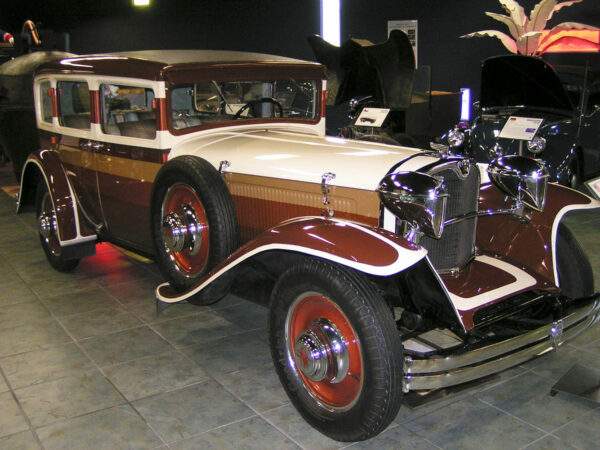
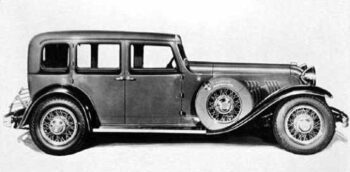
Ruxton sedan with Urban color scheme

Andrews is under-appreciated today.  The Ruxton is his legacy.  The nineteen remaining are full classics, automobiles that provide a vision of what might have been, automobiles ahead of their time, as was the man who tried repeatedly to bring the Ruxton to production.

Archibald Moulton Andrews was a man who saw the future and tried to create it in the present.

He should be remembered that way.


(THIS POST WAS CONTINUED FROM PART ONE.)
HOW THREE FAILING CAR COMPANIES KILLED THE RUXTON – PART ONE

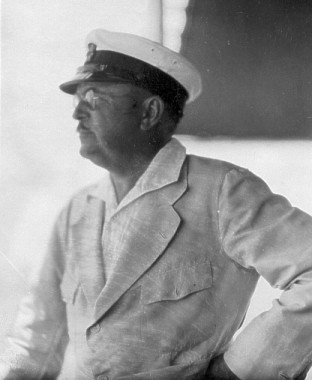
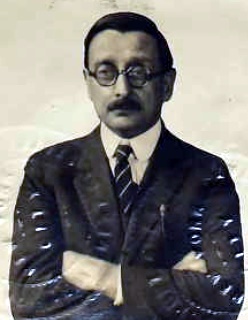
Archie Andrews, the man behind the Ruxton

Reviled as the man who killed Kissel, Archibald Moulton Andrews also is blamed for the destroying Moon and Hupmobile in an ultimately futile quest to build his dream car, the Ruxton.  Writing for Hemmings Classic Car and Hemmings.com, author Jim Richardson called Andrews “a song-and-dance man who fancied himself a carmaker,” but “knew nothing about building and selling automobiles” and “ran into the ground” the automobile manufacturers he controlled.  The New York Times claimed in 2014 that Andrews died a fugitive in Canada and had been convicted of bribing a judge.  In reality, it was the other way around.  Three failing car companies killed the Ruxton.

The New York Times chose to tell a false tale.  Apparently, the Times author did not read the paper’s own obituary reporting Andrews death in 1938 at his home in Greenwich, Connecticut.   Andrews was never convicted of a crime, much less a fugitive.  Richardson, like many others who accuse Andrews of bankrupting these companies, smugly ignores the actual history of these companies and the multiple management mistakes that fatally wounded each of them – mistakes made many years before Archie Andrews became involved with them.

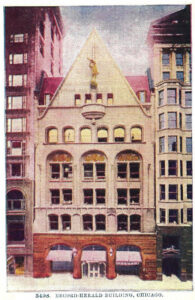
Herald Building in Chicago, where Archie Andrews got his start

Andrews’ life was regarded by his contemporaries as a ‘rags to riches’ saga.  Born in 1879, his first job was selling newspapers in front of the Herald building located in the “Loop” in downtown Chicago, Illinois.  By the age of 21, Andrews was managing the “unlisted” stock department at a Chicago brokerage – “unlisted stocks” being those not traded on recognized exchanges and, thereby, the most speculative.  A year later, Andrews had formed his own brokerage firm.  By 1920, Andrews owned the Herald building, renaming it the Andrews building.

Andrews lived large.  He was a celebrity as comfortably at home on his yacht as he was in the boardrooms of industry.  In 1920, he purchased the 95-foot ketch-rigged sailing yacht Zahma, described by Rudder Magazine in December of that year as having “five staterooms .  .  .  palatially furnished and a beautiful sea home.”

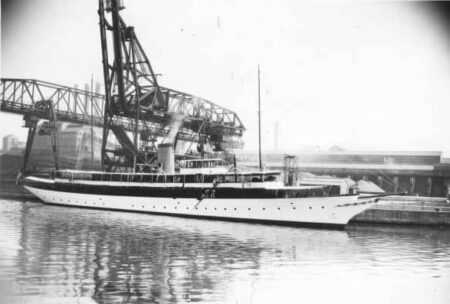
Archie Andrews' yacht Sialia
Archie Andrews’ yacht Sialia

In June of 1929, Andrews bought the 222-foot yacht Sialia from Henry Ford.   Requiring a crew of thirty-six, the press reported in 1932 that operating the Sialia cost Andrews over $137,000 annually.  His eastern residence, “Freestone Castle” in Edgewater Park, Greenwich, Connecticut, purchased in 1929 for $300,000, was an ivy-covered mansion befitting a man of vast wealth.  (More about Henry Ford can be found in previous posts.)
In later years, Andrew’s brokerage firm created an offering that permitted customers to purchase a bundle of one share each in twenty-five different companies – the forerunner of today’s mutual funds.  The New York Stock Exchange promptly established rules prohibiting such bundled sales and Andrews, just as promptly, sued the stock exchange and won.  His fortune, estimated at between $50 million and $80 million before the stock market “crash” of 1929, had been built on the promotion and sales of securities and real estate, with an emphasis on troubled companies.  He claimed to have lost a fortune in the “crash” and made another afterward.

Andrews, however, was not a traditional businessman.

Today, we would instantly recognize Andrews as a “corporate raider,” “activist investor,” or “corporate takeover specialist.”   These investors focus on buying stock of companies that are performing poorly and have depressed share prices that undervalue the company’s assets.  With the leverage their shareholdings provide, they demand management changes, even corporate divestitures, to realize the true value of the underlying assets and increase the value of the stock.

Archie Andrews may not have invented the concept, but he built his fortune in exactly that manner.   He then used that fortune to invest in companies that were very successful, becoming a respected businessman and member of the boards of directors of several large corporations.

One of those was the Edward G. Budd Manufacturing Company.

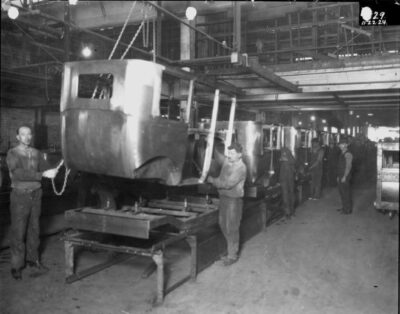
Budd body assembly line in 1924

Today, Budd is fondly recalled by railroad enthusiasts as the manufacturer of the streamlined stainless-steel passenger cars used by Burlington for their Zephyrs and by other rail lines, as well, in the 1950’s and 1960’s.  However, in the 1920’s and 1930’s, Budd’s primary business was manufacturing automobile bodies.  Its customers included Dodge, Willys-Overland, Studebaker, and Chrysler, among others.  Budd’s primary competitors were the Briggs Manufacturing Company and Murray Corporation of America, both of whom had major contracts with Ford.

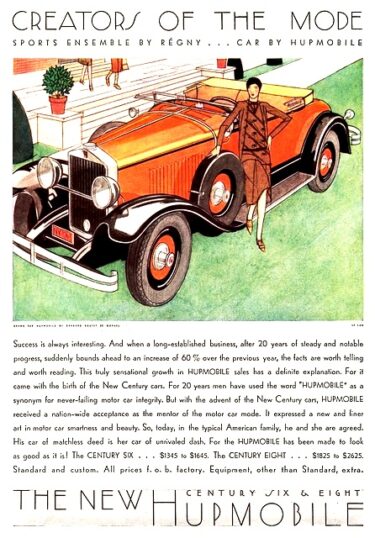
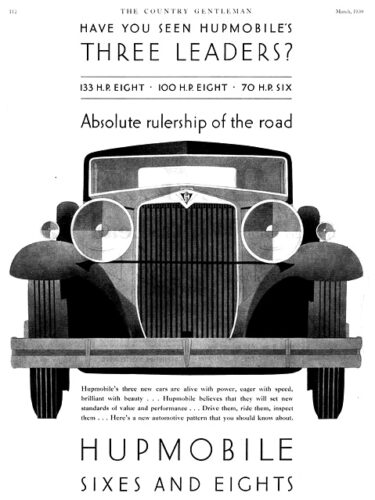
Hupmobile advertisement from the 1920's
Hupmobile advertisement from the 1920’s

Murray also built the bodies for Hupmobiles manufactured by the Hupp Motor Car Company.  In 1925, Murray had acquired Hupp’s in-house body building operation in Racine, Wisconsin as part of a five-year deal making Murray the exclusive manufacturer of Hupp bodies.  However, transporting those bodies from Racine to Hupp’s assembly plant in Detroit eliminated any profit for Murray.  It was obvious by 1928 that Murray’s contract with Hupp would not be renewed on similar terms.

Hupp had been successful in the mid-1920’s, but its management had then made mistakes that caused lasting damage to the company.   In 1925, Hupp introduced new eight-cylinder Hupmobiles and replaced its four-cylinder models with six-cylinder models.  Then, in 1928, Hupp’s management expanded production capacity by acquiring Chandler-Cleveland Motors Corporation and its large Detroit assembly plant.  Hupp’s production reached 65,881 automobiles in 1928.

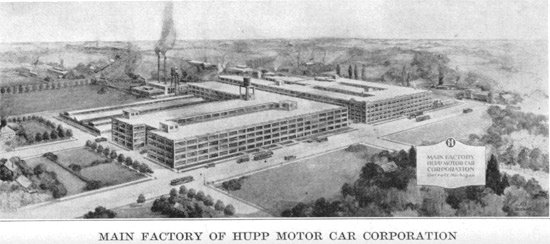
Hupp Motor Car Company main factory where the Ruxton could have been built

But the next year was different.  Even though the automobile industry was booming, Hupp’s production in 1929 dropped 23% to 50,578.  Hupp’s more expensive models had priced many of its former customers out of the brand.  Hupp’s efforts to build sales of its more expensive models backfired on its profits.  Hupmobiles were offered in such variety that economies of scale could not be reached in production of them.  The plant Hupp had acquired now turned out to be too large, saddling it with overhead costs it could not afford on the reduced volume.  After the restyling of the 1928 models was no longer fresh, Hupmobile sales slid, with nothing on the horizon likely to alter the downward trajectory.

In 1928, Archie Andrews was also a member of the Board of Directors of Hupp Motor Company.

Budd, as did its competitors, employed in-house automotive designers and engineers.  In addition to providing design assistance for customers lacking their own design departments, these staff designers and engineers created proposals for entirely new models.  (John Tjarda, for example, designed the “Dream Car” while on Brigg’s staff that ultimately became the Lincoln Zephyr.)  Usually, these designs were only on paper.  But body manufacturers also built running prototypes to more effectively display and promote proposed designs.
In 1926, Budd began developing a front wheel drive prototype automobile.

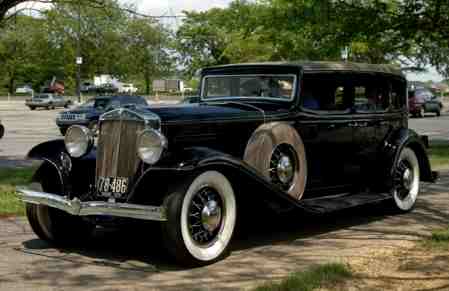
Packard FWD V-12 Prototype

In the mid-1920’s, front wheel drive was an exciting technology seriously considered for future production by several major automobile manufacturers.  Front wheel drive had established itself in racing, where front wheel drive Millers dominated the Indianapolis 500.  In 1925, Packard, the premier luxury automobile manufacturer of the time, signed a $5,000 per year contract with Harry Miller, designer of Indianapolis race cars, to consult on front wheel drive design for passenger cars.  In 1931, with engineering assistance from Cornelius Van Ranst, one of Miller’s engineers, Packard produced a prototype front wheel drive sedan.

Packaging front wheel drive, however, created design challenges.  Locating the transaxle ahead of a straight-eight engine added substantial length to the front of the automobile.   Packard addressed that issue in its prototype by designing a new V-12 engine that was shorter than Packard’s existing in-line eight.  However, Packard’s transaxle design was complex and the unit unreliable.  Unwilling to accept the increasing costs of developing a transaxle that would meet their standards, Packard ended the front wheel drive project.  (The project, however, resulted in one notable success: the V-12 engine designed for the front wheel drive prototype became the production engine in Packard’s most expensive automobiles, introduced as the new “Twin Six” in 1932.  The Packard front wheel drive prototype survived and is one of the automobiles in the private Bahre Collection, located in Paris, Maine.)

Earlier, in 1927, the Auburn Automobile Company also began development of a front wheel drive automobile.  It employed both Miller and Van Ranst, who ultimately was primarily responsible for the transaxle design employed in the Cord L29.  However, the design did not overcome the packaging problem.  The Cord’s transaxle was located ahead of its in-line eight-cylinder Lycoming engine, positioning the engine far back in the chassis.  That, in turn, led to diminished weight over the driven front wheels, causing reduced traction on steep hills.

Designer Joseph Ledwinka

The Budd prototype was brilliant.  Developed through the joint efforts of body designer Joseph Ledwinka and engineers William J. Muller and Earl J. Ragsdale, it  was ten inches lower than an equivalent rear wheel drive automobile – so low that running boards were  unnecessary and were omitted.  The styling was striking, with a rakish forward slant to the roofline and a hood so low that was barely taller than the tops of the front fenders.  (Ledwinka would later design the Citroen Traction Avant, for which Budd built the bodies.  Ragsdale would later patent “shotwelding” stainless steel, making possible those Budd streamlined trains.)

Archie Andrews was quick to see the promise of the Budd prototype.  Murray’s unprofitable contract with Hupp was ending and Hupp needed a new, stylish model with advanced engineering that would leapfrog its competition to stop its sliding sales.  Hupp also had a national dealer network that could successfully promote the car.  As a member of the boards of both Budd and Hupp, Andrews envisioned a perfect combination – one where Budd would build the bodies for the car to be manufactured and marketed by Hupp.

Andrews was undoubtedly correct.

He pitched this proposal to Hupp’s management.

As it would turn out, this to be Hupp’s last chance for survival as an automobile manufacturer.

Hupp’s management chose not to take that chance.   In 1929, Hupp refused to build the Budd prototype.

We cannot know how Hupp’s future would have been affected, had its management accepted Andrews’ plan.  Missed opportunities never display the missed outcome.  But there is reason to believe Hupp could have been successful producing and marketing the Budd prototype as a Hupmobile.  Introduced as a 1929 model in late 1928, despite the onset of the depression and adverse publicity resulting from its inherent traction deficiencies, 5,014 Cords were produced in slightly over two calendar years.   Had Hupp entered the market with their own front-wheel drive model, the technology could have been publicly accepted as the latest technological advance, rather than an isolated oddity.  Other manufacturers, already investing in the technology, would likely have followed Auburn and Hupp into the market, increasing the acceptance – and sales – of front wheel drive automobiles for all manufacturers.

Hupmobile advertisement from the late 1920's
Hupmobile advertisement from the late 1920’s

Instead, Hupp’s sales continued to fall.  Their new models differed little from the 1928 models. By 1931, sales had dropped to 17,450 automobiles.  A fresh design by Raymond Lowey for the 1932 models came too late to make a difference.  Hupmobile sales fell to 10,467 and then fell to 7,316 in 1933.   Hupp offered another Lowey redesign for 1934 in it higher-priced line and introduced a low-priced model using modified Ford bodies built by Murray under license.  Sales increased to 9,420 automobiles.

In the six years after Hupp’s management rejected Archie Andrews plan, Hupmobile sales dropped more than 85%.

In a span of six years, Hupp management, to borrow Mr. Richardson’s phrase in Hemmings, ran Hupp “into the ground.”  As we shall see later, that is where Archie Andrews found it in 1934.

Hupp was one of the three failing car companies that killed the Ruxton.

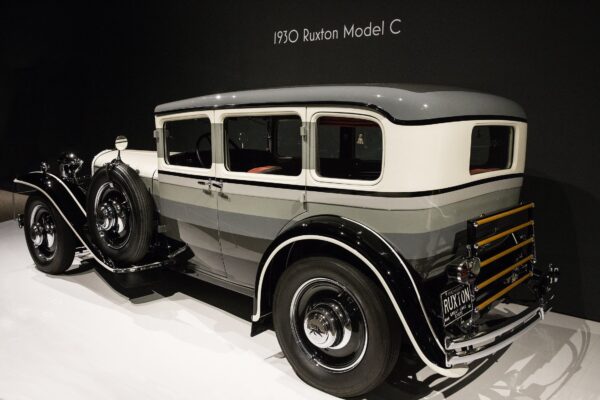
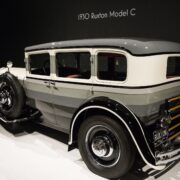
1930 Ruxton Model C
1930 Ruxton Model C

Denied production facilities and a dealer network by Hupp’s management, Archie Andrews formed his own corporation to manufacture the Budd prototype.  The name he gave the company illustrates what he thought of the venture:  New Era Motors, Inc.  The automobile was named “Ruxton,” after one of the initial New Era board members.

Andrews also hired William Muller away from Budd to join New Era and complete production engineering for the Ruxton.

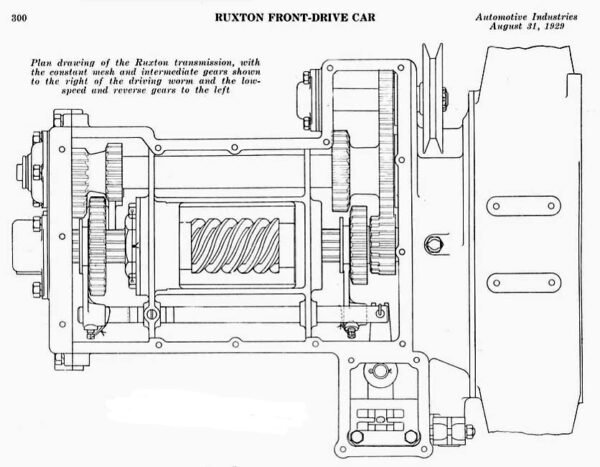
The Budd prototype had the same traction problems as the L29 Cord – and for the same reason: making space for the transaxle ahead of the engine shifted too much weight toward the rear.  Muller solved those problems by designing a unique transaxle.  His design split the transmission, with first gear and reverse ahead of the drive and third and fourth gears behind it, driving through a worm gear and wheel instead of a conventional ring and pinion. This compact transaxle allowed positioning the engine further forward.  As a result, the Ruxton suffered only a three percent traction loss on a fifteen percent grade.

Ruxton transaxle diagram

New Era needed a facility to assemble the chassis and produce the transaxle designed by Muller and it needed dealers to sell the Ruxton.  It had other elements required for production in place from the outset:  Budd would build the bodies and Continental would produce the engines.

In June of 1929, Gardner Motor Company announced it would build the Ruxton.  Gardner had previously contracted with General Motors to produce Chevrolets and its President, Fred W. Gardner, was a member of the initial New Era board of directors.   With its General Motors contract ended, Gardner was left with a plant capable of producing 40,000 automobiles a year, in which it was producing only 4,500 Gardner automobiles yearly.

1930 Gardner front wheel drive sedan

Then Gardner backed out.  The company founder’s son later claimed Andrews had not made the initial payment required.  Maybe – but it appears Fred W. Gardner had taken advantage of his membership in the initial New Era board of directors to plan Gardner’s own front wheel drive vehicle.  It would be announced as a 1930 model.  Perhaps Gardner rejected the Ruxton to avoid eclipsing their own car.  (If so, it did not work out well for Gardner.  The company would voluntarily liquidate its assets and go out of business in 1931.)  Upon Gardner’s withdrawal, Andrews next attempted to reach an agreement with Marmon Motor Car Company.  However,  that agreement depended on an exchange of New Era and Marmon stock.  The 1929 stock market “crash” intervened just as the negotiations were being finalized.  Marmon’s stock lost its value in a matter of days and that deal was stillborn.

Andrews next reached an agreement with the Moon Motor Car Company for production of the Ruxton.

Andrews is accused of destroying Moon, too.

He did not – as we will see in Part Two.

Moon is the second of three failing car companies that killed the Ruxton.

CONTINUED IN PART TWO

PROFESSIONAL CAR SOCIETY CONCOURS D’ELEGANCE

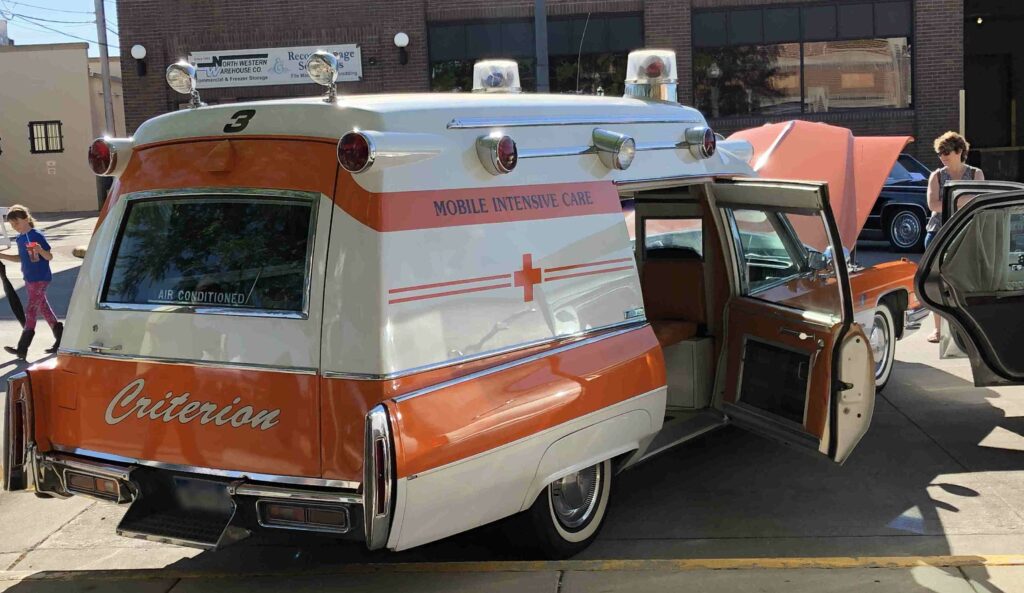
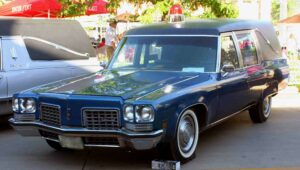
1974 Cadillac Miller Meteor ambulance

Writing almost a decade ago for Hemming Classic Car, an author concluded that “[s}adly, by the early 1930s, the custom coachwork era was ending, and it was all but gone by the time World War II erupted.”  He just wasn’t looking in the right places.   Elegant bespoke bodywork crafted on luxury car chassis, including Cadillac, Packard, and Lincoln, survived the War.  It was constructed by coachbuilders including Eureka, Superior, Sayers & Scoville/Hess & Eisenhardt, Henney, Miller-Meteor, Sovereign, and others.   These are the vehicles shown at the Professional Car Society Concours d’Elegance held in Rapid City, South Dakota, in June in conjunction with the Society’s annual International Meet.   That’s right: hearses, ambulances, and limousines.

The Society’s definition of a “professional car” is “a funeral, livery, or ambulance class vehicle having special coachwork executed on passenger car styling.”  These were, and still are, built by specialty manufacturers.  The most common chassis is Cadillac, largely because General Motors for many years produced a factory limousine, the Fleetwood 75, and companion “commercial chassis” specifically designed for hearses, flower cars, and ambulances.   Even so, professional cars were constructed on other chassis.  In the late 1940’s and early 1930’s, Henney built hearses and ambulances on Packard chassis.

1967 Lehmann-Peterson Lincoln limousine - 8 inch stretch
1967 Lehmann-Peterson Lincoln limousine – 8 inch stretch

In the 1960’s, Lehmann-Peterson – which today constructs Cadillac XTS extended sedans – built executive limousines on Lincoln chassis.   In the 1980’s, as Lincoln attempted to compete more vigorously for the luxury car market, hearses were constructed on the Town Car chassis.   Manufacturers of professional cars also based hearses and ambulances on Buick, Oldsmobile, and Pontiac chassis.

Medical Center Credits

Though hearses are the most common professional car, ambulances are the most colorful.  When these vehicles dominated emergency medical transport, ambulance services were typically operated by private companies and, in many instances, by the same company that operated a funeral parlor.  There was glamour to the ambulance of that bygone era.  In September of 1969, the television drama “Medical Center” debuted on NBC.  The show’s opening credits featured a musical theme mimicking the rising sound of a siren as the television screen showed a 1970 Cadillac ambulance rushing through the city’s streets to the hospital.  (You can watch it on You Tube.)

11974 Cadillac Miller Meteor ambulance
1974 Cadillac Miller Meteor ambulance

Such an ambulance was on display at the Professional Car Society Concours d’Elegance, as pictured at the top of this post.  It is a “high top” – meaning that the roof is elevated above the rear compartment – constructed by Miller Meteor on a 1974 Cadillac commercial chassis.

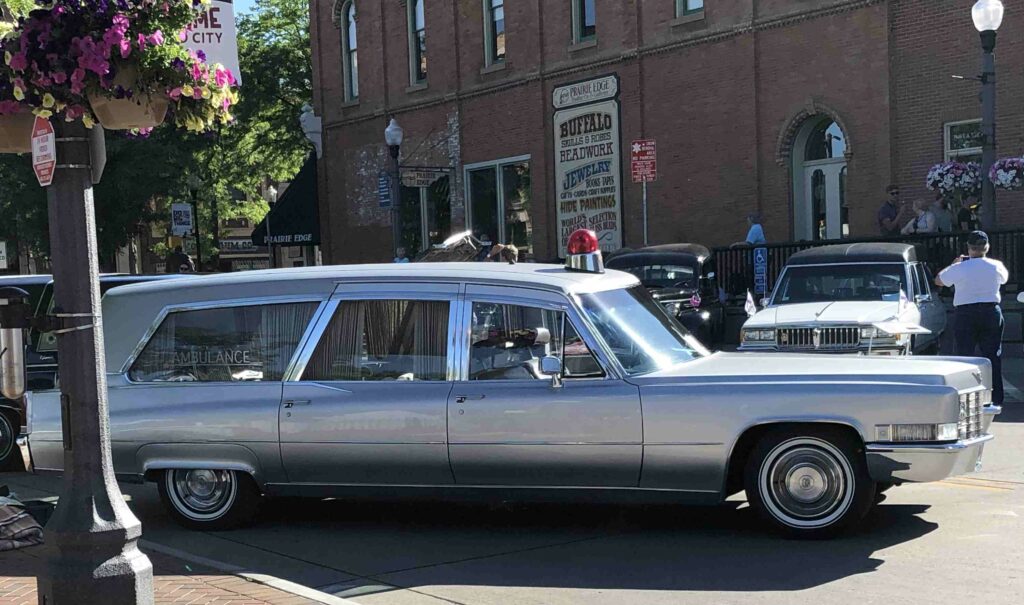
In smaller cities, purchasing and operating separate vehicles for funeral and ambulance service was cost prohibitive.  To meet the needs of that market, companies manufacturing professional cars created the “combination coach,” or just “combination.  This is a vehicle that can be configured as either hearse or ambulance.   Though sometimes painted in the customary black associated with hearses, “combinations” were often painted in other, albeit subdued, colors.  “Combinations” were built “limousine style,” which means the side windows extend the entire length of the vehicle.  Hearses were often built “landau style, with closed side panels behind the rear doors that featured a large landau bar. “Combinations” could be were equipped with rooftop rotating roof beacons that could show red light for ambulance duty or yellow light for funeral processions.

Inside, “combinations” could change configuration quickly.  Configured as an ambulance, the gurney would be positioned to the side, behind the driver.  Seats that folded from the floor or panel behind the driver’s compartment, or could be quickly installed, allowed medical personnel to administer to the patient during transit.  With the seats and gurney folded away or removed, the entire rear compartment could accept a casket in the same manner as a normal hearse.

1969 Cadillac combination coach

The Concours featured two “combination coaches,” including a beautifully presented 1969 Cadillac and a 1972 Oldsmobile 98.

1972 Oldsmobile 98 combinationn coach

1972 was also the year that Jack Webb (famous for the early television series “Dragnet” and later producer of many popular shows, including the police drama “Adam 12”) brought a new weekly series dramatizing emergency medicine to national television.  “Emergency” featured paramedics trained to providing treatment at the scene and able to communicate with hospital emergency rooms while en route with the patient.  These paramedics did not use conventional ambulances on automotive chassis.  They were not merely transporting a patient to the hospital.  They were taking the hospital’s emergency room to the patient.  For that, they needed the space for equipment that could only be provided by an emergency vehicle built on a truck platform.   (The vehicle used in filming the series is now displayed at the Los Angeles County Fire Museum.)

“Emergency” transformed the public’s view of emergency medicine.  Though the emergency medical services depicted in the show were then available in only a few metropolitan areas, demand for similar services developed nationally as the weekly drama demonstrated the life-saving abilities of paramedics.  More and more communities began adding EMTs to fire departments, displacing private ambulance services.  By the end of the decade, the automobile-based ambulance was a part of professional car history.  Reportedly, the last was built in 1979.

The market remained, however, for funeral and livery professional cars.

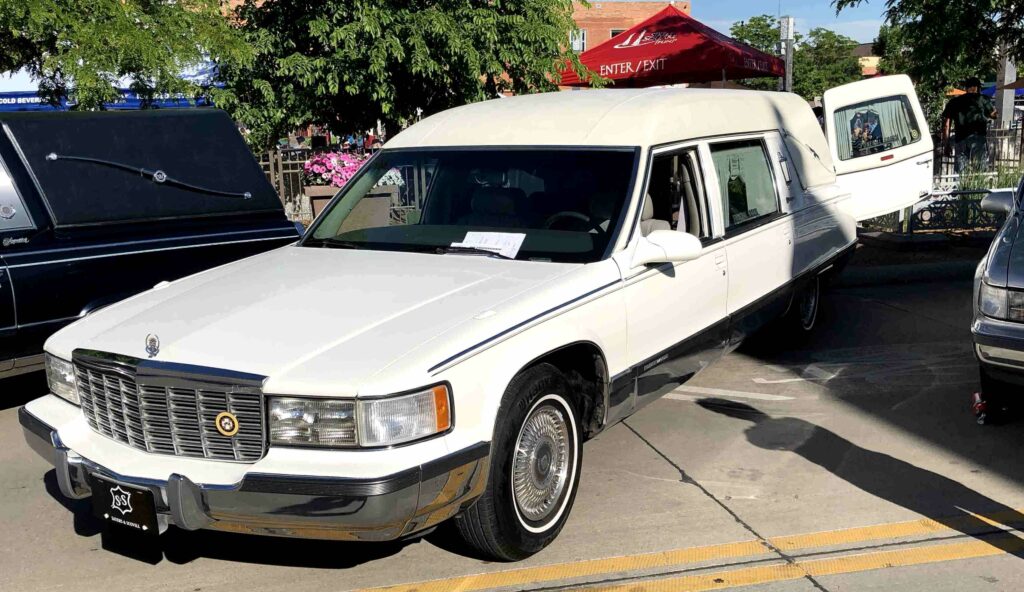
1994 Cadillac Sayers & Scoville hearse

Magnificent examples of these were also shown at the Society’s Concours event.

1972 Cadillac Commercial Chassis

Cadillac traditionally dominated the market for hearses, flower cars, and six door funeral limousines.  Cadillac produced a “commercial chassis” specifically designed to accept professional car coachwork until 1997, when it switched its passenger car line from body-on-frame to unibody construction.  Through 1984, this was a true chassis only – a frame with the engine, transmission, steering suspension, driveshaft and rear axle installed and front bodywork in place – exactly as the classic era marques, such as Duesenburg, Rolls-Royce, Packard and others supplied their chassis to the custom body makers of the day, including LeBaron, Brunn, Rollson, and the others whose passing the Hemmings author mourned.  The front seat, rear fenders, rear bumper and other supplied parts were boxed and shipped with the chassis to the company that would construct and mount the body.  (Prior to 1955, Packard supplied similar commercial chassis to Henney.)

1990 Cadillac Superior hearse

After 1884, Cadillac’s commercial chassis was essentially a completed passenger car, but with the rear portion behind the center pillar left unfinished.  Body builders were now responsible for cutting and lengthening the vehicle, modifying the rear structure, and then crafting the bodywork and interior.

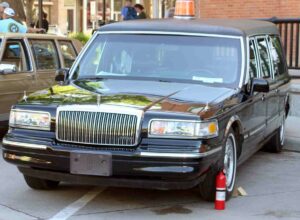
1996 Llincoln Town Car hearse

When Lincoln entered the funeral car market in the 1980’s, they supplied Town Cars to professional car manufacturers for funeral conversion.   A 1996 Lincoln hearse was shown at the Concours (along with the original window sticker displaying a price of over $60,000 – about $20,000 more than a new Town Car sedan).  Only two were built to this design, though other bodybuilders produced similar Lincoln hearses.

Should you be in the market for a new professional car, Cadillac continues to market vehicles specifically designed for modification into funeral cars: option codes W30 for the Extended Sedan, V4U for the Limousine, and B9Q for the Hearse.  Cadillac describes  these as “specifically engineered, designed and built for heavy-duty application and coachbuilder conversion.”  They are supplied only to body builders designated as “Cadillac Master Coachbuilders.”  (These cars are currently offered on the XTS platform, which will be discontinued in October.  General Motors has not yet announced a commercial chassis option for the CT6, and has yet to confirm a new assembly plant for that model, as noted in a previous Automobile Chronicles post.)

1990 Collins Commodore Elite Cadillac six door funeral car

When you view any professional car, including the magnificent array shown by members of the Professional Car Society at their Concours d’Elegance, you truly are viewing vehicles individually styled and custom crafted to the highest standards, the product of today’s finest coachbuilders.

Membership in the Professional Car Society is open to anyone with appreciation of professional vehicles – you don’t have to own one to join.  Its members are enthusiastic and friendly.  Before you know it, you’ll probably find yourself scouring the online ads for your own coach.

There is just something about a hearse that’s irresistible.

GUS WILSON – BEST AUTO MECHANIC EVER

Gus Wilson was the best auto mechanic ever.

He learned his trade young, opening the Model Garage sometime before July of 1925, at a time when the Model T was still the new car in Ford showrooms.  From then until his well-earned retirement in December of 1970, Gus Wilson was the man who could diagnose any automotive ailment, fix any car, any truck, and always do it with a wry smile and patient good humor.

Gus retired before the advent of on-board computers and diagnostic trouble codes.  But he would have mastered them easily.  Gus’s greatest gift was his innate ability to analyze problems logically.  Understanding how systems worked and interacted, he would eliminate each possible cause until the actual source of the problem was isolated.  Modern service manuals articulate that same approach in the diagnostic trees published for each trouble code.

Gus Wilson's Model Garage
Gus Wilson’s Model Garage

The stories of Gus Wilson’s adventures in automotive mechanics appeared each month in Popular Science magazine.  Some of the best were collected in two paperback books, Gus Wilson’s Model Garage, published in 1963, and Tales of a Master Mechanic, published in 1972.   The stories were written by “Martin Bunn,” the pen name used by at least five different authors over almost five decades.   Gus’s personality mellowed over the years, becoming less gruff and more approachable.  But his character as the ultimate automobile mechanic – the one who could always find the problem that evaded others and fix it – transcended the authors.   In the 1950’s and 1960’s, to call a mechanic a “real Gus Wilson” was to render the ultimate accolade.

By now, if you’re not already there, it is time to admit that Gus Wilson was a fictional character, as was his assistant, Stan Hicks, the tightwad regular customer Silas Barnstable, and the others who patronized Gus’s business, the Model Garage.  Gus Wilson lived in a time when being an automobile mechanic was a respected occupation and independent repair garages were important businesses in the community.  The Model Garage was much like many other small repair shops – gas pumps in front, two service bays and a small office.  It was in a city, never actually named or placed, like many smaller cities in the nation: growing and prospering, yet still a small town where the people knew each other, reputation and honesty mattered, and hard work paid off in the end.

Beyond chronicling Gus Wilson’s automotive adventures, these stories described an America that had standards and character, and optimism.  Implicit in these stories is an unflagging belief that problems have solutions, that hard work leads to success, that one’s word is his bond, and that the occasional dishonest person does not change the fundamental character of people as good folks who can be trusted to do the right thing.  The setting is one that appears in many literary works of the 1930’s through 1950’s describing New England, such as Thornton Wilder’s Our Town and the novels of James Gould Cozzens, but without any undercurrent of cynicism.  It is a type of community that many people in the United States still enjoy, while many others remember it with nostalgia and a vague sense of loss.

Though Popular Science, like all magazines, enticed readers with splashy feature articles prominently teased in full color on the cover, many subscribers first opened a new issue to the back of the magazine.  That’s where the latest Gus Wilson story, along with illustrations by Ray Quigley, would be found.  Along with the pleasure of reading each lively mystery of automotive diagnostics – mysteries that baffled others, but which master mechanic Gus Wilson solved at the end – the reader received an education.  There was something to be learned, both from the solution and from the logical way Gus isolated it.

Gus Wilson
Gus Wilson

If this format seems familiar, perhaps it is because Sir Arthur Conan Doyle adopted the same approach in his tales about another deductive genius, this one operating in London a bit before automobiles were invented.  Gus Wilson was the Sherlock Holmes of automobile mechanics.  Like Watson’s chronicles of Holmes’ cases, the authors of the Gus Wilson stories did not cheat.  All the clues were there, as accessible to the reader as they had been to Gus, and to those characters in the story who’d failed to find the cause.   That was the essential charm of the Gus Wilson stories.  You didn’t just read them.  You matched wits with Gus.  With every issue of Popular Science, there came a new opportunity to see if you could diagnose the month’s automotive conundrum before Gus did.

Usually, you didn’t.  But you learned from the master, as you read what he did.  Even if you didn’t realize it at the time.

Gus Rescues a Rookie

In January of 1959, Gus helped a rookie police officer with a misfiring police cruiser.  Every time the officer tried to chase a speeding car, the police cruiser would suddenly start bucking uncontrollably.  The officer would have to abandon the chase.  The cruiser had been checked and double-checked and nothing found wrong.  But the problem remained.  Gus found the cause: “crossfire.”  Taking a ride with the officer, he spotted the issue as soon as the next chase began.  The spark plug wires were running too closely to each other.  When engine speed increased, current travelling through one wire induced voltage in an adjacent wire, also triggering that wire’s spark plug and causing misfiring.  Gus moved the wires further apart and the misfire was gone.

That might seem simple and even obvious.  But, there was a lesson in that story that stuck with me for forty-five years, when Gus helped me diagnose the misfiring Cadillac.

I was able to diagnose and replace its defective coil pack on my own.  But the engine – an early Northstar V-8 with spark plug wires running parallel to each other along the valve cover – now had a different misfire.  I remembered that Gus Wilson story.  Sure enough, where the wires were positioned in the looms was critical.  I solved that misfire just as Gus had done.  I’m not sure I’d have hit that answer so quickly if I hadn’t read “Gus Rescues a Rookie.”

The Gus Wilson stories, in retrospect, sometimes even foreshadowed the future.

Gus Licks a Weighty Problem

In “Gus Licks a Weighty Problem,” published in May of 1960, the diagnostic challenge was a car –  a mid-fifties Buick Roadmaster, judging from the accompanying Ray Quigley illustration – that always started for Mrs. Allen, but sometimes refused to start for Mr. Allen.   The character of Mrs. Allen was obviously based on Gracie Allen, of Burns and Allen fame, and exhibited the same talent for illogical logic.  Mrs. Allen wanted stronger springs installed on the driver’s side of the car.  As she saw it, the intermittent no-start began to occur when her husband started gaining weight.  Her first solution was to put him on a diet.  But she arrived at a mechanical solution, as well.  Since the car always started for her and she was lighter than her husband, she reasoned that stronger springs on the driver’s side should insure the car would always start for him.

Weight was the problem, but not Mr. Allen’s weight.  Mr. Allen’s car keys were on a ring with many other keys, making a very heavy, weighty key ring that pulled downward on the ignition key. Over time, the weight had worn the ignition switch.  Mrs. Allen’s single key did not have enough weight to push apart the interior components of the switch, but the heavy ring of keys Mr. Allen used exerted enough downward force to prevent the switch from making contact when turned.

Gus replaced the ignition switch.  Mr. Allen was released from the diet, and Gus once again had solved the problem that baffled all others.

Forty-five years later, in 2005, General Motors sent dealers a service bulletin advising that a defect could occur in the Chevrolet Cobalt when “the driver is short and has a large and/or heavy key chain.”    The bulletin advised the dealer to “question the customer thoroughly to determine if this may be the cause” of the ignition turning off without apparent driver input and suggested the customer remove “unessential items from their key chain.”

In 1960, the consequences of a defective ignition switch were a car that wouldn’t start or stalled in traffic.  It would be another year before the Wisconsin became the first state to require seat belts in new cars; thirteen years before the airbags would first be offered in a new car (the 1973 Oldsmobile Toronado, as an option).  Federal regulation of automotive safety was essentially non-existent.  Amendments to the Federal Rules of Civil Procedure that would birth the modern class action lawsuit were still six years in the future.

By 2005, it was a different automotive world.  The federal government now regulated the automobile industry automotive safety through rules issued by the National Highway Traffic Safety Administration.   Automobile manufacturers were required to report safety defects and recall automobiles to correct those defects.  Failure to make those reports was now a crime.

The problem of an ignition switch that could not stand up to the effects of a heavy ring of keys, however, remained.  The specifics of the problem were slightly different in 2005.  The Cobalt’s switch could be rotated with very little torque, so a heavy key ring could inadvertently pull the switch from “on” to “off” if the keys were bumped.  In 2005, the consequences also were potentially more severe: a switch that was turned to “off” would not only stop the engine, ending power steering assistance and making the car more difficult to control, but would also disable the air bags.

Events began with that 2005 service bulletin ultimately resulted in General Motors recalling  thirty million vehicles around the world, paying a $900 million penalty as part of a criminal deferred prosecution agreement, and establishing a $600 million compensation fund for those injured and the heirs of those killed when air bags failed to deploy.   The number of deaths resulting from the defect is still debated.

Gus Plays with Fire
Gus Plays with Fire

Gus could be a hero, too.  When a fire broke out at the local lumberyard, the Fire Chief called Gus to the scene in “Gus Plays with Fire.”  A tank truck filled with gasoline was immobile inside the burning lumber yard, engine dead.  The only angle from which it could be towed was blocked by fire.  If not moved, the truck would explode when the fire reached it – with dire consequences to the adjacent homes.  The only way to get it out is to drive it out.  It is up to Gus Wilson to get it started before the inferno reaches it.

Gus gets it started, just in time.  He repairs the rubbing block on the arm of the breaker points  with a piece of lead from a pencil.  In the process, he works backward from the absence of spark at the plugs to locate the issue – the exact diagnostic process that anyone should use to isolate a no start issue, even today.  The truck is moved.  The neighborhood is saved.

For Gus’s thirtieth anniversary, the Mayor and the city gave Gus a parade – as befits one of the community’s leading citizens.  It was a hot July day and during the parade the mayor’s car suffers a breakdown.  Gus, with the entire community watching in the blazing sun, must get it running again.

You know he does it.

Gus Wilson was the best auto mechanic ever.

Gus Wilson may be retired, but he is not gone.  Gus is available online at a delightful website that features every Gus Wilson story, along with the illustrations that accompanied the stories, artistic gems in their own right.

Just visit the website Gus Wilson’s Model Garage.

You have one advantage that readers did not have when these stories were first published.

You don’t have to wait a month to read the next one.

THE WHEEL IN AUTOMOTIVE HISTORY

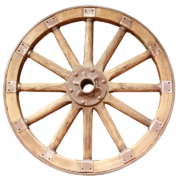
Wheel

Automobile Chronicles is about “Automotive History – Then and Now.”  But there would not be any automotive history were it not for the wheel.   Two of our readers, Emily and Melissa, who are both students and students of history, recently pointed this out and directed our attention to an article discussing the history of the wheel they had discovered in their research.

They have a point.  Automotive history tends to focus on more glamorous subjects – the artistry of the automotive form as it has evolved over the decades, the increases in power and performance as engineering overcomes limits once thought impossible to surmount.  But, none of that would go anywhere – literally – without the wheel.  Indeed, if there is any form fundamental to the automobile, it must be the perfectly circular wheel.  Not only does the automobile use the wheel to move and steer, it is wheels in the form of pulleys that harness engine power to operate accessory drives essential to operating its electrical, cooling, and emissions systems and providing climate comfort for its occupants.

So, who invented the wheel?

Potters wheel
Potters wheel

That distinction is lost to history, though scholars date the first use of the wheel – as a potter’s wheel – to Mesopotamia in 3500 B.C.   Using wheels for transportation developed much later – probably because the wheel requires an axle to be of any real use – and combining the wheel and an axle is a rather sophisticated mechanical achievement, as explained by Interesting Engineering:

“The idea of adding an axle isn’t a simple one. For the system to work, the wheel must rotate freely around the axle. This is achieved by fitting the axle directly in the center of the wheel to maximize continuity during motion. In addition, the axle and the hole alignment must be perpendicular to reduce friction. Furthermore, the axle should remain as thin as possible to reduce its surface area while still being able to support the load.”

The wheel was a uniquely human invention – not something copied form nature.  Egyptian and others may have used logs as rollers.  But logs are not wheels.  Wheels required human ingenuity to devise, and then to evolve from a tool used to produce pottery or make moving loads easier into the basis of transportation.

By the time of ancient Greece, about 2000 B.C., the wheel had spokes, an improvement attributed to the Shintashta culture that also developed the first known chariots.  About one thousand years later, the Celts added iron rims to their wheel to increase wear – the first known effort in history toward increasing tire mileage.

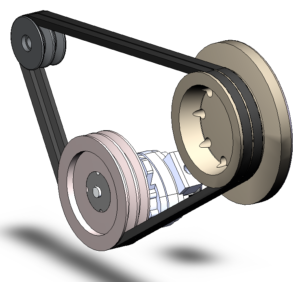
Belt drive
Belt drive

But what about the pulley – the smaller wheel that is the foundation of those accessory drives and timing belts of today’s engines?   That, too, dates to Mesopotamia, where pulleys were used for lifting water starting about 1500 B.C.  The device’s modern popularity, however, dates to that uniquely American problem-solver, Benjamin Franklin.

The story, according to Ebudilla.com, is that Franklin, in 1730, ordered a new printing press.  It was too large to fit the staircase leading to his third-floor premises.  Seeing the wheels on the wagon that had delivered the press gave him an idea and he rigged up a pulley system to lift the press, by-passing the stairs.  From there, the idea was copied and spread.  So, at any rate, goes the story – and it’s a good story, even if there may have been some embellishment over the years.

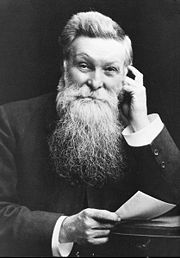
John Boyd Dunlap
John Boyd Dunlap

We cannot end this post, though, without mentioning the men who made the wheel what it is today:  John Boyd Dunlap, a veterinarian in Belfast, and John Fagan, the physician treating Dunlap’s son.  Dr. Fagan had prescribed cycling as a cure for headaches afflicting the child.  To cushion the bumps, they invented the pneumatic tire.  Mr. Dunlap would create the tire company bearing his name.  Dr. Fagan became Sir John Fagan when he was knighted.

On this Sunday, May 26th, many of us – certainly this author – will be glued to the television screen from early morning to late night as the annual “Greatest Day in Racing” progresses from the Grand Prix of Monaco through the Indianapolis 500 and ends with the Coca-Cola 600.  The commentators will tell us about the aero packages, the engines (or “power units” as Formula One calls its hybrid motor).  They will certainly tell us about the tires – the compounds, the wear, and the inevitable tire failures.

They probably won’t mention the wheel that made it all possible.

So thanks, Emily and Melissa.  Every now and then, it is good to be reminded that today’s accomplishments and events are grounded in their history.

In that sense, automotive history begins long before the automobile.

TESLA NEEDS DEALERS TO MAKE A PROFIT

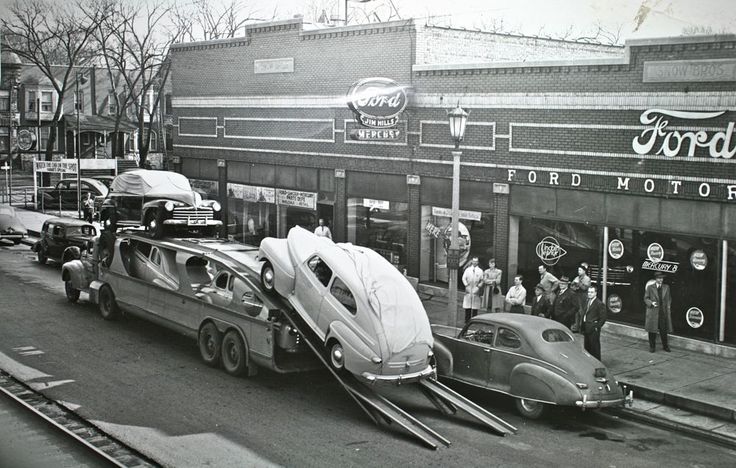
Why Tesla Need Dealers to Make a Profit - Ford Dealer Taking Delivery of New Cars in 1940'd
Ford dealer taking delivery of new cars in 1940’s

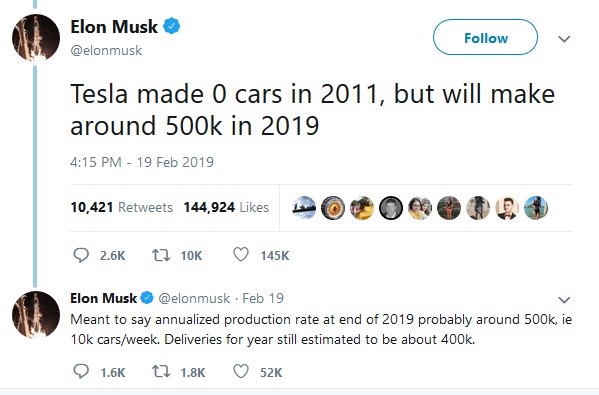
Over one hundred years ago, automobile manufacturers invented dealers to save themselves the capital cost of maintaining inventory and to make the process of delivering new automobiles to customers both efficient and someone else’s problem.   “Those that do not learn from history are doomed to repeat it.”  The quote, commonly attributed to Santayana, describes Tesla today:  Tesla needs dealers to make a profit.  It has none.  That is one of the reasons it is currently losing money – almost a quarter of a billion dollars in just the first three months of 2019.

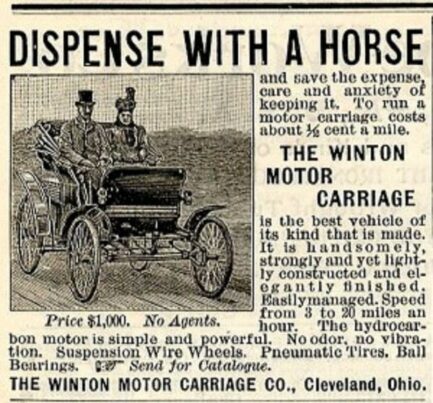
Winton automobile advertisement

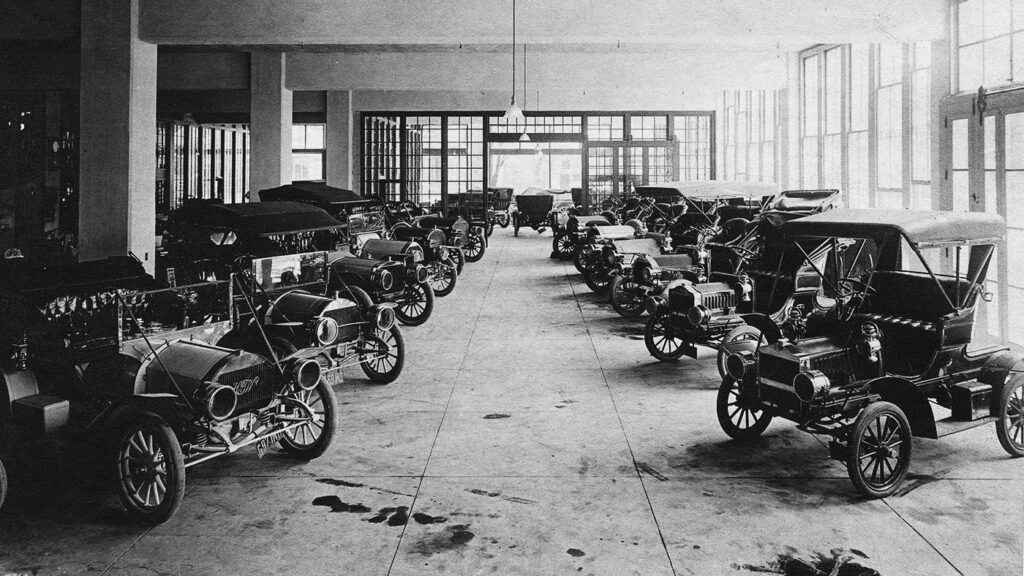
In the first years of the twentieth century, automobile manufacturers seldom has access to bank loans.  For the most part, they relied upon investors to raise money, an arrangement that was fine for starting the enterprise, but not an adequate source of working capital to keep it going.  (Even Henry Ford, as noted in our previous post about Ford and the Dodge brothers.)  As the industry grew, automobile manufacturers were no longer competing with the horse.  They were now competing with each other.

Technology – both in the automobile itself and in the methods of production – was advancing with remarkable speed.  In 1904, the Oldsmobile’s one-cylinder runabout was the best-selling automobile in the United States, with 5,508 sold.  Twelve years later,  Packard introduced its famous “Twin Six,” a luxury priced automobile featuring a V-12 engine.  It sold 10,645 of them.  The best-selling car in 1916, of course, was the Model T – with 734,811 rolling off the assembly line.

For these reasons, early automobile manufacturers were almost universally undercapitalized.

When we refer to early manufacturers as “under-capitalized,” the common image is of a shoestring operation struggling to build a few cars and failing when it could not sell them.  But that is not the real picture of “under-capitalized” automobile manufacturers in the early days.  They were successful – very successful.

That was the problem.

The automobile market in the first two decades of the twentieth century was expanding so rapidly that automobile manufacturers required huge levels of investment to be and remain competitive.  In 1904, William C. Durant capitalized Buick at $100,000.00 and displayed the Buick roadster at the New York Auto Show.  He booked 1,108 orders.  By 1907, Buick production had reached four times that number and Durant was envisioning a merger of automobile companies, to be the United Motors Corporation.  To capitalize it, he intended to issue stock totaling $1.5 million.  He approached J. P. Morgan & Company to underwrite one-third of the issue.  J. P. Morgan himself rejected the idea.  He could not see the automobile as anything but a rich man’s toy and called Durant an “unstable visionary.”

William C. Durant
William C. Durant

By 1909, Durant had founded General Motors.  To Buick, he had added Oldsmobile, Oakland, and Cadillac.  Durant now wanted to buy Ford – and Ford had just lost the first round of the Selden patent litigation, so might be amenable to the right offer.  To make that offer, Durant approached a bank to borrow $2 million, toward raising $8 million for the purchase.  The bank turned him down.

The automobile industry, however, continued to expand – and expand, and expand.  But when banks finally did begin loaning to the industry, they were quick to cut off funds at the slightest setback.

In 1910, a correction in the stock market triggered banks cutting off credit to automakers, including General Motors.  With its working capital cut off by banks calling loans and seizing accounts to offset loan balances, General Motors was forced to shut down production – a loss Durant calculated at $60,000 a day to a company that had fixed plant and equipment worth $14 million and $26 million of inventory.  Durant went on a rapid cross-country quest, borrowing from General Motors dealers and the banks with whom those dealers did business, thereby raising the money needed to keep operating.

Tesla’s troubles today are really the same problems facing the automobile industry over one hundred years ago.  But Tesla is ignoring the solution devised by the industry so long ago and used successfully ever since.

Financing unsold inventory was an enormous problem for early automobile manufacturers.  Unsold inventory tied up money they desperately needed for financing plant and equipment and meeting payroll.  The more production increased, the bigger the drag from unsold inventory.  This financial drain was exacerbated by disorganized distribution that prolonged the time between production and sale.

There were, however, people who had access to the capital that the automobile manufacturers lacked.   These were local businessmen already successful within their communities.  They had existing business relationships with local banks.  They could borrow money to finance an inventory of new automobiles awaiting sale to the ultimate purchaser.  They became the first automobile dealers.

Carl Fisher Dealership in Indianapolis. Fisher was a founder of the Indianapolis Motor Speedway and of the Lincoln Highway

With the dealer able to finance new car inventory, the automobile manufacturer was able to sell its production to the dealer at the factory door.  The dealer and his bank paid cash to the manufacturer.   The car was sold to the dealer “F.O.B. Detroit.”  “FOB” meant “free on board,” a phrase denoting that the seller has completed its end of the transaction and that any risk of loss thereafter is upon the purchaser, i.e., the dealer.  It was up to the dealer to get the car to the showroom floor and sell it to the consumer.

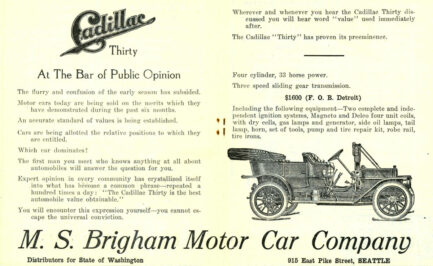
Cadillac dealer advertisement 1910

Two problems solved:  the manufacturer shifted the burden of financing unsold inventory to the dealer and shifted the problem of distribution to the dealer.

But not Tesla.

When Tesla builds an automobile and ships it, Tesla still owns it.   While that vehicle is in transit, Tesla still owns it.  Tesla owns it until the customer pays for it, buying it directly from Tesla.  Tesla must support the entire cost of the entire inventory of vehicles not yet sold to the ultimate purchaser.

In the meantime, Tesla is not making a dime from that unsold inventory.  It can’t use the money tied up in that inventory to build more Tesla’s or develop future models.

This is why Tesla needs dealers to make a profit.

There is, however, yet another reason Tesla needs dealers to make a profit.

By 1919, the automobile industry had become the largest new industry in the United States.  Automobile manufacturers no longer had problems raising working capital.   It was now the dealers who needed access to better financing.  To meet expanding demand, manufacturers needed more dealers and dealers needed ever larger inventories.  The ability of dealers to finance this inventory directly affected the ability of the manufacturers to meet demand.

That year, General Motors invented a way to assure dealers would have access to the financing needed for adequate inventory and, at the same time, earn a handsome profit to General Motors.

It formed the General Motors Acceptance Corporation, or “GMAC.”  GMAC later became best known for consumer financing (and, through various corporate crises, became today’s Ally Bank).  However, GMAC originally was organized to provide inventory financing to General Motors dealers.  By 1919, General Motors size allowed it to offer credit to dealers in competition with local banks or when local banks were not an adequate source of financing.  General Motors still was paid cash at the dock for the automobile and the dealer still bore all the costs of distribution.   All that had changed was that General Motors, rather than outside banks, profited from the dealer’s expense of financing the unsold inventory.

This model was so successful that other automobile manufacturers copied GMAC to create their own captive financing arms.  Today, all major automobile manufacturers offer this “floor plan” financing for dealership inventory.

Except Tesla.  Tesla has no way to make money financing unsold inventory because Tesla has no dealers.

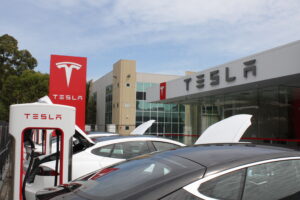
What a Tesla dealer would look like?

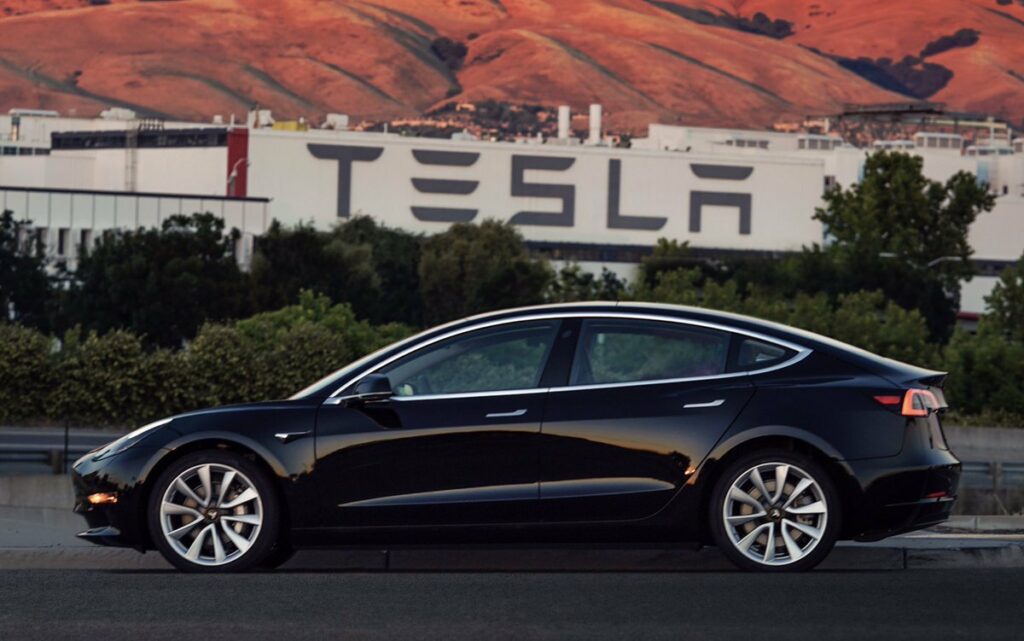
Tesla reported a $702 million loss for the first quarter of 2019.  Though it originally had projected profits for the first and second quarters, Tesla now expects no profit until the third quarter.  Tesla explains that production will “be significantly higher” than deliveries this year.  That means Tesla will be supporting a large inventory of unsold automobiles.

It is an expense they cannot afford and could have avoided – if they sold Tesla’s through dealers.

Here's Tesla real competition- the modern dealer
Here’s Tesla real competition- the modern dealer

Tesla attributes some of the loss to logistic problems delivering vehicles in Europe and China.  But the problem of exporting and importing automobiles is not qualitatively different than distributing automobiles within the United States.  Following World War Two, automobile manufacturers in Europe began exporting automobiles to the United States.  But they did it through importers, such as the legendary Max Hoffman (who introduced Volkswagen and BMW, as well as Mercedes-Benz, to the post-War market in the United States).  These importers took on the role of an importing dealer, paying at the factory gate for the vehicles and supporting the inventory of vehicles and parts necessary to sell and service them.

Though largely ignored in the press, within Tesla’s first quarter results is yet another reason that Tesla needs dealers to make a profit.  As noted by stock market analyst Jim Cramer, Tesla reported a $57 million loss before adjustment for depreciation, interest, taxes, and amortization (EBDITA) in the first quarter of 2019.  That means Tesla is losing money on every car they build.

After initially announcing the $35,000.00 Model 3, Tesla quickly retreated from selling them online (where 78% of Model 3 models are sold).  The $35,000.00 Model 3 promised for years and finally offered for sale on February 28th was pulled from online sale on April 11th.  It now can be ordered only in a Tesla store or by phone.

Anyone who has ever bought an automobile or truck from a dealer knows why Tesla did that.

You don’t really want to sell your loss leader and you can’t up-sell a customer online.

Which may be the most important reason why Tesla needs dealers to make a profit.


For other posts about how history repeats itself with Tesla, see our other post about Tesla and Ford and our post about its CEO, Elon Musk, and the Securities and Exchange Commisssion.

THE REAL REASON PACKARD DIED

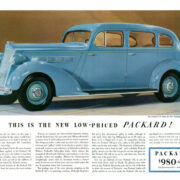
1935 Packard One-Twenty advertisement - not the real reason Packard died
1935 Packard One-Twenty advertisement

The One-Twenty vs.
the “Senior” Model Packards

Those who attribute Packard’s demise to introduction of the One-Twenty model in 1935 indulge in the fallacy that corporations fail from one factor which, had it been different, would have affected a different destiny.  The real reason Packard died was not the One-Twenty.  In truth, the One-Twenty saved Packard.  It was the “Senior” series Packards – the Eight, Super Eight and Twelve – beloved by those that blame the One-Twenty for undermining Packard’s prestige – that fatally undermined Packard’s financial destiny.  They didn’t kill the company.  They did weaken it enough that Packard was vulnerable to bad luck and management errors that ultimately did it in.  Continuing the “Senior” models in production and the poor decisions that followed are the real reason Packard died.

The numbers do not lie.

In 1934, Packard sold 6,265 automobiles – all “Senior” models selling at prices from $2,500.00 to $5000.00   Packard lost $7,290,549.26.  It had a small profit of $506,433.91 in 1933, but lost money in all the other years after 1930.  It lost $6,824,311.72 in 1932, and approximately the same amount in 1931.   Things had turned dramatically for Packard after 1930.  Packard had a profit of $25,183,286.38 in 1929.  In 1930, profit dropped to $9,034,219.53.

It was obvious to Alvan Macauley, president of Packard, that the company’s survival depended on producing a less expensive automobile.  The One-Twenty was the result.

Packard One-Twenty four door sedan

The One-Twenty was introduced in January of 1935, at a price below $1,000.00.  The Senior” models remained in production at the same higher prices.  Packard sales for 1935 totaled 52,045 automobiles of which about 7,000 were “Senior” models.  Packard made a profit of $3,315,622.38.  Without the One-Twenty, Packard would again have lost between $6 million and $7 million, depending on the mix of “Senior” models sold.

The One-Twenty was the $10 million difference between 1934 and 1935.

In 1936, Packard sold 80,878 automobiles to reach a profit exceeding $7 million.  In 1937, with the 115C model in production and priced below the One-Twenty, sales reached 109,528 automobiles.  Profit was approximately $3 million.

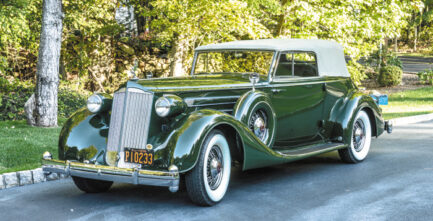
1936 Packard Twelve
1936 Packard Twelve

Packard’s accounting during these years did not break out costs and revenue by model line and did not allocate overhead costs by model line.  So, it is impossible to know just how much money continuing the “Senior” lines after 1935 cost the company.  That it was an enormous amount is beyond reasonable dispute.

After 1930, sales of the “Senior” lines reached the break even point only once – in 1933.  After introduction of the One-Twenty, the “Senior” lines drained money from Packard’s profits on the lower priced models.  For just the three years from 1935 through 1937, that totaled about $20 million.  That is $20 million Packard didn’t put in the bank, in addition to approximately $20 million it lost before 1935 and in addition to perhaps as much as another $20 million lost producing the “Senior” Packards in 1938 through 1941.

The “Senior” models may have drained $60 million from Packard in ten years.

Adjusted for inflation, that is $1.113 billion in 2019 dollars.

When looking for the real reason Packard died, this is the beginning of what became, in time, the end.

Though Alvin Macauley had been very quick to see the need for Packard to introduce a lower priced automobile, he seems to have been blind to the financial damage continuing production of the “Senior” models was doing to the company.

The disappearance of the market for handcrafted luxury automobiles costing $2,500.00 or more during the 1930’s is commonly attributed to the Depression.   However, the depression simply accelerated a trend that had started in the 1920’s.  Even before the Depression, that market was steadily shrinking as new production technology improved the quality and performance off mass-produced automobiles.  Ford’s development of the River Rouge complex (as chronicled in a previous post) foreshadowed the path the entire industry would take.  Automobiles priced at $2,500 or more held ten percent of the automobile market in the 1920’s.  In 1932, they were 2% of the market.  By 1937, this had been cut to 0.5% of the market.  Most of Packard’s competition had been eliminated by then, so Packard competed only with Cadillac and Lincoln.

Macauley squandered the financial bonanza of the One-Twenty.  As company President, Macauley concluded each year’s Annual Report to Shareholders with his personal remarks.  Not once after introduction of the One-Twenty did he refer in those remarks to the “Senior” line Packards.  Rather, his remarks uniformly focused on the increase in revenue resulting from Packard’s increasing sales of lower-priced automobiles.

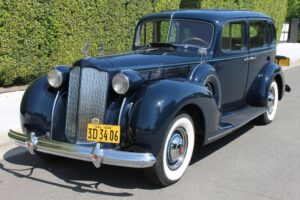
1938 Packard Super Eight

Packard’s decision to sustain production of the “Senior” cars during the last half of the 1930’s was almost quixotic.  Lincoln continued the Model K because Edsel Ford wanted it to – and had the Model A and B Fords to finance it.  Cadillac continued to produce twelve and sixteen-cylinder automobiles because General Motors also could afford to lose money for prestige, and because it had the “companion” LaSalle to provide Cadillac dealers with sales.  Packard lacked the financial strength of Ford and General Motors that allowed those companies to indulge in huge losses for corporate prestige.

Macauley saved Packard by introducing the One Twenty.

He set the stage for its failure by continuing the “Senior” models afterward.


The Japanese Bomb Packard

In April of 1941, Packard introduced the Clipper.

By then, Packard was a changed company, run by the people Macauley had brought in to produce the One-Twenty.  Max Gilman was now company president, chosen by Macauley.  Gilman knew a new model would be needed to maintain sales.  To style it, he went outside of the company to hire Howard “Dutch” Darin.  This was not a totally new car.  It was to be built on the One-Twenty’s chassis and use the same engine, but with a new front suspension and an entirely new, completely modern appearance.

1941 Packard Clipper

The Clipper was a hit.  No – it was a home run.  Packard had introduced a newly styled automobile that appeared far more modern than its competition.  Packard sold 16,000 Clippers in 1941.  It could have sold more, but – at Macauley’s insistence and over strong opposition within the company – Packard had subcontracted production of Clipper bodies to an outside manufacturer, the Briggs Manufacturing Company.  Briggs couldn’t meet demand.  It was August before production was able to provide dealers with adequate inventory.

1942 would have been a bonanza for Clipper sales.

Then the Japanese bombed Pearl Harbor.

Last 1942 Packard
Last 1942 Packard

Packard went to war, along with the rest of the automobile industry, when it ended production in February of 1942.  During the War, it produced engines for PT boats and the Merlin engines used in the P-51 Mustang, as well as in the British Mosquito, Lancaster, Warhawk, and Hurricane.  (Packard had been solicited in 1940 to build the Merlin for the British under license from Rolls-Royce because only Packard was deemed capable of producing engines in quantity to the tolerances required for the Merlin.)

Though these wartime products were of Packard quality, the profits were ephemeral.  Packard production during World War Two was rewarded with a profit of 1.2%, dictated by the government contracts and imposition of an excess profits tax on industry.  Though Packard management avoided debt and maintained cash reserves, the company’s working capital declined during the war years from $46 million to $35 million.

World War Two cost Packard dearly.  Without the War, Packard could have used profits from the Clipper to rebuild its finances in the years following 1941`.  Packard had finally begun moving the “Senior” models to the One-Twenty’s chassis in 1938 and 1939, in the process dropping the Twelve and replacing the Super Eight with the 160 and 180.   Further melding these models into the mass-produced lines would have removed an enormous drain on Packard’s profits.  Coupling that with the jump the Clipper gave Packard over its competition provided Packard with a golden opportunity for profit in the years to follow 1941.

Those opportunities were sunk on December 7, 1941, along with the Pacific Fleet.


The Bathtub
bathtub Packard
bathtub Packard

Packard fans all know the “bathtub,” the models Packard introduced in 1948 and continued in production through 1951 that looked like a bathtub upside down.  Today, they are commonly regarded as ugly.  They are also blamed with starting the nails in Packard’s corporate coffin.  They were designed by Alvan Macauley’s son, Edward, based on a concept car he had designed during the war, the Phantom.  The Phantom started life as a shortened two-door Clipper.  It evolved during the war years into the bulbous design that was faithfully copied by Packard for the 1948 line.

As with prior significant events in Packard history, the introduction of the “bathtub” Packards and their failure in the post-War new car market centers on Alvan Macauley.  Macauley had controlled Packard from the 1920’s, first as President and then, after 1939 and until 1948, as Chairman of the Board of Directors.  His dominance of Packard was absolute.  The Board members were completely loyal to him.

In the years before World War Two, the path Macauley had chosen for Packard was copied by its competitors, Lincoln and Cadillac.  In 1937, though still producing the Model K, Lincoln introduced the Zephyr, a mass-produced automobile priced far below previous Lincoln products.  In 1941, General Motors dropped the LaSalle line that had been sold by Cadillac dealers.  In its place, GM introduced a new Cadillac model 61 in the same price range LaSalle had occupied.  Like Packard, Lincoln and Cadillac were phasing out their handcrafted models, moving to shift their brands’ prestige to mass-produced quality automobiles.

The 1941 Clipper was priced at $1,420.00 – above the One-Twenty at $1,291.0 and below the functional replacements for the “senior” line, the 160 and 180, with the 160 starting at $1,795.00.  This put the Clipper in the price range that that eventually became, after World War Two, the lower end of the luxury car market – the market that eventually would be dominated by the Cadillac deVille.  Cadillac, like Packard, had dropped its handcrafted models, the twelve and sixteen-cylinder powered cars, in favor of eight-cylinder models priced competitively with the Packard 160 and 180.  Though Packard still offered the 115C priced below the One-Twenty, the introduction of the Clipper was Packard’s claim to its share of the evolving market for modern luxury automobiles.

An unexpected event turned out to handicap Packard’s ability to capitalize after the War on the market it has begun to create with the Clipper.

On January 22, 1942, Max Gilman, the President of Packard, was in an automobile accident on Woodward Avenue in Detroit.  He and his passenger were both injured and hospitalized.  The problem was that his passenger was the wife of another Packard executive and that Alvan Macauley’s moral compass was offended by this “scandal.”  From a present-day perspective, this seems a bit too Puritan.  In the 1970’s, the arrest of Henry Ford II for drunk driving with a woman not his wife in the car caused a public stir, but more from curiosity than moral opprobrium.  (Ford’s famous response to the press was “never complain, never explain.”)  No one suggested he should leave the Ford Motor Company.  But this was another time, and Macauley considered Gilman’s conduct immoral.  Though the board had decided that Gilman should stay, Macauley acted unilaterally and fired Gilman.

Firing Gilman deprived Packard of a president who had demonstrated with the Clipper that he understood the market for the Packard brand and could give that market a car that set design trends, rather than following them.  It also meant finding a replacement for Gilman – not in a rational and developed process, but in a hurry.  Macauley chose George Christopher.  It was a bad choice.

Christopher was a production man.  He had no sense of the market.  After the War, as Packard converted back to producing automobiles, Christopher promised Packard shareholders that the company would produce 100,000 automobiles in 1946, a number it did not reach until 1948.  He focused on producing low priced cars that he believed could sell in volume, oblivious to a market so starved for new cars that Packard’s dealers easily could have sold that same volume in the higher priced Packard models, had only Christopher elected to emphasize their production.  As it was, Christopher’s decisions meant most of Packard’s sales were not in the luxury market increasingly being defined by Cadillac, but instead were in lower priced cars.   Christopher even produced a Packard taxi cab model.

Christopher, in short, had no idea of what he was supposed to be selling.  He’d promised volume production.  To him, that meant selling cars cheaply.  It did not occur to him that he was facing a new era in which a booming economy would birth a large market for luxury automobiles very different than those represented by the old Super Eight and Twelve models.

Christopher was also hamstrung by events beyond his control.  It took much longer than he had anticipated to resume automobile production after the War.  He needed to build a new assembly line.  Steel was in short supply after the war, partly due to union strikes against steel producers.   Packard suppliers were also hit with strikes, leaving Packard without the parts needed to produce new cars.  Now that the Clipper was the only model with which Packard could resume production, Macauley had elected to stay with Briggs as the supplier of all Packard bodies.  Briggs had convinced Macauley that it could produce bodies more cheaply than could Packard.  The decision eliminated Packard’s ability to produce bodies in-house, making it totally dependent on Briggs.  Briggs had a lengthy and confrontational history of labor problems.  Supplier issues, along with strikes against Briggs, kept Packard assembly lines motionless for 81 of the 90 days in the first quarter of 1946.

Packard did realize it needed a new model.  It committed $20 million to expanding post-War production and budgeted $8.5 million for tooling for the new model.  But “new” to Packard meant something entirely different than “new” meant to General Motors.

1948 Packard - Cadillac in background
1948 Packard – Cadillac in background

Though there were no automobiles in production during most of World War Two, those who would be responsible for new car styling after the war were actively experimenting with design ideas during the War.  Prominent among these ideas were streamlined designs that were very rounded in shape, often covering much of the wheels.  Known as “envelope” bodies because they carried the body line from front to back with no break for a separate rear fender, even General Motors designers considered this style for Cadillac.  In the end, Harley Earl rejected this approach and introduced an entirely new Cadillac design for 1948, one that featured a signature tail lamp that would evolve during the ensuing decade into tail fins and showed a distinct hip at the rear quarter panel.  In 1949, Cadillac introduced a modern, high-compression V-8 as standard equipment across the line.  General Motors had already introduced a fully automatic transmission in 1939.

1950 Packard
1950 Packard

Packard chose to revise the Clipper and stay with the same straight eight-cylinder engine it had been building before the War and to continue production of six-cylinder models, as well.  Though Packard’s design staff, headed by John Reinhart, favored a design that would streamline the existing Clipper design, Christopher was influenced by the envelope school of design and wanted the bulbous design based on Edward Macauley’s Phantom.  (Reinhardt would design the “bathtub’s” replacement, introduced in 1951 )

The thought process at Packard in the years leading to the 1948 introduction of the “bathtub” models, known as the 22nd Series, show management that was consistently risk averse.   Christopher’s emphasis on production goals for lower-priced models was a form of denial that avoided addressing the need for developing features, including V-8 engines and an automatic transmission, that would be beyond Packard’s resources without either raising significant new capital or incurring substantial debt.  Immediately after the War, Christopher had obtained for Packard a $30 million line of credit to finance reconverting the factories to automobile production.  There is no indication that Christopher or the Board of Directors ever considered incurring debt to develop truly new models.

Instead, Christopher chose to hoard the company’s cash.

Though George Christopher presided over these decisions, Alvan Macauley – still Chairman of the Board until his resignation in 1948 – was the person truly responsible for them..  The decisions may have been made by others, but Alvan Macauley remained the man in charge.  Those decisions could not have been reached without his approval, tacit or actual.

Chriopher kept the “bathtub” in production for 1950 and the bottom dropped out of Packard sales.

Packard would never again be a significant factor in the luxury automobile market.


Epilogue – The Real Reason Packard Died

I have a soft spot for Packard.  Their slogan was “Ask the Man Who Owns One.”  My father owned four and his last Packard was also the last true Packard – a 1956 Patrician, bought new with every option except air conditioning.   I still have a set of keys to it on my desk.

With the benefit of that perfect vision always provided by hindsight and putting sentiment aside, responsibility for the failure of Packard ultimately rests with decisions made by Alvan Macauley.

The real reason Packard died starts with the decision to continue production of the “Senior” models.  No rational businessman pursues production of an expensive product for a shrinking market that cannot make a profit, eroding the capital of the business with every product sold.  Macauley, however, did just that – and quite deliberately.   Decisions after World War Two were designed to ‘play it safe’ by outsourcing body building and not investing in a truly new model with modern features.  Having squandered vast sums on the “Senior” models, the mentality of Packard management had became risk-averse.  They failed to see that the greater risk lay in allowing opportunity to pass them by.  Had they had the financial cushion timely termination of the “Senior” models could have created, management may have seen the post-War market for what it truly was: the largest market for luxury automobiles in history.

The real reason Packard died is not that the One-Twenty saved the company at the cost of Packard’s prestige, and thereby damaged the brand in the marketplace.  The real reason Packard died is that Packard’s management squandered the lifeline the One Twenty had provided.


For further information about Packard’s post-War fortunes and its ultimate demise,  see also our additional post Pat Foster and the Myths of Packard’s Demise.


Sources:  Packard annual reports are available at packardinfo.com.

GHOSN v. JAPAN, INC.

Carlos Ghosn with Nissan GT-R

In engineering the arrest of Carlos Ghosn, the executives at Nissan displayed their nation’s barbarous judicial system and their company’s self-destructive management for the entire world to see.  It is not a pretty picture.  But it certainly is a revealing one.  Japan tortures Ghosn, and the world is watching.

Nissan, Renault, and Mitsubishi together form an “alliance,” an agreement for collaboration between the three independent companies.  Ghosn, the chief executive officer of both Nissan and Renault, wanted a merger of the companies.  Renault owns 43% of Nisssan, and this gave Ghosn the votes to get what he wanted.  Nissan’s management opposed that plan – and plotted to have Ghosn arrested by Japanese prosecutors and held in solitary confinement to stop him.

It is said that nations, like individuals, have an inherent character that inevitably guides their actions.  If so, the effective kidnapping of Carlos Ghosn by Japanese prosecutors at the behest of Nissan executives reveals more about Japan’s character than Japan apparently wants the world to see.  The recent granting of bail to Ghosn, an action almost unprecedented in the Japanese judicial system, shows that Japan has noticed the damage it has done to its national image.  But, belatedly granting bail to Ghosn does not change the system of criminal “justice” Japan employs, or the fundamental flaws in its national character that made possible the arrest and incarceration of Ghosn in solitary confinement.   Ghosn’s incarceration highlights a society that allows use of mental torture of criminal suspects to extract confessions and then justifies conviction because the accused confessed.

Civilized societies do not do that.

It also doesn’t help Nissan.

For Nissan, this is history repeating itself – a history that previously resulted in Nissan almost going bankrupt, only to be saved by Carlos Ghosn.

NISSAN’S CHARACTER FLAW

Since the founding of the United States as a constitutional society, coerced confessions have been considered violations of fundamental Constitutional rights.  The Fifth and Fourteenth Amendments prohibit use of a coerced confession in evidence at a criminal trial; the Eight and Fourteenth Amendments give the accused the right to “reasonable bail.”  Why are coerced confessions inadmissible?  It is not merely because coercing them is unfair, though it is.  The primary reason a coerced confession is inadmissible is because it is unreliable.  When you coerce a confession, you overcome the individual’s will to resist.  That means the individual will say what you want him to say.  A society that tolerates coercing confessions is not merely unfair.  It is a society that has no interest in the truth.  It is interested only in the unfettered exercise of power.

The executives at Nissan engineering the arrest of Ghosn had every reason to view him as a direct threat to their power over the company.  These are, after all, the executives responsible for Nissan’s recent scandals: safety and emissions standards violations that implicated Nissan’s highest levels of domestic management in corporate wrongdoing.  In September of 2018, only three months before Ghosn’s arrest, Nissan blamed decades of cheating on emissions and fuel economy standards.  Nissan’s official company statement explained that “[a]s a company – executives, manager to plant supervisors – Nissan had extremely low awareness of the gravity of violating  .  .  .  standards and rules.”  Notice that the statement does not claim these Nissan executives were ignorant of the rules.  It merely claims they didn’t think violating them was a big deal.  A year before that scandal surfaced, Nissan admitted another standards scandal involving uncertified inspectors.  The company had been doing it, and concealing it, for decades.   Apparently, that scandal had not been enough to give Nissan executives, managers, and plant supervisors heightened “awareness” that rules really are meant to be followed.

NISSAN AND THE KEIRETSU
Carlos Ghosn
Carlos Ghosn

Carlos Ghosn was chairman of Nissan during these periods, but plainly not the man responsible for operating the company.  That man was Chief Executive Officer, Hiroto Saikawa.  Saikawa, however, had publicly stated his complete opposition to Ghosn’s plan to merge Renault, owner of 43% of Nissan’s voting stock, into a combined company.   He opposed Ghosn’s plans to focus Nissan more directly on the United States market, rather than the Japanese market.  He was also about to be fired.  After Ghosn’s arrest, insiders reported that Ghosn intended to ask the Nissan Board of Directors at their November meeting to dismiss Saikawa, citing as reasons the safety and emission scandals and poor sales in the United States.  With 43% of the shares (and France, which owns a substantial block of Renault shares) behind him, Ghosn had the control needed to win that vote.

What Ghosn did not consider was the extent to which Japan has not changed since it lost World War Two.

Prior to World War Two, Japan’s industrial and banking industries were highly integrated.  It was common for companies to have large ownership interests in other companies, even competitors, and for those companies to own large percentages of each other’s shares.   The structure of these companies, termed “zaibatsu,” created integrated conglomerates with enormous control over Japanese government and society, including the military.  Four companies were considered in the first tier of zaibatsu.  Mitsubishi was in the first tier of zaibatsu.  Nissan was one of eight smaller companies considered second-tier zaibatsu.

The zaibatsu were an involved and essential component of the Japanese military aggression before and during World War Two.  After Japan’s surrender, American occupation forces planned to dissolve most of the zaibatsu companies, including Nissan.  Those plans, however, were abandoned.  Breaking up Japan’s interlocked industries became secondary to reinvigorating the Japanese economy to keep Japan from falling under the Communist influence overtaking China, Korea, and Southeast Asia.   Nissan emerged intact.

In the following years, Japanese industrial society reformed into alliances and cross-holdings that renewed the same type of closed integration of corporate ownership that existed before the War.  Called “keiretsu,” these were centered around the financial institutions that had been the banking components of the zaibatsu.  The keiretsu companies, like the zaibatsu companies, are marked by interlocked shareholding.  The interlocked ownership leads to interlocking boards that have the same individuals serving on boards of several companies with the keiretsu.

This is a structure designed to concentrate control.  It is also a structure designed to keep outsiders out – a design no different than it was when the zaibatsu controlled Japanese industry.

NISSAN REPEATS ITS FAILED HISTORY

The 43% ownership of Nissan by Renault, the product of Nissan’s serious financial problems in the 1990s that had the company $22 billion in debt and verging on bankruptcy by the time Renault rescued it in 1999, makes Nissan a very rare exception to the typical keiretsu interlocking ownership that assures vested Japanese industrial and banking interests effective control of the keiretsu companies.   The reality for Nissan is that a company whose name translates as “made in Japan” is controlled by Renault.  Being controlled by Renault meant being controlled by Carlos Ghosn.  That control was accepted when the price was saving the company.  It was no longer acceptable when Nissan executives saw Nissan on its way to being subsumed into a larger entity, one that would be beyond control of the Japanese interests that effectively control all large Japanese industrial and banking enterprises.

Renault Nissan Mitsubishi Alliance

According to the Wall Street Journal, a few months before Ghosn’s arrest executives at Nissan asked the Japanese Ministry of Economy, Trade, and Industry to intervene, to prevent merger with Renault.   The ministry had agreed to intervene but wanted more say in negotiations than Nissan’s executives would cede to it.

Nissan executives decided to pursue a different approach.

We now know how that turned out.

Published reports suggest that Ghosn’s chances for acquittal are vastly improved by his release on bail.  That, of course, really says little about the merits of the case, since the typical practice in Japan is to convict everyone accused by incarcerating them in solitary confinement until they confess.  Ghosn remains a board member of Nissan – though not allowed to attend board meetings by the Japanese court.   With Nissan executives having so directly confronted Renault with outright rebellion, Renault and Nissan recently announced a new oversight board that will, they say, govern by “consensus.”  While that approach epitomizes the keiretsu approach to business, the structure seems mostly designed to paper over the public schism between Nissan and Renault.  If Renault really is ceding Nissan management veto power, then it is conceding to a management that has a history of dishonesty and failure.   If Renault continues as the dominant partner, then the coup engineered against Ghosn will be only the first shot in a war Nissan cannot afford to win.

Nissan will need exactly what Carlos Ghosn intended to provide through a merger with Renault if it is ultimately to survive the challenges facing the automobile industry in the next two decades.  To compete in the global market against truly large automotive manufacturers, it will need the scale merging with Renault would provide.  None of this is news.  For several years before his death, the late Sergio Marchione of Fiat Chrysler had been warning that smaller automobile manufacturers, including Fiat Chrysler, would need to merge with larger companies to survive.  He was not looking at next year, but he was looking at the next decade and the decade after that.  He perceived a level of future investment that only the largest global automotive manufacturers would be able to afford.

For Nissan, this is history repeating itself.  As in the 1990’s, Nissan is facing the future with unimaginative vehicles, diminishing market share in the United States, and ingrown management.

Nissan remains independent of Renault.

But, without Ghosn, who will rescue it this time?


For more details about the inhumane and uncivilized system of Japanese “hostage justice,” visit Human Rights Watch.

MUSK SETS UP THE SEC

Elon Musk tweet - Musk Set Up the SEC
Elon Musk tweet

You won’t see a headline reading “Musk sets up the SEC.”  But the Securities and Exchange Commission is in a pickle of its own making with no way out.    Elon Musk, founder and  Chief Executive Officer of Tesla, Inc., has been a persistent critic of short-sellers in the stock market, people who stand to profit if Tesla stock loses value.  The SEC – intentionally or not – aided and abetted these stock market speculators at the expense of small shareholders when it brought action against Musk in 2018 for tweeting a claim that he had financing secured to take Tesla private and tried to bar him from participating in Tesla, Inc.’s management.  Musk settled with the SEC on terms that left him in control of the company.

The SEC now claims that Musk’s recent tweet, reproduced above, violates this settlement agreement because he did not have Tesla’s official approval for the tweet, though he corrected it hours later in a tweet that did have company approval.  (The SEC asserts the first statement was false because it said Tesla would produce 500,000 vehicles in 2019, instead of stating that Tesla would reach a production level in 2019 equivalent to 500,000 vehicles annually.)

Musk has set up the SEC.  There is probably little risk that a federal court is going to bar him from managing Tesla, Inc.  But there is a real risk that a federal court could rule that agreement violated the First Amendment.  If that should occur, the SEC will have lost a fight they have long avoided – and a power many critics claim they have routinely abused.

The Securities and Exchange Commission does not make many headlines, apart from those in the Wall Street Journal and business periodicals.  It is an artifact of the “New Deal,” created in 1934 by the Securities Exchange Act.  The Act was designed to prevent securities fraud and, as part of that process, prohibit corporate insiders from trading on insider information.  Tesla shares lost 12% of their value in the day after the SEC announced the 2018 action against Musk, the one person generally considered indispensable to Tesla achieving future success.  The only beneficiaries were short-sellers – functionally, Tesla’s enemies and certainly not shareholders Congress was trying to protect in creating the Commission.

Tesla Factory and Model 3

Seeking now to hold Mr. Musk in contempt for a statement that, at best, was slightly inaccurate and that he clarified hours later, the SEC is now to insisting on the right to gag corporate officers.  The concept of “prior restraint” on speech is anathema to the First Amendment.  Case law may allow the government to punish a statement.  But it seldom allows the government to prohibit a person from making a statement.  The order the SEC achieved in its earlier settlement with Musk does exactly that, and is Constitutionally vulnerable for that reason.

The Securities and Exchange Commission is already in a court battle over this issue.  In January, the CATO Institute sued the SEC in federal court challenging the SEC’s practice of settling enforcement actions with agreements that prohibit the defendants in those actions from speaking publicly about the agreement or their conduct.  Someone who settles with the SEC because he or she lacks the resources to continue the fight will be prohibited from making any statement in public that reveals what the SEC did, or why he settled despite his or her claim of innocence.

The CATO Institute wishes to publish a book by such an individual and makes two important points in its suit – both relevant to the SEC’s contempt action against Musk.  First, of course, it argues that SEC gag agreement violates the First Amendment rights of the speaker.  But, second – less obvious, but equally important – CATO argues that the gag order violates the public’s right to hear what the speaker has to say.  Communication involves both speaking and hearing.  The First Amendment is designed as much to protect the public’s right to hear opinions as it is to protect the individual’s right to express them.

The Securities and Exchange Commission has a lot to lose in the CATO lawsuit.  That suit isn’t merely about publishing a book.  It isn’t even simply about the ability of the SEC to impose gag orders as part of future agreements.  At stake is the disclosure of every one of the secret agreements it has made in the past – agreements which, if the gag orders are Constitutional violations, are then subject to disclosure under the Freedom of Information Act.  At risk for the SEC is the very real possibility that the agency’s conduct will receive a level of public disclosure that it has avoided for decades.   Government agencies that make a fetish of hiding their actions usually do so for a reason.

The SEC’s attempt to hold Musk in contempt implicates the exact same Constitutional issues as the CATO lawsuit and does so in a factual setting that could hardly be worse for the SEC’s position.  Musk has truly set up the SEC for a fight it has tried to avoid and probably cannot win,

Commentary has generally focused on the trivial nature of the supposed violation and the impact on Tesla, Inc. that results from distracting Musk from management while he defends himself.  The  exception has been Holman W.Jen kins, Jr., of the Wall Street Journal.  In his March 2nd column, Jenkins correctly observed that Musk’s tweet was “almost diabolically innocuous” and that the SEC is now in a “miserable position,” either forced to back down with “another slap on the wrist” or attempting to ban Musk from Tesla, a move that will be “seen as pushing a company’s shares off a cliff while millions of investors still have faith in its glorious future.”   If, however, the SEC attempts a “middle ground” of banning Musk from making online comments, Jenkins noted that the SEC risks a First Amendment fight that “could end up curtailing its sweeping and little-challenged powers over what [stock] market participants are allowed to hear and say.”

What Jenkins misses, however, is that the First Amendment issue is the first issue, should Must chose to raise it.  No federal court has the power to hold a litigant in contempt for violating a court order that is itself unconstitutional.  Musk is entitled to raise that issue as an absolute defense to the contempt action, not merely as a means to soften a possible penalty.

As it pursues its case, the Securities and Exchange Commission will again be allying itself with stock market speculators against the interests of Tesla’s many small shareholders.  It will make itself into Goliath, while Musk will easily assume the role of David.

It may just lose, big time.

More and more, Elon Musk seems to be channeling Henry Ford – a topic visited in earlier posts that explored the parallels between Ford, the car and person, and Elon Musk and Tesla.

Musk has produced a automobile that the established industry did not even try to produce.   In so doing, he has created a market that did not exist previously.   He is using litigation to make himself into the champion of a cause, win or lose in court.  Like Ford, he has created a public images that perfectly serves to promote himself and his company.  And, of course, like Ford did with Model T, Musk is cutting the price of the Model 3 whenever he can.  His recently announced decision to sell Tesla automobiles only online is as revolutionary to the automobile industry today as the assembly line was in Henry Ford’s day.

Like Henry Ford, Elon Musk knows exactly what he is doing.  “Musk sets up the SEC” may not be in a headline, but it is the essence of the battle between Musk and the Securities and Exchange Commission.  The SEC cannot afford to let Musk call their bluff.


For more about Tesla, visit our post Can Tesla Succeed?

WISCONSIN AUTOMOTIVE MUSEUM

1929 and 1930 Kissels

Fifteen percent of all Kissel automobiles remaining in the world are in Hartford, Wisconsin.  Kissel was a prestige automobile known for quality and value, even style, produced between 1907 and 1931.  Hartford was – and still is – home to Kissel.  Over 27,000 were produced at the Kissel plant there.   About 150 survive, of which 25 are on display at the Wisconsin Automotive Museum in Hartford.

1920's Kissels
1920’s Kissels

Today, Kissel is best known for the model 6-55, nicknamed the “Golden Bug” for its bright yellow color.  A two-seat speedster, the Golden Bug is considered a full classic by the Classic Car Club of America.  In its day – the 1920’s – it was the automobile of choice for some of the era’s most renown celebrities.  Amelia Earhart drove one.  So, too, did heavy weight boxing champion Jack Dempsey, Indianapolis 500 winner Ralph DePalma, band leader Eddie Duchin, and film stars Greta Garbo, Ruby Keeler, Al Jolson, and Mary Pickford.

1923 Kissel "Golden Bug" at Wisconsin Automotive Museum
1923 Kissel “Golden Bug” at Wisconsin Automotive Museum

You can’t miss the Golden Bug in the Museum’s collection.  A 1923 model, it begins a display of 1920’s Kissels that includes a 1927 Brougham, a 1926 four door brougham, a 1926 “All Year” coupe roadster, and a 1925 “Enclosed Speedster” painted an exquisite dove grey with dark grey accents – perhaps the most elegant Kissel on display.

Nearby, earlier Kissels are displayed, among them a 1912 “semi-racer” that was one of the first Kissels to emphasize speed and performance.  A wing off the Museum lobby features Kissels from the marque’s declining years:  a 1929 model and two of only four surviving 1930 models.

The evolution of the Kissel brand and the breadth of its model range is on vivid display in Hartford.  The vehicles tell the story of a small company that prospered, for a time, in the shadow of automotive giants, only to fail when producing quality became unaffordable.  (For more about Kissel, see our post about Kissel’s role in production of the Ruxton.)

1912 Kissel
1912 Kissel

This is, however, the Wisconsin Automobile Museum – not the Kissel museum.  The Museum celebrates all of Wisconsin’s automotive heritage – including its racing history.

Alan Kulwicki NASCAR Thunderbird

Front and center in the Southeastern Wisconsin Short Track Hall of Fame, located on the second floor of the Museum, is one of Alan Kulwicki’s NASCAR Winston Cup Thunderbirds – with the name  “underbird” on the front bumper cover.  The Hall of Fame’s display also includes an homage to Dick Trickle and two cars that bookend what many consider the prime of Matt Kenseth’s career: the Monte Carlo he drove to his first NASCAR win, prepared by Robbie Reiser, and the last car Reiser prepared for Kenseth, a Rouch Ford.

There is another automobile associated with Wisconsin:  Nash.

1950 Nash Statesman Super Airflyte

Nash may be a distant memory today – but it is a featured brand at the Museum.  They even have a new one, on loan to the museum and prominently displayed with other Nashes on the Museum’s first floor by the Nash Club of America.  It is a 1950 Nash Stateman Super Airflyte two-door sedan.

It has 61 miles on the odometer.

You’ve heard about the “little old lady who drove the car only on Sundays to church?  (Not the one with the shiny new Super Stock Dodge.)   The lady that bought this Nash intended to use it to learn to drive, an intent she never realized.  The vehicle was towed from one home to another as she moved, never driven .  Eventually, it was purchased by a Club member who has preserved it as new.

Nash history is rooted in Wisconsin.  Produced in Kenosha, Nash merged with Hudson in 1954 to create American Motors Corporation.  in 1957, the Nash and Hudson names were dropped by AMC’s President, George Romney, in favor of the “Rambler” name for all American Motors automobiles.  Thus, the circle was closed:  Nash was founded in 1916 when Charles W. Nash bought the company that manufactured the Rambler automobile and Jeffries trucks and dropped the Rambler name in favor of his own.

Nash Healey
Nash Healey

But it is Nash, not Rambler, that gets the spotlight at the Wisconsin Automotive Museum.  In addition to the first floor display, a Nash Healey is featured in a second floor display of performance and sports cars.  (That display also includes a later effort by American Motors to shed its stodgy image: the Javelin.)

The Hudson Essex Terraplane Society also exhibits at the Museum.  On the first floor is a 1949 Hudson Commodore Custom Eight – an automobile that turned out to be the brand’s apogee.  This is the remarkable “step down” Hudson, the car that in racing form dominated NASCAR in the early 1950’s and pioneered unitized body construction.   An homage to it’s NASCAR successes and it’s later fame i: s displayed on the Museum’s second floor:  a Hudson restored as “Doc Hudson” of the animated film “CARS.”

Continental Mark II
Continental Mark II

The Museum also houses a large and varied collection of other automobiles, some rare, all interesting.  These include a 1969 Camaro with the Z11 Pace Car option, a Continental Mark II, and two automobiles that remind us that Chrysler really invented tail fins: a 1960 Chrysler flanked by a 1961 Imperial.  Two Kaisers are on display – a Virginian, the top of the Kaiser line, and the unique Vagabond that was designed with seat that folded down and a rear hatchback instead of a trunk – just like an SUV today.   The collection of brass era automobiles includes a Maxwell and a Dodge Model 30, the first automobile built by the Dodge Brothers under their own brand.  That car set the stage for the  courtroom battle of automotive titans described in earlier Automobile Chronicles posts.  (Be sure to read the sequel, too.)

The Wisconsin Automotive Muesem is located at 147 North Rural Street in Hartford, which is about 40 miles Northwest of Milwaukee.  It is open until May 1st from Wednesday through Sunday, holidays excepted.  After May 1st, it is open 10 a.m. to 5 p.m. daily, except Sunday, when it opens at noon.  Information is available through their website.

It is a special place.  Take all the pictures you like and ask all the questions you want of the Museum volunteers who truly enjoy sharing their joy in the Museum with visitors.   There is a sense that taking time is important here, that you shouldn’t rush, and that you should savor what they have for you to see and appreciate.

Lionel O gauge train layout

Oh, and there’s one other display at the Wisconsin Automotive Museum you cannot find in any other automobile museum anywhere – not even at that other wonderful Wisconsin automotive museum, The Automobile Gallery in Green Bay.  The first thing you see when you walk into the Wisconsin Automotive Museum in Hartford is a gigantic operating Lionel O gauge train layout.

Even before I wanted cars, I wanted that train layout.  It is a duplicate of the one Lionel had in their corporate showroom in the early 1950’s.

I still want it.