
There is a popular myth that automobile designers exist primarily to gull consumers into becoming dissatisfied with their old cars and convince them to needlessly spend money buying new ones. That designers are fulfilling consumers’ desires seems not to occur to the critics.
But the right designer at the right time can do more than simply draw a pleasing style.
The right designer can save the entire company that hired him.
Brooks Stevens did just that.
The company was Willys – and their product was the Jeep.
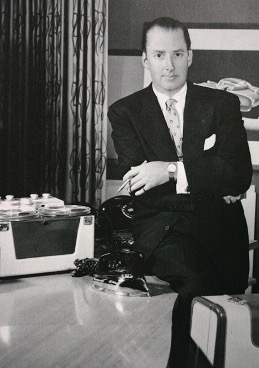
Brooks Stevens was an industrial designer, born on June 7, 1911. The Milwaukee Art Museum, where his archives are housed, explains that “[h]e was from the first a person who liked to design and build, and fortunately for the history of industrial design, he never stopped.” One of his many friends, automotive journalist Richard Langworth, described Stevens as “a tall, good looking man who belied his age, whose appearance and demeanor reflected accreditation to what Cole Porter would have called High Society. . . For Stevens there was only one way to fly to Paris – Concorde – and one way to get to England in the summertime – first class on the QE2. His personal tastes reflected similar standards, producing an effect of refined elegance.
“In his presence people were impressed but not overawed, because he was so completely natural and so full of courtesy and fun. It was never hard to gain Brooks Stevens’ acquaintance, whether one was a coverall-clad mechanic or the President of General Motors. Along with an inborn civility and an interest in others went an all-encompassing enthusiasm and love for everything connected with cars, an encyclopedic firsthand knowledge of the industry, and a streak of nihilism.”
Brooks Stevens was a pioneer of industrial design. This was a new field, one that gained momentum when General Motors established the Art and Color Section under Harley Earl. If making the product appear more attractive and modern helped sell cars, then why not apply the same approach to selling other products, such as appliances? The advantage Stevens had over his competitors, such as Raymond Lowey, was location. They were in New York. Stevens was in Milwaukee. So was his clientele. It helped that his father was the vice-president of engineering for Cutler-Hammer and steered a contract to redesign the appearance of the company’s electrical control boxes to his son. That entre helped, but it was Stevens’ talent that allowed him to turn the Depression into an opportunity. Companies needed every possible competitive advantage to survive – and modernizing their product’s design could provide that advantage.
This was the man who would give Jeep its future.
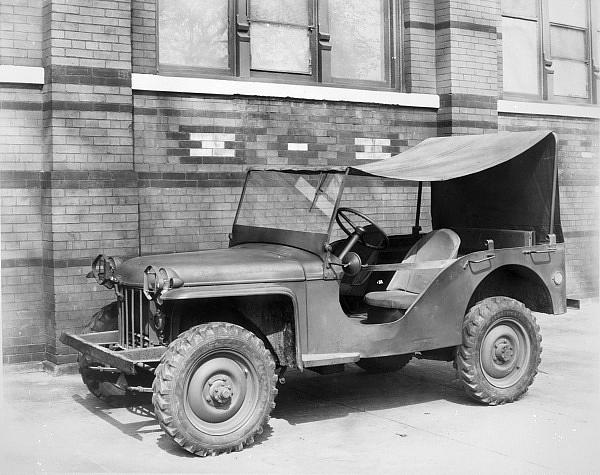
Before World War Two began, Willy-Overland Motors was running out of money. Its future, if it were to have one, depended on landing a government contract to produce a military light reconnaissance vehicle. The United States Army had studied the German military use of the Volkswagen Type 82 Kubelwagen. Less than a month after Paris fell to the Germans on June 14, 1940, the Army issued specifications and invited bids – but with a requirement that a prototype be delivered within seven weeks. Only the American Bantam Car Company and Willys-Overland submitted bids. Only Banatam produced a prototype by the deadline – so Bantam won the contract to supply 70 vehicles for further evaluation. Bantam, however, was exactly that: small. It did not have production facilities adequate for manufacturing the volume of vehicles the Army would require. When the production contract was awarded, it went to Willys-Overland, whose entry was selected over a Ford bid largely because the Willys engine had more power and torque than the tractor engine Ford proposed. By the end of the war, Willys had produced 362,000 jeeps. Demand was so great that Ford was later also awarded a contract, producing 281,000 jeeps.
Now, with the war over, Willys-Overland was facing the same problem it had faced before the War. The cars they manufactured didn’t sell. They needed something new, something people would buy.
In 1942, Stevens had delivered a speech to the Society of Automotive Engineers. In that speech, and in an article published in Popular Mechanics, he envisioned the post-war automobile market. Though Stevens’ predictions proved generally accurate (except for the one anticipating less use of chrome and “other useless ornamentation”), one comment stood out to Willys-Overland’s management. Stevens had suggested that after the War “a civilian version of the army jeep might be a most acceptable and desirable piece of transportation equipment.” He had also suggested it “could be executed with simple tooling and a minimum of fabrication expense, yet could have pleasing lines within these limitations.”
In January of 1943, the then-president of Willys-Overland, Joe Frazer, asked Stevens to create proposals for post-war Willys-Overland automobiles. As Stevens would later recount, he arrived for an 11:00 a.m. appointment to present the proposals to Barney Roos, vice-president of engineering – only to be kept waiting until the end of the day. Finally, he was ushered into Roos’s “fifty foot deep office on the fourth floor” to make his presentation. When he finished the presentation, Roos told him he had the job.
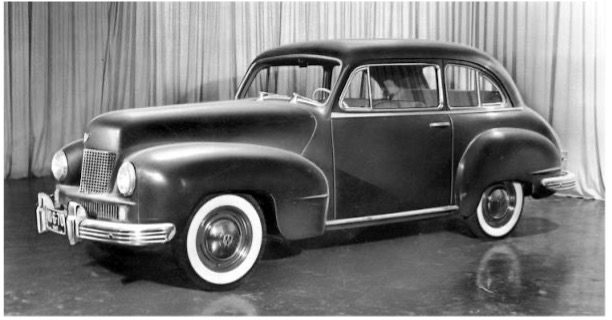
A prototype from the design is shown here. What Frazer wanted was a replacement for the pre-War line of Willys auto-mobiles, not a post-War jeep. Accordingly, Stevens submitted designs for a small passenger car based on the same engine used in the jeep, but carrying little else over from the military vehicle.
Frazer’s background was sales. He wasn’t an engineer. He envisioned what he thought he could sell. He did not give much thought to what Willys-Overland could produce.
When the War ended, reality foreclosed manufacturing the vehicle Frazer envisioned and Stevens had designed. Like other independent automobile manufacturers, Willys-Overland had always contracted body manufacture to outside companies. Frazer’s prediction of a seller’s market for automobile companies was correct. What Frazer missed was the corollary: it would also be a seller’s market for suppliers. With the war over, companies manufacturing automobile bodies could choose the highest volume and consequently most profitable contracts. They did not want Willys-Overland’s smaller volume.
What ensued was an executive suite power struggle at Willys-Overland as Frazer tried to wrest control from company chairman Ward Canady. Frazer lost. Canady quickly replaced him with Charles Sorenson, a production genius now retired from Ford. At Ford, Sorenson had developed the techniques that allowed casting the flathead V-8 engine block as one piece, which made it possible to economically mass-produce V-8 engines.
Sorenson found a solution to Willys-Overland’s problem. Sorenson bought a stamping plant complete with presses. Willys-Overland could now produce its own bodies. But those presses had been designed to manufacture washing machines. They had a maximum “draw” of six inches. (“Draw” is the extent to which sheet metal is formed into a shape from the original flat blank.) That equipment could not stamp the curved surfaces of Stevens’ original proposal.
Sorenson told Stevens they needed a new design, one consistent with their production limitations.
Stevens delivered it three days later. The new proposal was a station wagon. It wasn’t what Willys-Overland executives had expected. It was what they could produce, and it was a product they could sell. Designed with largely straight panels that could be produced on the company’s former washing machine presses, the boxy shape drew directly on the wartime Jeep’s appearance and, by that, upon its reputation for reliability and strength. Designed as a six-passenger station wagon, a type of vehicle previously identified with upscale country estates, it aimed at a completely new market – families that needed a vehicle that could serve as both family car and utilitarian load-carrying vehicle.
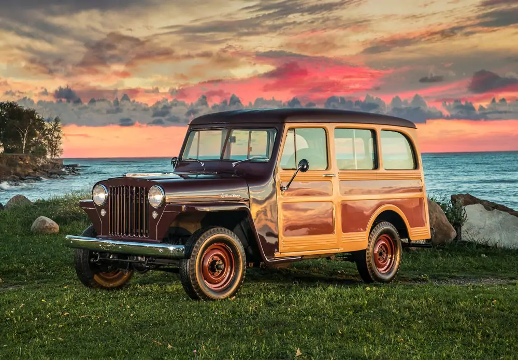
Introduced in July of 1946, the Jeep Station Wagon was the father of the sport utility vehicle. It would remain in production through the 1964 model year. Jeep also used the Station Wagon as the basis for its line of three-quarter and one-ton trucks – using Stevens’ design to give those vehicles the same instantly recognizable brand identity.
The Jeep Station Wagon began the long association between Brooks Stevens and Jeep that continued when Kaiser Motors bought Willys-Overland in 1953. Stevens had been one of the designers Kaiser retained to rework Howard “Dutch” Darrin’s designs for the 1949 through 1951 Kaiser and Fraser automobiles. After the acquisition, Kaiser elected to expand the Jeep product line. It retained Stevens to design a new line of pickup trucks, to be produced as an addition to the existing trucks based on the Station Wagon.
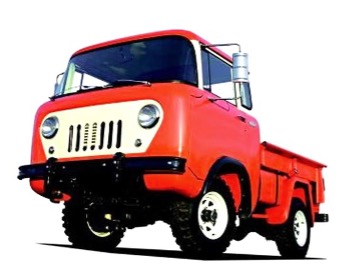
The result was the FC – forward control – truck that debuted for the 1957 model year. The FC’ s modern look was still unmistakably Jeep. The cab-over-engine design featured the signature outline of a military jeep grill as its “face.” With a six-foot bed, the truck’s overall length was two inches shorter than a Nash Metropolitan. No other vehicle approached its curb weight to payload weight capacity ratio of 1 to 1. The FC could climb a sixty percent grade. It also reflected Stevens’ genius in reworking an existing product to create a new product that his customer – the manufacturer – could afford to produce at a profit: the FC chassis was that of the CJ-5 and its engines were the existing Jeep four (that dated to the pre-War Willys-Overland and had been improved for the military jeep) and the Kaiser six from its now defunct automobile line.
The FC trucks, like the station wagon, created their own market. But Jeep’s success in creating a market for four-wheel drive trucks had attracted competition. Chevrolet and Dodge were now offering four-wheel drive as a factory truck option and Ford would inevitably follow. International Harvester was developing a direct competitor for the Jeep CJ – the Scout. Import brands – Land Rover and Toyota – were also competing with Jeep for four-wheel drive buyers.
Jeep needed a new product. It needed to leapfrog the competition with a new vehicle offering innovation available nowhere else.
They called Brooks Stevens. The Jeep Wagoneer, introduced in November of 1962 as a 1963 model was all that and more. It was the first four-wheel drive vehicle offering an automatic transmission, the first with independent front suspension, and the first vehicle of any kind since the 1930’s to feature an overhead cam engine. Power steering, power brakes and air conditioning were available. The Wagoneer was the vehicle designed for the person who wanted a vehicle that could do it all, in comfort.
Stevens’ design for the Wagoneer, which also served as the basis for the new Gladiator truck line, would span eighteen years of production encompassing three different corporate owners of the Jeep brand. In the process, it would define the modern sport utility vehicle.
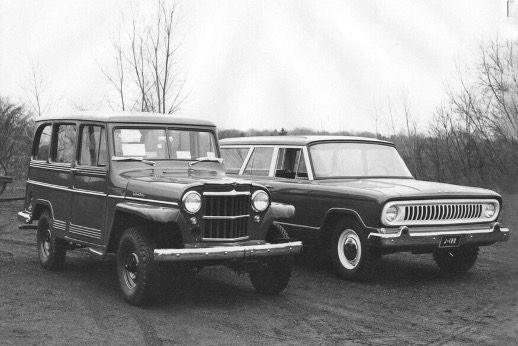
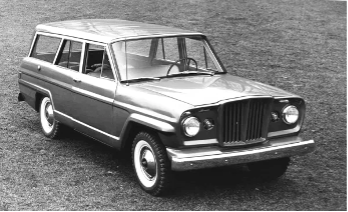
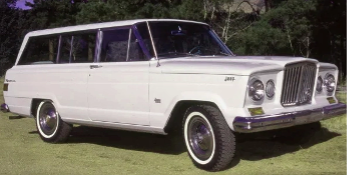
Though the Jeep Wagoneer is considered Stevens’ masterwork, he was a prolific designer of a variety of industrial products. In 1950, it was calculated that products of Stevens’ design accounted for $1 billion in annual sales – over $10 billion in today’s dollars. You’ve probably seen the Oscar Mayer Weinermobile. Stevens designed it. If you’re a train buff, you know that top industrial designers of the forties and fifties designed express passenger trains. Stevens designed the Milwaukee Road’s top tier express trains, the Hiawathas. These featured the most innovative observation cars on any railroad: the Sky Top Lounge cars with panoramic windows around and above the passengers. Stevens designed outboard motors and boats for Evinrude, the Lawn Boy lawn mower, the Harley-Davidson Hydra-Glide motorcycle, the Skylark pattern for Formica, children’s tricycles for AMF, cookware for Mirro, product packaging for 3M, and more mundane industrial equipment. The soft-cross logo for Miller High Life beer – Stevens designed that, too. You can learn more about his designs and see images of the products at the website of the Milwaukee Art Museum, which houses the Brooks Stevens Archives.
Brooks Stevens died on January 4, 1995.