
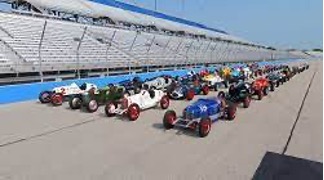
Every year in July they gather at the Milwaukee Mile. Miller race cars, in motion, doing what they were designed to do: go fast. But when you observe them in the pits, you’ll find yourself surprised by their mechanical beauty. These are race cars engineered without compromise, with even the unseen finished to perfection, and designed to win. These are the cars that dominated automobile racing in the United States in what automotive historian Griffith Borgeson called “the Golden age of the American Racing Car.”
These are the creations of Harold (Harry) Artemis Miller.
Born in Menominee, Wisconsin, on December 9, 1875, Harry Miller died on May 4, 1943. Though he had achieved success and fame in life, his death was little noticed – the passing of a man who had outlived his genius. Only with the retrospective clarity of history has that genius again come into focus.
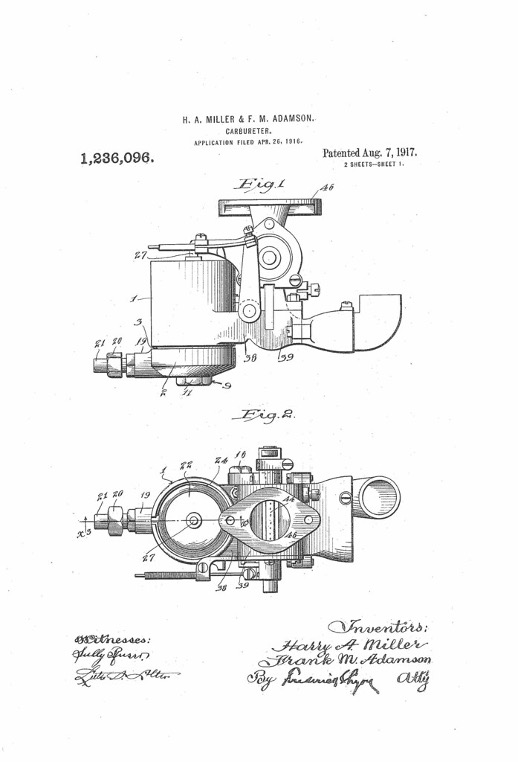
Miller quit school at age thirteen, leaving home at age seventeen. He arrived in Los Angeles, California, in 1895. He learned the skills of a machinist, working in machine shops, bicycle shops, and a foundry. His education was not from the classroom, but from his work experience coupled with an innate ability to understand what he observed. In 1907, Miller formed a company to manufacture a carburetor of his own design: the “Miller Master Automatic Carburetor.” It used multiple jets progressively opened by a barrel shaped throttle valve to provide more precise air/fuel ratios than conventional carburetors, especially at higher engine speeds. Manufactured for many street vehicles, including the Ford Model T – production was 5,000 carburetors per month – the Miller Master Carburetor also quickly became the carburetor of choice for automobile racing.
Then came the commission that would transform Miller from a manufacturer of parts and provider of services into the builder of racing engines and race cars that would ultimately dominate racing in the United States.
Known as the “King of Speed,” Bob Burman had achieved fame racing a Peugeot. He’d also blown up his engine at the end of the season. Now, as a new racing season approached in the fall of 1914, Peugeot explained to him that they could not provide a new one. They were no longer producing race engines. World War I had begun. Peugeot was producing for the military only. Burman turned to Miller to produce a new engine – in four months. Miller delivered on time. Miller’s engine was an improved version of the Peugeot design. With it, Burman’s car was faster than before. Burman won two races and orders followed from others for engines designed and manufactured by Miller. The first entire Miller race car was designed in 1916 around a 289 cubic inch four cylinder engine featuring a one-piece crankcase and cylinder block cast of aluminum with a 3.625 inch bore and 7.0 inch stroke, four valves per cylinder operated by a single overhead camshaft driven by spur gears, tubular connecting rods, detachable heads, and a barrel crankcase supporting a two-piece crankshaft through 360 degrees.
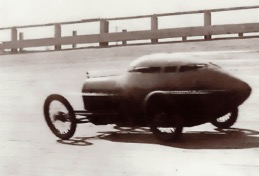
While that car was under construction, Barney Oldfield dropped by. Miller had previously rebuilt Oldfield’s Delage, but it was no longer competitive. He decided to order a complete car from Miller. The result, completed in 1917 at a cost to Oldfield of $15,000 – inflation adjusted, that is over $300,000 today – became famous as the “Golden Submarine.” It was revolutionary because it was a completely enclosed car with a teardrop body of aluminum over a light steel framework – a construction method the Italians would later call “superleggera” and claim they invented – finished in gold lacquer. Its engine had a dry sump crankcase, cast iron block with integral heads, and desmodromic valves – a system Oldfield favored because the camshaft both opens and closes the valves mechanically. (The cam has two lobes for each cylinder, one to open and the other to close the valve. Because the system uses no springs, this avoids valve bounce at high rpm.) It produced 125 horsepower at 2,950 rpm – though the engine was designed to produce peak horsepower at 4,000 rpm.
Fame followed Oldfield and the Golden Submarine wherever it went. Pitted in match races against Ralph DePalma and his Packard, Oldfield won all three held in Milwaukee and four of six held at other tracks. Oldfield then used the Golden Submarine to break every international dirt track record for distances of one to fifty miles.
In 1919, Miller produced the first Miller 183 engine, the number indicating cubic inch capacity. It was ordered by Tommy Milton to his own general specifications. At the time, Milton dominated American racing, winning five of nine championship races that year. He would be the first driver to win two Indianapolis 500 races. (In 1936, retired from racing and now driving the pace car at the 500, Milton would suggest giving the pace car to the race winner and thereby inaugurate a Speedway tradition.)
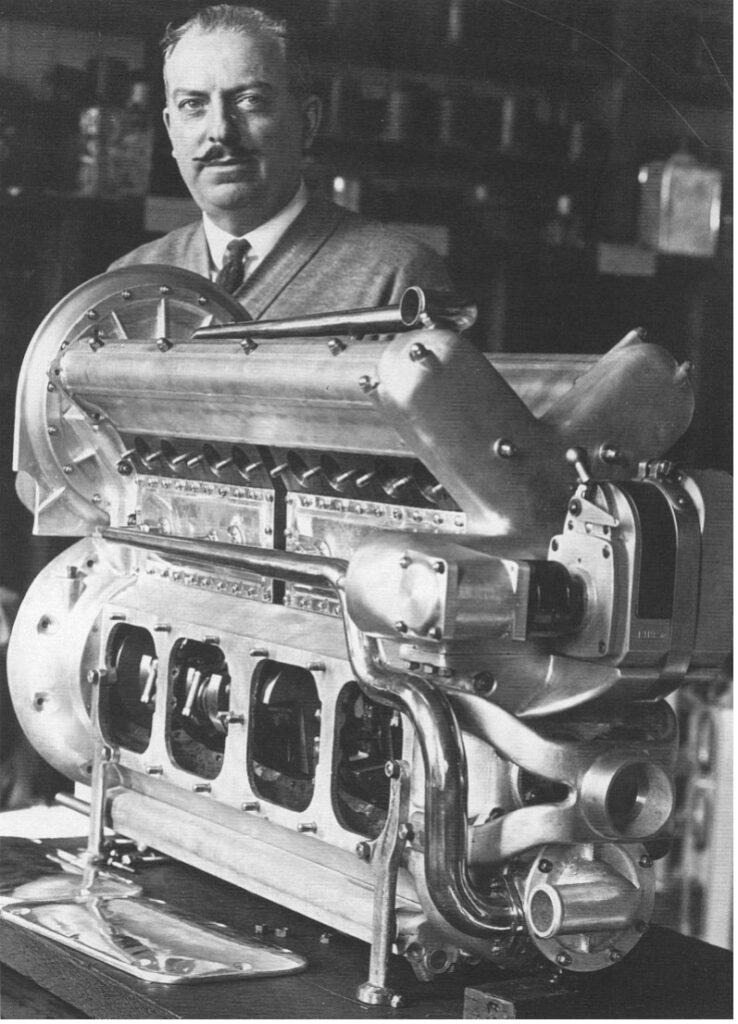
The 183 was a straight-eight cast in two blocks of four cylinders, with four valves per cylinder, bore of 2.6875 inches and stroke of 4.0 inches, designed to run on a mixture of gasoline and benzole with 7.8 or 8 to 1 compression ratios. It had integral (non-detachable) cylinder heads and dual overhead camshafts, again driven by spur gears and counterweighted to eliminate vibration. The carburetion was remarkable. Miller designed a new twin-throat carburetor that effectively was one carburetor per cylinder – an arrangement that reportedly inspired creation of the famous Weber carburetor. Miller had also discovered ram tuning. With a separate pipe from the carburetor to each intake port, he recognized that the length of the intake pipe affected engine performance. He experimented with different lengths to achieve the optimum length and shape of the intake runners.
After initial cooling issues were resolved and changes made to the camshaft design, Milton took the 183 to its first victory at the 250 mile race at Tacoma, Washington, in 1921. Following the race, Jimmy Murphy and Harry Hartz, ordered Miller 183 engines for their Duesenburg French Grand Prix cars.
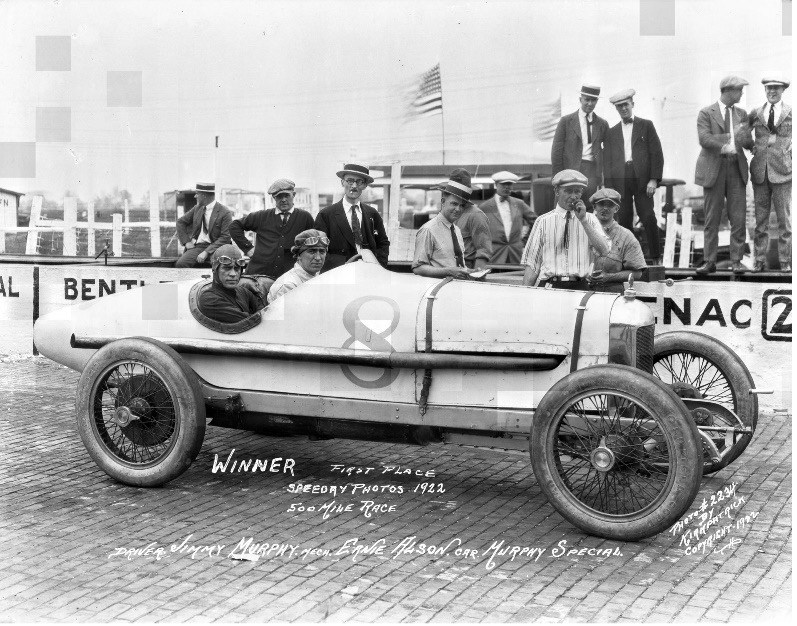
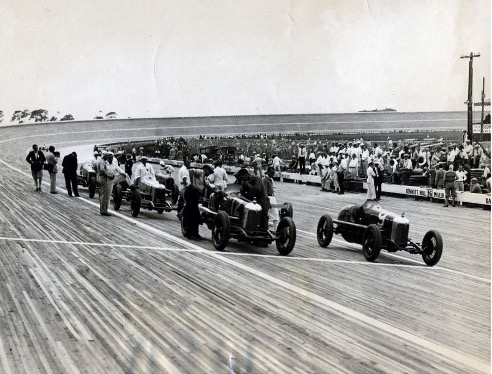
Replacing the original Duesenburg engine with the Miller 183, Murphy dominated the 1922 Indianapolis 500. He qualified on the pole, led 155 of the 200 laps, and won the race with an average speed of 94.48 mph that shattered the previous record of 89.84 mph. He finished over two laps ahead of Hartz in second place in his Miller powered Duesenburg. Murphy and his Miller-engine “Murphy Special” went on to win the AAA national championship. By the time he won the final race of the season at the board track in Beverly Hills, California, he was driving a car built by Miller.
This was the beginning of a decade in which Miller would dominate racing in the United States, the “golden era” to which Borgeson referred.
In 1922, Millers or Miller-engine cars won eight of nine major American races. In 1923, Miller cars won all nine major American races. In 1924, it was seven of nine. 1925, four of ten. In 1926, seventeen of twenty-two. 1927 saw Millers win seven of the nine major American races held that year. In 1928, Millers won five of six. And in 1929, Millers won all twelve major American races.
A new engine displacement formula was imposed for 1923 by the AAA, then the sanctioning organization for major races in the United States, to be effective after the Indianapolis 500 at the end of May. The Miller 183 continued to win races to that point, after which Miller introduced a 122 cubic inch engine that met the new rules and continued Miller’s winning streak. Design of the Miller 122 was similar to that of the 183. It was again a straight eight, but it differed by employing hemispherical combustion chambers. It also introduced a unique design feature – driving the magneto from a power takeoff at a right angle to the main gear tower, a Y shaped series of gears transmitting rotation from the crankshaft to the camshafts. (Battery ignition had been rejected by Miller for both the 183 and 122 because it added weight and batteries could not stand up to the vibration created by racing speeds on rough tracks, including the brick surface at the Indianapolis Motor Speedway.)
Throughout this period, Duesenburg had been a rival to Miller, but the Miller 183 and 122 engines had put it at a disadvantage. Fred Duesenburg responded with supercharged engines for the 1924 Indianapolis 500 – one of the two races won by a Duesenburg that year. Now it was Miller’s turn to play catch-up. Miller did produce supercharged versions of the 122, but only a few, as a new 91 cubic inch displacement limit was to be imposed for the 1926 season in a futile effort to limit racing speeds.
In response, Miller produced the classic race car of the pre-War era, the Miller 91, the number again representing cubic inch displacement.
Work on the new engine began following the 1925 Indianapolis 500, which had again been won by a Duesenburg. The Miller 91 engine was designed from the outset as supercharged, with the supercharger powered by spur gears driven from the crankshaft. Tolerances in the engine were extreme and precise – for example, clearance between the crankshaft counterweights and the crankcase wall was 0.03 inch. The Miller 91 could exceed 8,000 rpm without issue.
By this time, race cars no longer had riding mechanics – the AAA had made them optional in 1923 – and Miller had taken full advantage of the rule change to make the Miller 122 race cars as narrow and aerodynamically efficient as possible. With the 91, he went even further.
In 1924, Jimmy Murphy had become convinced that a front wheel drive race car would be unbeatable. That may seem an odd theory today, where the understeer of front drive cars is thought incompatible with sporting handling. But racing in the 1920’s was on rough racetracks that often became oily as the race progressed. Tires were narrow, with tiny patches of tread in contact with the track surface. Front drive offered better traction – and it also offered a lower vehicle, with a lower center of gravity and less frontal area creating aerodynamic drag. Murphy took his concept to Miller, where Miller and one of his key employees, Leo Gossen, worked to turn the concept into a race car.
Though the standard Miller 91 was a rear drive car, as had been its predecessors, the front drive version of the Miller 91 was even more advanced. The transmission was of Miller’s own design, transversely mounted and short enough to fit within the seventeen inch distance between the frame rails. This transmission was fragile, but intended for speedway racing where the only gear shifts were those required to get up to racing speed. The front suspension was a De Dion design, where the axle half shafts act in concert with a bar that bears the weight of the vehicle, so that the wheel camber is unchanged through suspension travel, the first use of this design in racing. Front brakes were inboard.
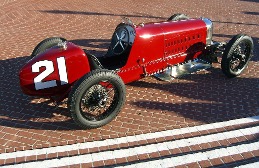
The Miller “Packard Cable Special,” pictured here is one of only two front drive Miller 91’s to survive in unmodified condition. Its usual driver was Leon Duray, though Ralph Hepburn drove it in the 1929 Indianapolis 500. Duray used the car to set a closed course speed record of 148.170 mph. Afterward, he took the Packard Cable Special and another Miller 91 to Europe, racing the Packard Cable car at Monza in Italy. Though it did not finish the race, it did get noticed – by Ettore Bugatti, who bought both Millers from Duray. (That is why the Bugatti Type 50 engine looks as though Miller designed it.) Leon Duray also used a front drive Miller 91 to set a lap record during Indianapolis 500 qualifying in 1928: 124.018 mph – a lap record that remained unbroken for nine years. A Miller driven by Louis Meyer won that race as Millers accounted for 22 of the top 25 finishing positions.
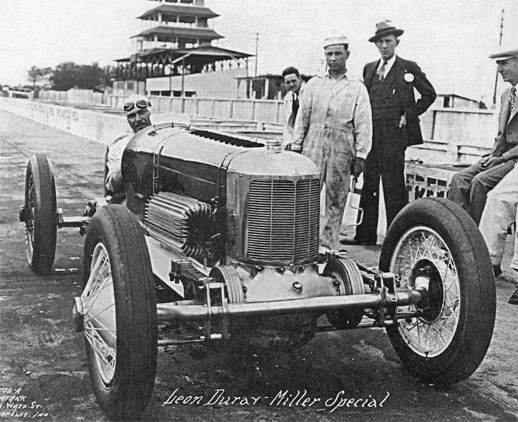
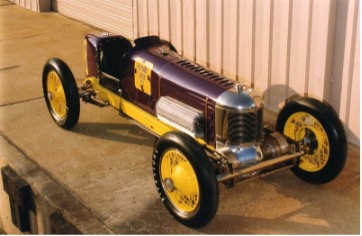
(The Millers sold to Bugatti were discovered intact at Bugatti’s facility in Molsheim, France, in 1953 by Griffith Borgeson, automotive journalist and historian. Borgeson purchased both, retaining the Packard Cable Miller while donating the other to the Indianapolis Speedway Museum. He eventually sold the Packard Cable Miller to William Harrah. It was purchased from Harrah’s estate by William Lyons, then sold to Robert Rubin, who restored it and donated it to the Smithsonian Institution. And that is the how Ettore Bugatti preserved the only two front drive Miller 91s that remain in their original condition.)
Miller would again win the 500 In 1929, but the “golden era” was ending, with new rules announced for the next racing season by the AAA Contest Board that banned supercharging, again required riding mechanics, and were designed to favor engines based on those of production passenger cars.
Maybe Miller saw the proverbial writing on the wall, because in 1929 he sold his business for $150,000. Add to that the $60,000 retainer received from E. L. Cord to work on developing front wheel drive for passenger cars and Miller could have lived out his days in comfort and luxury. He’d sold out just before the stock market crashed in October.
But he couldn’t stay away.
He joined with executives of several major aircraft manufacturers and formed the Miller-Schofield Company to manufacture aircraft engines and performance parts for the Ford Model A. The venture failed, with corporate bankruptcy in 1930. On his own, Miller then turned back to what he knew best – building race engines and race cars.
He designed a four wheel drive race car powered by a twin-cam V-8, of which four were produced. It cost $30,000 depression dollars to build them, and they were failures. There was neither the time nor the money to sort the flaws and perfect the designs.
Miller was forced into bankruptcy in 1933.
He would go on to other projects, including a Miller-Ford race car for the Indianapolis 500 in 1935 that was advanced in design, but rushed in execution. Lacking the patience needed for Miller to perfect the design, Henry Ford cut off funding. In 1937, Miller began a project for a new Indianapolis race car that eventually attracted corporate support from Gulf Oil. Miller designed a new car with a mid-engine supercharged six cylinder of 180 cubic inches – the first “oversquare” engine (bore wider than stroke length). It had four wheel drive, disc brakes, and independent suspension. It did not qualify for the 1938 Indianapolis 500 and the three new versions built for the 1939 race failed to finish the race. Gulf dropped its support for the program.
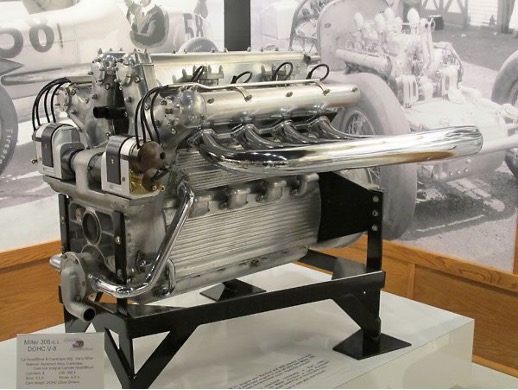
Even so, a Miller’design would dominate racing in the United States in the three decades after World War II, though under a different name.
Some of the assets of Miller’s company had been purchased at the bankruptcy auction by Fred Offenhauser, another key employee. Miller had previously designed a four cylinder marine engine of 151 cubic inch capacity, based on the same design as the 183 and 122 cubic inch engines. In the early 1930’s, Miller had been asked to turn that marine design into an economical racing engine. The result was a 220 cubic inch four cylinder. Miller’s interest in a four was minimal – his interests lay with developing new concepts, not producing old ones. He made little effort to market it and the tooling and rights to the 220 four became an asset of the bankrupt business, assets that Offenhauser – who had been primarily responsible for refining the marine design into a race engine – purchased.
These became the Offenhauser engines that would win the Indianapolis 500 twenty-five times, the last Indianapolis win coming in 1976.
You can see a Miller in a museum, but that won’t do justice to these cars. To see them at speed, hear them as they pass the pits, is to get a fuller sense of what these cars were and to appreciate the achievements of Harry Miller. That opportunity occurs every July – “Millers at Milwaukee “- at the same Milwaukee Mile race track in West Allis, Wisconsin, on which these cars raced when Harry Miller built them. For dates and more information, check the Harry Miller Club website.