
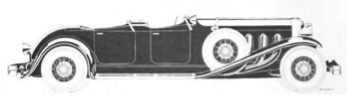
The customer was 19 years old. He wrote to Harold Ames, the sales manager at Duesenberg. He proposed trading in his Model A Ford on a new Duesenberg and included his ideas for how the new car should be designed. Nothing in the letter suggested its author possessed the financial means to purchase a Duesenberg, but the ideas expressed intrigued Ames. He walked the letter over to Gordon Buehrig, the Chief Designer at Duesenburg and suggested Buehrig work up a sketch or two and send along with a polite response. Buehrig did – primarily thinkng the sketches might be the basis for something they could display at an auto show.
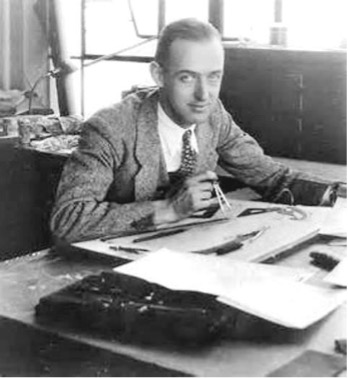
That Gordon Buehrig was working at Duesenberg was, by his own admission, a consequence of his uncanny ability to quit a secure job for one that wasn’t. He traded job security for the freedom to create designs of automobiles as he envisioned them. Even though he was only twenty-five years old when he became Chief Designer at Duesenberg, Buehrig had been preparing for the position for years. He had been expelled from his college chemistry class because his professor discovered Buehrig’s notebook was filled with sketches of automobiles, not chemical formulae. Buehrig had landed a job as an apprentice at the Gotfredson Body Corporation, which was then producing automobile bodies for Wills St. Claire, Peerless, and Jewett. That job would provide experience that would be invaluable when he later became a designer.
The process of manufacturing automobile bodies in the 1920’s was an exercise in mass production, but not in the sense that phrase is commonly understood today. Most automobile manufacturers outsourced body production to specialist companies, such as Gotfredson. The same techniques that had been used to make carriages were now used to build automobile bodies. Bodies were constructed with a wood framework that was then covered with panels of steel or aluminum. The design would originate with a sketch and, once approved, the body engineering department would prepare detailed drawings. These drawings – the “body draft” – showed every piece that would be used in construction of the body, the location of each screw, the shape of each part, and the fit of each joint. From the body draft, the “sample body shop” would mill each wood component. It then constructed a “sample body” – exactly as it would be manufactured in production, except that joints were not glued. This allowed verifying that all components fit properly. That sample body was then disassembled, and each component given a part number. Each wood piece was shellacked and then stored. This became the “master body.”
When an order for that body was received – typically for several hundred – a milling machine would produce individual components in quantity matching each component of the master body. Once all body parts had been milled, the master body would be returned to storage and the production parts assembled into the body framework using an assembly jig. They would produce as many as the number of bodies ordered. The wood framework would be covered by the metal panels nailed to the framework. Mouldings covered joints between the panels and covered the nails that secured the panels. These mouldings were typically 1/8 inch aluminum and also secured to the wood framework by nails. So that the moulding nails were not visible, holes were drilled in the moulding with a special bit that created a burr around the hole. The nail was driven deeply through the holes and the burr hammered over the nail, then filed down to a smooth finish concealing the nail.
As Buehrig’s occupational experiences were training him to eventually be an automobile designer, the need for automobile designers was transforming the way automobile manufacturers designed cars. To be competitive, automobile and body manufacturers needed to produce vehicles that were attractive to purchasers. Design could no longer be entrusted to body engineers. Automobile design required an aesthetic sense and knowledge of those specialized techniques that had been developed to allow visualizing how an automobile will look, from every angle, long before the commitment to manufacture it is made. Gordon Buehrig had anticipated this. He asked Clarence E. Wexelberg, designer, engineer, and body draftsman at C. P. Kimbell & Co. in Chicago, a local body manufacturer for advice about pursuing a career in body design. Wexelberg told him to return to school. After that, he suggested Buerig apply for a position with Fisher Body Co. or C. R. Wilson Body Co., the two largest body manufacturers in Detroit.
Buerig took the advice. He enrolled at Bradley Polytechnic Institute in Peoria, Illinois, taking courses in art, drafting, metalwork, and woodworking. At the conclusion of the semester, he asked for interviews at both Fisher and C. R. Wilson. Wilson’s chief engineer, Walter Jones, was moving to Gotfredson Body Company and offered Buerig an apprenticeship in their sample body shop. Within six months of starting, he was transferred to the body engineering department. He then found a position as a draftsman in the body engineering department at Dietrich, Inc., in January of 1926. When Buehrig joined, Dietrich was manufacturing bodies for the most premium of automotive brands: Lincoln, Packard, Franklin, and Pierce-Arrow.
Today we think of these marques as one-of-a-kind cars, custom built to the individual order of the original purchasers.
With rare exceptions, that’s not the way it was.
Most classic era automobiles were series production bodies.
A series production body was manufactured in essentially the same way as the process described above derived from carriage building. The automobile manufacturer would anticipate sales and place an order for a specified number of bodies with a body builder, such as Dietrich, Locke, Murphy, Rollston, or Derham. The automobile manufacturer would provide the specifications and design for the body. The builder would do the engineering work and create the needed drawings. It would then manufacture the production run of bodies and store them. When a buyer ordered a new automobile of that brand with that body, the body builder would then finish the body to the finish and features chosen by the buyer and ship the completed body to the automobile manufacturer for installation on the chassis. The buyer would have his new automobile in as little as a month from placing the order. An automobile manufacturer in the luxury field might order ten or twenty bodies of the specified design or, if a higher volume manufacturer, such as Packard, as many as two hundred. These series production bodies were, nonetheless, expensive. The typical body for a Ford might cost $45.00. A basic series custom body for a Packard or similar car of the luxury class would run at least $1,200.00. With smaller production runs, each body would cost even more.
Within three years of starting at Dietrich, Buehrig would become Chief Designer at Duesenberg.
In between these jobs, Buehrig would hold a drafting position at Packard, be one of the first hired at Harley Earl’s Art and Colour Section at General Motors – where he would be exposed to GM’s new way of designing by creating a full-sized clay model – and then would become the body designer for Stutz, where he designed the Weymann bodied speedsters the company entered at LeMans in 1929. (Weymann bodies were wood bodies covered in treated fabric, made with joints that kept each wood component 1/16” inch apart from the next, thereby avoiding squeaks from the body.)
Gordon Buehrig began his job as Chief Designer for Duesenberg on June 10, 1929. Off and on, he would remain with Duesenberg, Auburn, and Cord for the next eight years. The automobiles he designed there are today among the most prized of the classic era.
Duesenberg faced direct competition from Bentley, Hispano-Suiza, Isotta-Fraschini, Mercedes-Benz, Minerva, and Rolls-Royce. A step down were other competitors, including Cadillac, Lincoln, Marmon, Packard, Pierce-Arrow, and Stutz, all of which were priced well below Duesenbergs. Yet, the same body manufacturer that produced a body for Duesenberg might also manufacture a body for these less expensive luxury brands. The difference in the vehicles lay in the Duesenberg’s power and performance. At 265 horsepower, the Model J had double – or more – horsepower than any other luxury brand. (For example, the 1929 Packard Model 626 Speedster produced 130 horsepower from the Packard straight eight engine, the most of any Packard offered that year. Most 1929 Packards were rated at 105 horsepower. Even that figure exceeded the power supplied a Cadillac or Lincoln, both of which produced 90 horsepower from a V-8 engine.)
That difference in power and performance mattered to the buyer in the market for a performance oriented automobile, one the owner would drive and enjoy – an open car or a coupe. But if the buyer were in the market for a chauffeur-driven automobile, he or she was more likely focused on comfort, convenience, and style than on performance. A Lincoln with a limousine body cost about $5,000 for the completed automobile. Equipped with essentially the same body from the same body company, the Duesenberg would cost $12,000. When Duesenbergs were introduced at the 1929 New York Auto Show, the sedans and limousines it displayed were almost ignored. The crowds were around the Murphy bodied convertible coupe and the LeBaron bodied phaeton. Yet, Duesenberg needed the sales of closed cars and limousines just as much as it needed sales of dramatic and sporty models.
The solution was to hire Gordon Buehrig to design bodies for Duesenberg – bodies that were unique and unavailable on any other brand.
Buehrig designs ultimately would account for approximately half of Duesenberg’s total production.
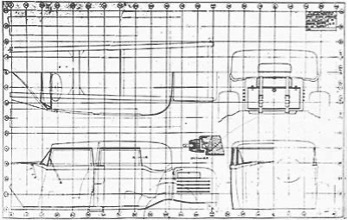
Buehrig creating the body drafts himself, instead of leaving that task to the body manufacturer, was the key to making his designs unique. Other automobile manufacturers let the body builder work from 1/16th scale sketches and create the body drafts from the sketches. IThat allowed the body builder to construct the design with its own proprietary design elements, leading to these same design elements, such as the pitch of the roof and body “sweeps” (which refers to the radius and lengths of curves in the body), appearing on all the bodies it built regardless of the automobile brand. By specifying these elements in his body drafts, Buehrig insured that the body manufactured would reflect Duesenberg’s own design, and none other.
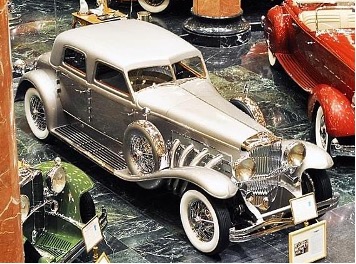
Perhaps the most famous of Buehrig’s Duesenberg designs is the “Twenty Grand,” officially the Arlington Torpedo Sedan, constructed for the 1933 “Century of Progress” world’s fair held in Chicago. The nickname referred to its price: $20,000. (In 1932, a Ford Model B was priced at $495 to $650, depending on body style.) It was displayed with three other automobiles built specifically for exhibition at the fair under the “Dome of Tomorrow”: the “Golden Packard,” a reference to its gold plated interior trim, Cadillac’s V-16 Aerodynamic coupe, and the Pierce-Arrow Silver Arrow. The Twenty Grand was based upon Buehrig’s 1930 design of the Beverly Berline, a series production body.
After the fair concluded in 1934, the “Twenty Grand” languished in Duesenberg’s inventory until purchased by a previous customer, Shreve Archer, of the Archer, Daniels, and Midland Co., an agribusiness company then as it is now. Archer had the car repainted black and insisted on some minor body modifications. It was ultimately acquired by J. B. Nethercutt and restored to its original appearance, winning Best of Show upon its debut at the Pebble Beach Concours d’Elegance. It remains on display in perfect condition at the Nethercutt Collection in Sylmar, California.
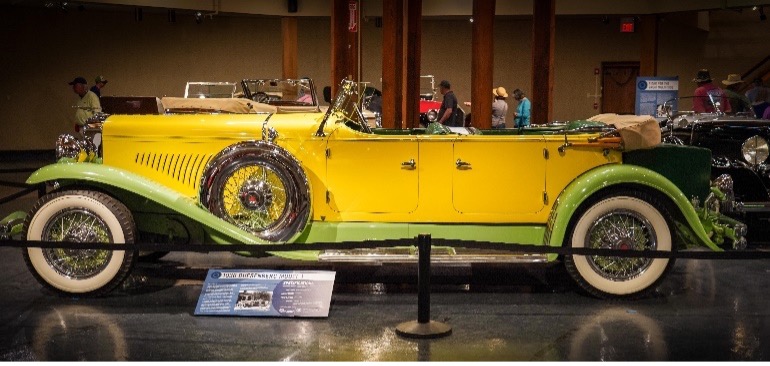
Another of Buehrig’s design triumphs was accidental. In preparation for a Chicago auto show at the Drake Hotel, he specified the color and trim on the Tourster body to be installed on the Duesenberg on display. The colors were to be light green for the fenders and belt moulding and pale yellow – Goldenrod Yellow – for the body itself. When the body arrived from the body builder, the yellow was not pale. It was bright yellow – very bright. DuPont had changed the color without changing its name. When Buehrig chose the color, he’d relied on an outdated paint chip. There was no time to repaint, so they decided to feature it as a “showstopper.” From Chicago, the car was sent to the Salon in Los Angeles. As Buehrig described it, “Gary Cooper walked in, saw it and bought it.”
Buehrig would leave Duesenberg in January of 1933, concerned with his job security as Duesenberg’s sales had almost vanished. He returned to General Motors.
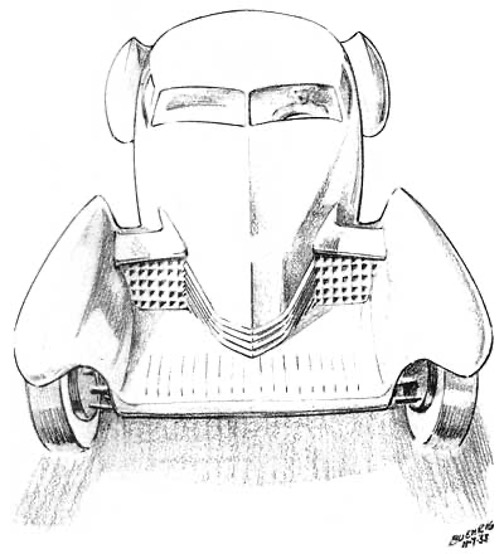
It was at GM that Harley Earl, the vice-president in charge of design, devised a competition among his studios. Though his fellow designers considered Buehrig’s design of an aerodynamic car with radiators mounted between hood and fender to be the best submitted, the judges placed it last. (There is some irony in the contest grand prize: an all-expense paid trip to the Century of Progress, where Buehrig’s “Twenty Grand” would be displayed under the same roof as the Cadillac Aerodynamic coupe designed by Earl’s studios.)
Buehrig may have lost the competition, but his design would win the test of time.
Only eight months after leaving, Buehrig returned to Duesenberg – lured back by Ames to create a new smaller, less-expensive Duesenberg. Ames had seen Buehrig’s GM contest design and liked the distinction it achieved by eliminating the external radiator shell. As it turned out, the project was sidetracked for a time while Buehrig redesigned the Auburn line. But the project received high priority.
The result – directly tracing its design to Buehrig’s contest design – was the 1935 Cord 810.
And that 19 year old customer who wanted to trade his Model A on a new Duesenberg and knew what he wanted in its desig n? The one to whom Ames had Buehrig reply and enclose sketches of what he thought the customer was requesting, as envisioned by Buehrig?
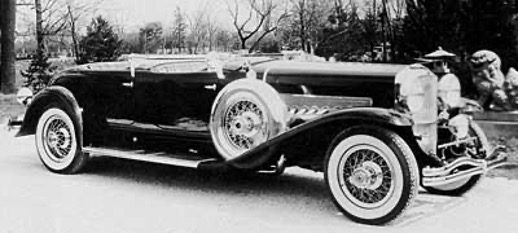
That 19 year old customer’s name was Marcus “Mark” Jay Lawrence. When he received the sketches, he called Ames and asked how much it would cost. Perhaps Ames had investigated this customer more closely by now – Lawrence’s late father had been a wealthy publisher and manufacturer of veterinary supplies – so he had priced the body with body builders. Ames wrote Lawrence and quoted $19,000. (A one-off body was far more expensive than a catalog custom because all of the work in creating the master had to be absorbed by the price of that single body.)
Lawrence telegraphed back: “Proceed immediately.”
The result was the Torpedo Phaeton.
Both the Phaeton and its owner met violent ends. Lawrence had established a second home on a ranch in Arizona and developed a reputation as a gambler and playboy. He crashed the Duesenberg through a guardrail in 1937, totaling all but the engine. He wasn’t so lucky in 1938. One Ernesto Lira, a prominent sportsman, believed Lawrence had been sleeping with Lira’s wife. Lira beat Lawrence to death with the camera he had intended to use photographing the couple in a compromising situation. Lira received a 40 year prison sentence for murder.
Lawrence left an estate valued at $700,000, the bulk distributed to his relatives, including his mother. She established the Marcus J. Lawrence Memorial Clinic in Cottonwood, Arizona, in his memory and later donated to establish the Marcus J. Lawrence Memorial Hospital, now the Verde Valley Medical Center.
Gordon Buerig ultimately joined the Ford Motor Company, where he was involved in the engineering – not the design – of the 1956 and 1957 Continental Mark II. (Though one of the most talented automotive designers of the twentieth century, office politics at Ford kept him from designing automobiles and kept him, instead, working in engineering.) Buehrig ended his career at Ford specializing in plastics development at a time when this was innovative technology in the automotive industry. Upon his retirement from Ford, he was invited to teach at the Art Center College of Design in Pasadena, California, thereby influencing automotive design for generations to come.